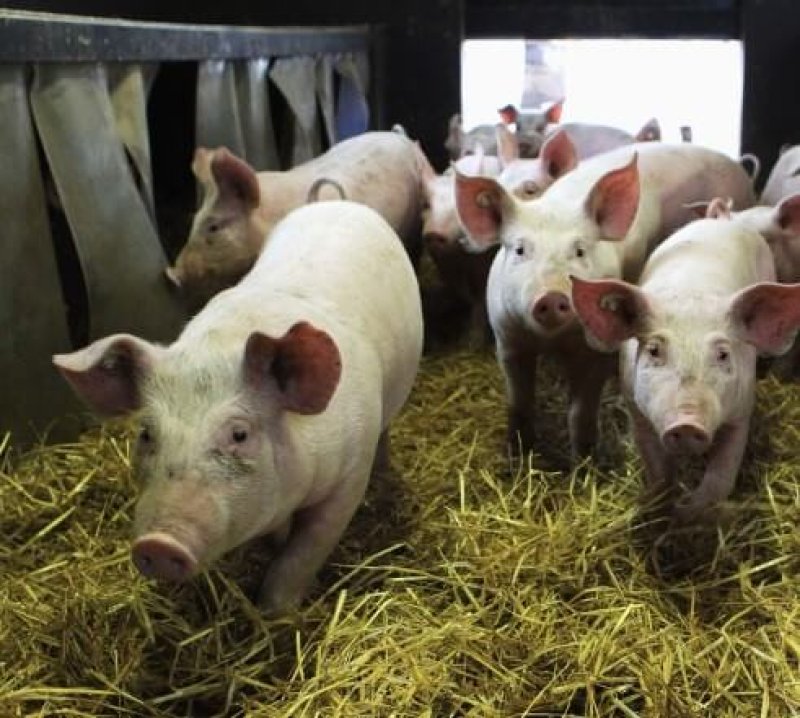
World’s largest pork producer to market hogs for pig-human organ transplants

pigs human organs feature

Smithfield Foods, the world’s largest pork producer, has established a separate bioscience unit to expand its role in supplying pig parts for medical uses, with the ultimate goal of selling pig organs for transplantation into humans.

Routine pig-human organ transplants are years away, but recent scientific advances are breaking down barriers that frustrated prior attempts to use pigs as a ready supply of replacement parts for sick or injured people, making it an attractive new market.

“We want to signal to the medical device and science communities that this is an area we’re focused on – that we’re not strictly packers,” said [Courtney Stanton, vice president of Smithfield’s new bioscience unit].

Transplants are used for people diagnosed with organ failure and who have no other treatment options…[Smithfield] owns more than 51 percent of its farms and hopes to sell directly to researchers and health-care companies, which now typically buy from third parties.

George Church, a Harvard Medical School genetics professor and researcher, welcomes the involvement of a big pork producer. “Even though we’ve got companies like eGenesis that would make the first pigs, you still need someone who will breed them and do it to scale,” he said.

The GLP aggregated and excerpted this blog/article to reflect the diversity of news, opinion, and analysis. Read full, original post: Smithfield makes move on market for pig-human transplants

For more background on the Genetic Literacy Project, read GLP on Wikipedia

{{ reviewsTotal }}{{ options.labels.singularReviewCountLabel }}
{{ reviewsTotal }}{{ options.labels.pluralReviewCountLabel }}
{{ options.labels.newReviewButton }}
{{ userData.canReview.message }}

Related Articles

Infographic: Global regulatory and health research agencies on whether glyphosate causes cancer

Infographic: Global regulatory and health research agencies on whether glyphosate causes cancer

Does glyphosate—the world's most heavily-used herbicide—pose serious harm to humans? Is it carcinogenic? Those issues are of both legal and ...

Most Popular

Screenshot-2026-04-22-at-12.21.32-PM
Viewpoint: Why the retracted Monsanto glyphosate study doesn’t change the science—the world’s most popular herbicide is safe 
Picture1
The FDA couldn’t find a vaccine safety crisis, so it buried its own research
ChatGPT-Image-May-1-2026-11_42_59-AM-2
Viewpoint: NAD is the wellness grifters latest evidence-lite longevity fad. At least the mice are impressed.
ChatGPT-Image-Apr-16-2026-02_56_53-PM
Financial incentives, over diagnosis, and weak oversight: Autism claims are driving up Medicare costs
global warming
‘Implausible’: Top climate scientists reject worst-case scenario—soaring temperatures and fast-rising sea levels
ChatGPT-Image-May-12-2026-11_27_01-AM-2
AI likely to improve health care, research shows—but not for blacks and ethnic minorities
ChatGPT-Image-May-7-2026-01_23_27-PM-2
Viewpoint: Will AI democratize personalized cancer treatment or fuel medical misinformation?

Sorry. No data so far.

glp menu logo outlined

Get news on human & agricultural genetics and biotechnology delivered to your inbox.