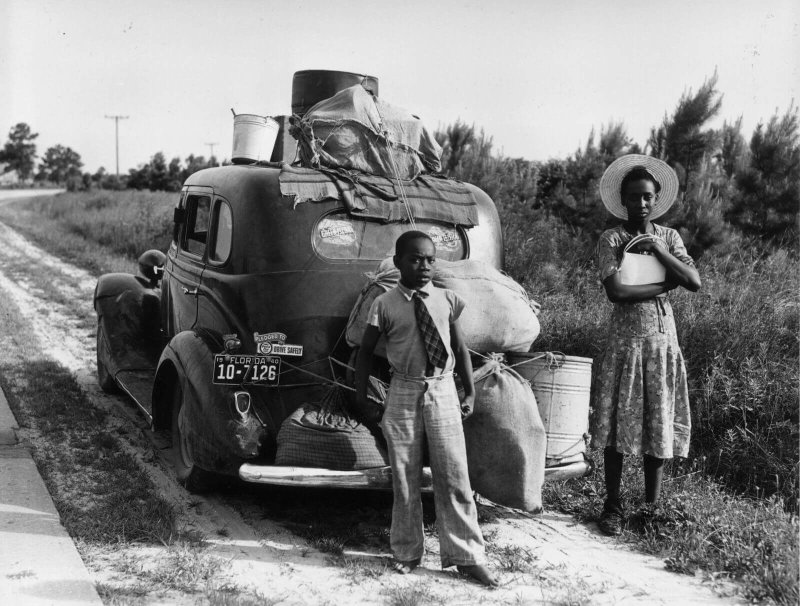
The Great migrations in the US in the first half of the 20th century show up in our genes

sep c migration
Credit: MPI/Getty Images
[Software engineer Chengzhen Dai] and his advisor, designer and engineer Carlo Ratti, teamed up with population geneticist Alicia Martin of the Broad Institute and other colleagues to test their hypothesis [that geography has played a major role in how ancestry and admixture occurs] using data from National Geographic’s Genographic Project, a now-discontinued effort to sequence genomes from around the world to track migration patterns.

Focusing on the genomes of 32,589 participants who’d provided a postal code, the team compared single-nucleotide polymorphisms (SNPs) in those genomes with the SNPs present in reference genomes curated by the 1000 Genomes Project, a UK-based initiative that compiled genomic data on 2,504 people representing 26 populations worldwide.

Follow the latest news and policy debates on sustainable agriculture, biomedicine, and other ‘disruptive’ innovations. Subscribe to our newsletter.

As Dai and his colleagues had predicted, genetic relatedness turned out to correlate with geography, although the drivers of that relationship seemed to vary among demographic groups. Among African-Americans, for example, there was broad genetic relatedness among people living along the East Coast, from Florida to Maine, indicating frequent migration within that area. But the researchers also found evidence of reduced migration through certain regions. Overall, the authors write, the patterns they found are consistent with movement trends during the Great Migration of the early- to mid-20th century, in which millions of African-Americans left the South for cities in other areas of the country.


Read the original post

{{ reviewsTotal }}{{ options.labels.singularReviewCountLabel }}
{{ reviewsTotal }}{{ options.labels.pluralReviewCountLabel }}
{{ options.labels.newReviewButton }}
{{ userData.canReview.message }}

Related Articles

Infographic: Global regulatory and health research agencies on whether glyphosate causes cancer

Infographic: Global regulatory and health research agencies on whether glyphosate causes cancer

Does glyphosate—the world's most heavily-used herbicide—pose serious harm to humans? Is it carcinogenic? Those issues are of both legal and ...

Most Popular

Screenshot-2026-04-22-at-12.21.32-PM
Viewpoint: Why the retracted Monsanto glyphosate study doesn’t change the science—the world’s most popular herbicide is safe 
ChatGPT-Image-Apr-16-2026-02_56_53-PM
Financial incentives, over diagnosis, and weak oversight: Autism claims are driving up Medicare costs
Picture1
The FDA couldn’t find a vaccine safety crisis, so it buried its own research
global warming
‘Implausible’: Top climate scientists reject worst-case scenario—soaring temperatures and fast-rising sea levels
ChatGPT-Image-May-1-2026-11_42_59-AM-2
Viewpoint: NAD is the wellness grifters latest evidence-lite longevity fad. At least the mice are impressed.

Sorry. No data so far.

glp menu logo outlined

Get news on human & agricultural genetics and biotechnology delivered to your inbox.