


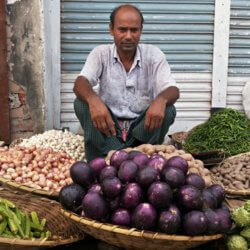
The Indian government is currently debating whether to life an 18-month freeze on trials of 13 genetically modified food crops, including the contentious eggplant, known as brinjal in India. It’s a hotly contested issue.
The ban has been fiercely opposed by cop biotechnology experts. They passed what they call The Bangalore Declaration, which urged the government to “take urgent measures to remove unjustified and arbitrary constraints that jeopardize the functioning and development of the Indian agribiotech R&D”.
Last July, a committee of technical experts comprising scientists from public research laboratories and academic institutions set up by the Supreme Court, in a preliminary report, recommended extending the temporary moratorium to 10-years.
“[I]t is apparent that there are major gaps in the regulatory system,” the committee wrote. “These need to be addressed before issues related to tests can be meaningfully considered.”



The Supreme Court committee later rejected the 10-year recommendation but set limits on what it would take to lift the ban. The committee also said no to herbicide tolerant crops on the ground that they would exert a highly adverse impact over time on sustainable agriculture, rural livelihood and environment. “The TEC finds them completely unsuitable in the Indian context,” the report said.
Now with a reassessment in the works, Suman Sahai, winner of the prestigious Norman Borlaug Award and head of the anti-GMO Gene Campaign NGO, has reaffirmed her opposition to GMOs in India.
“Who asked for GM crops,” she told the Hindustan Times. Is it the farmers or consumers? After China, India is the biggest producer of brinjal and we have no insurmountable problems with it.”
Both brinjal and mustard are cross-pollinating plants, so the consequences will be no single, non-GM mustard or brinjal left. Some say you can segregate, but have we managed to segregate Bt cotton? It has gone everywhere. We are not facing up to the truth. Eastern India is very vulnerable because there is a lot of brinjal diversity there.
Uniformity of biodiversity will have its own environmental implications. There is a well-known phenomenon called gene silencing. Very often plants altered genetically don’t survive because you have interrupted the natural process. Those that do survive, certain genes may stop expressing. What can get silenced we have no idea. Yet we are ready to risk the entire germplasm.
