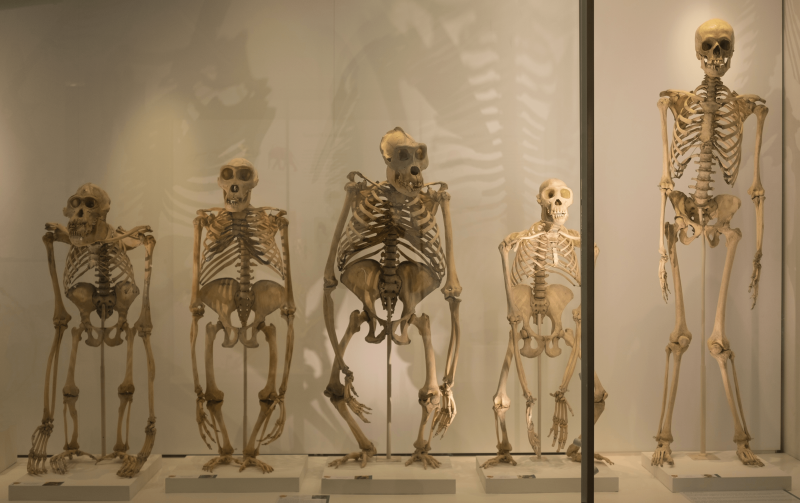
While scientists have long been intrigued by the question of how humans’ bipedal stance and movement evolved from a quadrupedal ancestor, neither past studies nor fossil records have permitted the reconstruction of a clear and definitive history of the early evolutionary stages that led to human bipedalism.
However, a new study, which centers on recently discovered evidence from skulls of a 6-million-year-old fossil ape, Lufengpithecus, offers important clues about the origins of bipedal locomotion courtesy of a novel method: analyzing its bony inner ear region using three-dimensional CT-scanning.
“The semicircular canals, located in the skull between our brains and the external ear, are critical to providing our sense of balance and position when we move, and they provide a fundamental component of our locomotion that most people are probably unaware of,” explains Yinan Zhang, a doctoral student at the Institute of Vertebrate Paleontology and Paleoanthropology of the Chinese Academy of Sciences (IVPP) and the lead author of the paper, which appears in the journal the Innovation. “The size and shape of the semicircular canals correlate with how mammals, including apes and humans, move around their environment. Using modern imaging technologies, we were able to visualize the internal structure of fossil skulls and study the anatomical details of the semicircular canals to reveal how extinct mammals moved.”
“Our study points to a three-step evolution of human bipedalism,” adds Terry Harrison, a New York University anthropologist and one of the paper’s co-authors. “First, the earliest apes moved in the trees in a style that was most similar to aspects of the way that gibbons in Asia do today. Second, the last common ancestor of apes and humans was similar in its locomotor repertoire to Lufengpithecus, using a combination of climbing and clambering, forelimb suspension, arboreal bipedalism, and terrestrial quadrupedalism. It is from this broad ancestral locomotor repertoire that human bipedalism evolved.”
Most studies of the evolution of ape locomotion had focused on comparisons of the bones of the limbs, shoulders, pelvis, and spine and the way they are associated with the different types of locomotor behaviors seen in living apes and humans. However, the diversity of locomotor behaviors in living apes and the incompleteness of the fossil record have hampered the development of a clear picture of human bipedalism’s origins.
The skulls of Lufengpithecus—originally discovered in China’s Yunnan Province in the early 1980s—have given scientists the opportunity to address, in new ways, unanswered questions about the evolution of locomotion. However, the heavy compression and distortion of the skulls obscured the bony ear region and led previous researchers to believe that the delicate semicircular canals were not preserved.
To better explore this region, Zhang, Ni and Harrison, along with other researchers at IVPP and the Yunnan Institute of Cultural Relics and Archaeology (YICRA), used three dimensional scanning technologies to illuminate these portions of the skulls to create a virtual reconstruction of the inner ear’s bony canals. They then compared these scans to those collected from other living and fossil apes and humans from Asia, Europe, and Africa.

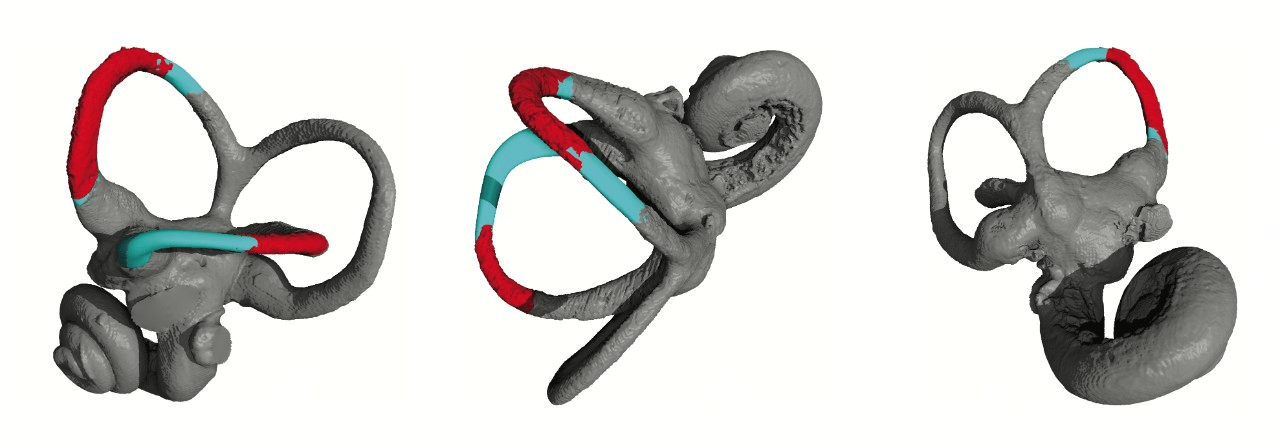
Three different views of the reconstructed inner ear of Lufengpithecus. Image courtesy of Yinan Zhang, Institute of Vertebrate Paleontology and Paleoanthropology, Chinese Academy of Sciences.
“Our analyses show that early apes shared a locomotor repertoire that was ancestral to human bipedalism,” explains IVPP Professor Xijun Ni, who led the project. “It appears that the inner ear provides a unique record of the evolutionary history of ape locomotion that offers an invaluable alternative to the study of the postcranial skeleton.”
“Most fossil apes and their inferred ancestors are intermediate in locomotor mode between gibbons and African apes,” adds Ni. “Later, the human lineage diverged from the great apes with the acquisition of bipedalism, as seen in Australopithecus, an early human relative from Africa.”
By studying the rate of evolutionary change in the bony labyrinth, the international team proposed that climate change may have been an important environmental catalyst in promoting the locomotor diversification of apes and humans.
“Cooler global temperatures, associated with the build up of glacial ice sheets in the northern hemisphere approximately 3.2 million years ago, correspond with an uptick in the rate of change of the bony labyrinth and this may signal a rapid increase in the pace of ape and human locomotor evolution,” explains Harrison.