
The International Agency for Research on Cancer (IARC) is a semi-autonomous intergovernmental agency under the umbrella of the World Health Organization (WHO) of the United Nations (UN) funded by member countries, including the United States. It brings together groups of scientists to review studies to identify chemicals, physical and biological agents, and lifestyle factors that could possibly cause cancer in humans.
IARC focuses on “hazard assessments” as opposed to “risk assessments,” meaning that it tries to find out if something could cause cancer. It does not assess whether an agent is likely to cause cancer (that’s a “risk” assessment, and risk is dependent on exposure). As a result, IARC has classified hundreds of agents and situations as cancer-causing that are classified by regulatory agencies around the world as safe.
Of the nearly 1,000 factors that IARC has evaluated, only one has been deemed non-carcinogenic. The IARC’s list of “known” (group 1), “probable” (group 2A), and “possible” (group 2B) carcinogens includes: sunshine, mobile phones, alcoholic beverages, wood dust, coffee, outdoor pollution, working as a hairdresser, wood smoke, night shifts, hot yerva mate tea, red meat–and the herbicide glyphosate. Only the glyphosate designation has led to worldwide protests by advocacy groups and concern by government agencies in some countries, particularly in Europe. The risk/hazard distinction confuses the public and even some regulatory agencies, and is exploited by activist groups who often want to portray relatively safe products as dangerous.
IARC became embroiled in a scandal in June 2017 when Reuters reported that Aaron Blair, head of the IARC’s glyphosate review group, withheld information showing no link between glyphosate and cancer. Blair said that unpublished research by the US National Cancer Institute that he participated in would have made it less likely that glyphosate would meet the agency’s criteria for being classed as “probably carcinogenic.” According to Blair, the data was available two years before IARC assessed glyphosate, but was not published in time because “there was too much to fit into one scientific paper.”
Michael Eisen, a professor of genetics, genomics, and development at the University of California-Berkeley and the founder of the Public Library of Science, told Mother Jones: “This is a board of people whose job it is to assess evidence, so they should be able to do that before it’s published … The broader issue is that they seem eager to have reached the conclusion that they reached.”
In October 2017, Reuters reported that a draft of IARC’s glyphosate review differed substantially from its final, published review. Reuters found 10 changes made to the animal studies chapter. In each case, a negative conclusion about glyphosate was either deleted or replaced with a neutral or positive one. Reuters was not able to determine who made the changes.
Glyphosate
IARC’s controversy over glyphosate, the world’s most popular herbicide, began in March 2015, when it issued a statement (also published in medical journal the Lancet) that re-classified glyphosate as “probably carcinogenic to humans.” Its release read:
IARC classified glyphosate as “probably carcinogenic to humans” (Group 2A). This was based on “limited” evidence of cancer in humans (from real-world exposures that actually occurred) and “sufficient” evidence of cancer in experimental animals (from studies of “pure” glyphosate). IARC also concluded that there was “strong” evidence for genotoxicity, both for “pure” glyphosate and for glyphosate formulations.
It was a surprise finding to some in the scientific community because every major regulatory agency (then and since) has determined that glyphosate, often paired with genetically modified crops, is not carcinogenic. In fact, its “lethal dosage” measure (LD 50) is about that of common table salt.
IARC’s determination was widely reported in the media and activists have used it to push for bans and “carcinogen” labels, succeeding in several countries and states. The state of California added glyphosate to its “Proposition 65” list of carcinogens, requiring products containing glyphosate to be labeled as a carcinogen. In a New York Times article titled “Stop Making Us Guinea Pigs” influential food writer Mark Bittman [read GLP profile here] argued that because of the IARC review, glyphosate should be banned, at least until “Monsanto can prove” that the herbicide is safe.
The mainstream science community has pushed back. All foods are chemicals and many can be toxic at certain levels. But each chemical has a dosage curve showing how much ingestion is needed to cause harm, and most foods contain very low doses of these toxins. As the US Centers for Disease Control and Prevention states:
Just because we can detect levels of an environmental chemical in a person’s blood or urine does not necessarily mean that the chemical will cause effects of disease.
IARC’s results were more nuanced than many media reports or even IARC’s summary statement suggest. There was no finding of a link between glyphosate traces of food and cancer. The group found “limited evidence” of carcinogenicity in agricultural workers exposed to glyphosate for non-Hodgkin lymphoma and prostate cancer. The panel found “sufficient evidence” of carcinogenicity in experimental animals. The panel did not determine a specific cancer-causing mechanism or what level of exposure to glyphosate may be harmful. According to IARC researcher Aaron Blair, a scientist at the US National Cancer Institute, “’Probable’ means that there was enough evidence to say it is more than possible, but not enough evidence to say it is a carcinogen … It means you ought to be a little concerned about.”
This ambiguity explains why IARC found cancer hazards, while the World Health Organization itself declared that the IARC study did not indicate a need for more regulation of glyphosate. Since the IARC report, several health agencies have reviewed the science and concluded that glyphosate is not a carcinogen.
- A Joint Meeting of the Food and Agriculture Organization of the United Nations (FAO) Panel of Experts on Pesticide Residues in Food and the Environment and the World Health Organization (WHO) Core Assessment Group on Pesticide Residues (JMPR) concluded in May 2016 that “glyphosate is unlikely to pose a carcinogenic risk to humans from exposure through the diet.”
- In September 2016, the US Environmental Protection Agency issued a review authored by 13 independent scientists, concluding:
…there is not strong support for the “suggestive evidence of carcinogenic potential” cancer classification descriptor based on the weight-of-evidence, which includes the fact that even small, non-statistically significant changes observed in animal carcinogenicity and epidemiological studies were contradicted by studies of equal or higher quality. The strongest support is for “not likely to be carcinogenic to humans” at the doses relevant to human health risk assessment for glyphosate.
- A June 2015 re-review of glyphosate by Health Canada concluded:
An evaluation of available scientific information found that products containing glyphosate do not present unacceptable risks to human health or the environment when used according to the proposed label directions.
- In November 2015, the European Food Safety Authority (EFSA) issued its evaluation of the IARC report:
Glyphosate is not proposed to be classified as carcinogenic under the EU regulation for classification, labelling and packaging of chemical substances. … neither the epidemiological data (i.e. on humans) nor the evidence from animal studies demonstrated causality between exposure to glyphosate and the development of cancer in humans.
- The German BfR, an agency that does evaluations for the European Commission, issued a FAQ on glyphosate in March 2016, concluding: “based on current scientific knowledge, no carcinogenic risk to humans is to be expected from glyphosate if it is used in the proper manner for the intended purpose.”
Weed scientist Andrew Kniss assembled a chart to illustrate the problematic findings in the IARC study, and then analyzed what he had found.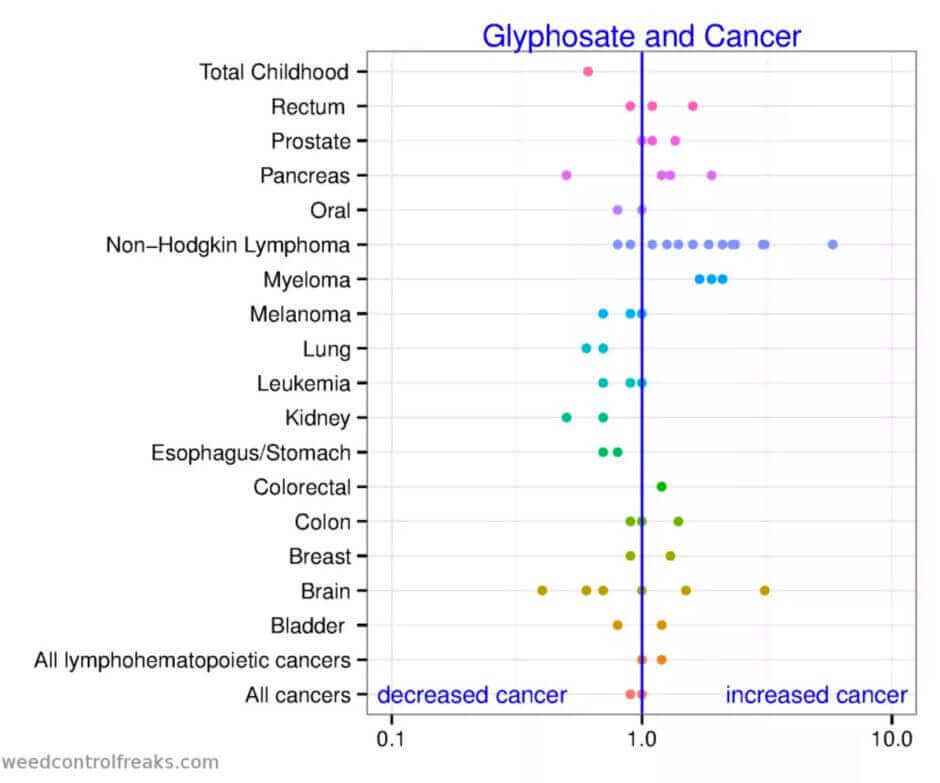
In the figure, each point represents he relative risk of developing cancer between people who had been exposed to glyphosate and those who hadn’t. To interpret the figure, any points on the left side of the blue line (less than 1) means that, on average, people who were exposed to glyphosate were less likely to get that type of cancer.
So what does this all mean? I may change my mind when the IARC’s full monograph is published later, but based on the data I could find, I don’t see any evidence for alarm. And I say that as someone who is exposed to more glyphosate than a vast majority of the population. There is nothing here that I think can tarnish glyphosate’s reputation as a very safe pesticide.
One of the basic principles of toxicology is that “the dose makes the poison.” Lots of things can cause cancer, but not everything that can cause cancer does, because people are not exposed to the levels necessary to cause cancer in the real world.
In the video below, Arizona State University risk expert Andrew Maynard notes that the IARC classification “doesn’t indicate how likely” glyphosate is to cause cancer. “It is the equivalent of saying a rock could kill you but not pointing out that it probably needs to be dropped on your head from a great height first,” he says.
Controversies
In October 2016, Reuters journalist Kate Kelland reported that IARC advised academic experts on its glyphosate review not to disclose documents they were asked to release under US Freedom of Information laws—purportedly in an attempt to keep private the group’s deliberations.
In October 2017, the Times (UK) reported that Christopher Portier, a scientist who advised IARC’s glyphosate review, received $160,000 from law firms bringing claims by cancer victims against glyphosate manufacturers. He did not declare the conflict of interest in a letter to the European Commission urging it to accept the IARC classification.


History
IARC was created May 20, 1965 by resolution of the World Health Assembly.
At its founding, members of IARC Governing Council were: the Federal Republic of Germany, France, Italy, the United Kingdom, and the United States. Today, IARC’s membership includes 25 countries.
The first IARC Director was John Higginson (1966-1981), who was followed by Lorenzo Tomatis (1982-1993), Paul Kleihues (1994-2003), Peter Boyle (2004-2008), and Christopher Wild (2009-present).
Funding
Major funding sources include the European Commission, the US National Institutes of Health (NIH), the World Cancer Research Fund International, and the Bill and Melinda Gates Foundation.
In September 2016, Republican Congressman Jason Chaffetz, Chairman of the US House of Representatives’ oversight and government reform committee, sent a letter to Francis Collins, Director of the National Institutes of Heath, asking why NIH continued to fund IARC despite having a record of “controversy, retractions, and inconsistencies.” According to Chaffetz, NIH has given IARC several millions of dollars in grants since 1992, including over $1.2 million in 2016.
Key People
Christopher Wild, director
Aaron Blair, head of IARC’s glyphosate review group
Christopher Portier, scientist who advised IARC’s glyphosate review
Criticisms
The IARC has been widely criticized for a lack of transparency and for confusing and scaring the public about the causes of cancer.
In a 2015 article in the Atlantic, science journalist Ed Yong questioned the IARC’s “confusing” classification scheme. “what we have is a classic ivory-tower mentality: a group of academics who hole up in a room, make proclamations to the world, and ignore the chaos that consistently ensues,” wrote Yong. “Perhaps we need a separate classification scheme for scientific organizations that are ‘confusogenic to humans.’”
In December 2016, a group of 10 well-known academic, government and industry scientists criticized IARC for using “outmoded hazard-based assessments.” In a commentary published in the journal Regulatory Toxicology and Pharmacology, the scientists argue that using only two categories, carcinogens and non-carcinogens, “serve neither science nor society.” Instead, they suggest approaches based on hazard and risk characterisation, which allow for more informed risk management decisions.
In response to the IARC study, Sir Colin Berry, a professor of pathology at Queen Mary University of London, said “There are over 60 genotoxicity studies on glyphosate with none showing results that they should cause alarm relating to any likely human exposure … For human epidemiological studies there are 7 cohort and 14 case control studies, none of which support carcinogenicity.”
Berry continued: “The authors have included non-Hodgkin lymphoma (NHL), but that diagnosis is no longer used in pathology because it’s far too imprecise. Even if you do include NHL there are still 7 studies, only one of which is positive – and that one is not a good study in my view. The weight of evidence is against carcinogenicity. … This appears to be a rather selective review.”
According to Oliver Jones, Senior Lecturer in Analytical Chemistry at RMIT University in Melbourne, Australia, IARC’s “probable carcinogen” designation “sounds scary and IARC evaluations are usually very good, but to me the evidence cited here appears a bit thin.” He added: “From a personal perspective, I am a vegetarian so I eat a lot of vegetables and I’m not worried by this report.”
Professor and journalist David Zaruk has documented a series of damaging charges against IARC, among them:
- IARC had cherry-picked the studies to include in their evaluation;
- The studies were of a very low quality (mostly not fit for peer review);
- Monograph lead author, Kate Guyton, had announced at an anti-chemical NGO meeting the year before that they would find certain pesticides carcinogenic;
- Environmental Defense Fund activist, Christopher Portier, chaired IARC’s independent advisory group that recommended doing a monograph on glyphosate;
- Portier sat as the only external technical advisor to the glyphosate working group;
- IARC did not declare Portier’s affiliations with EDF, even though they knew about this clear conflict of interest at least six months earlier;
- IARC did not distance itself from Portier’s political lobbying using his affiliation with the working group;
- Rather, IARC went on the offensive, attacking scientists and agencies who disagreed with their findings, including EFSA and the German BfR;
- IARC’s communications team went so far as to provide information to an activist writer in Le Monde to attack EFSA;
- IARC diminished industry studies and rejected any involvement, advice or data of industry experts.
- Their anti-industry bias is outrageous. At IARC’s 50th anniversary, which had over 1000 cancer researchers and administrators in attendance, not a single industry cancer researcher from the pharmaceutical industry was invited.
- IARC’s Guyton tried to suppress glyphosate panel members from cooperating with freedom of information requests;
- IARC’s director, Christopher Wild, interfered with a US Congressional committee’s internal investigation;
- IARC panel members were found to be meddling with US EPA research on glyphosate;
- IARC’s communication team displayed a series of unethical dirty tricks;
- A study has just been published where ten toxicologists show how IARC’s hazard assessment is outmoded and inadequate.