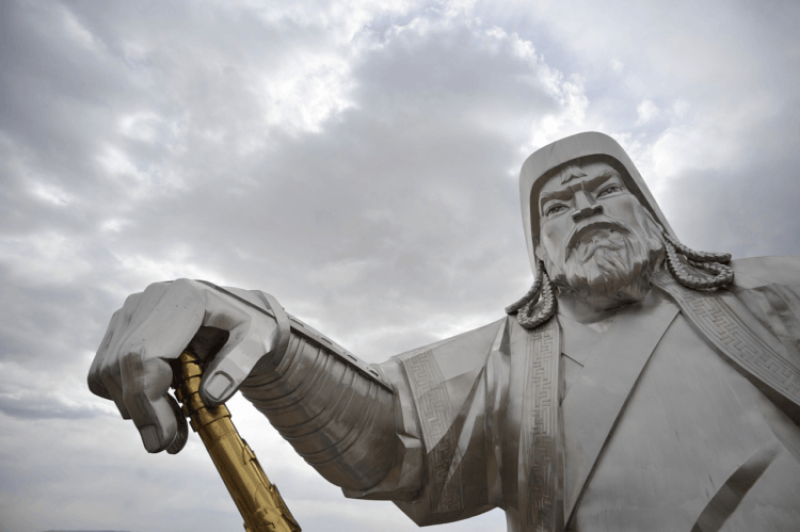
Genghis Khan has over 16 million descendants today — but he’s not alone. 10 other men have massive genetic legacies

Genghis Khan has over 16 million descendants today — but he’s not alone. 10 other men have huge lineages
Credit: Pixabay/ Jonas Kim

Since a 2003 study found evidence that Genghis Khan’s DNA was present in about 16 million men alive at the time, the Mongolian ruler’s genetic prowess has stood as an unparalleled accomplishment. But he isn’t the only man whose reproductive activities still show a significant genetic impact centuries later. A 2015 study published in the European Journal of Human Genetics found that a handful of other men had prolific lineages, too.

To identify those lineages, the geneticists analyzed “the Y chromosomes of more than 5,000 men from 127 populations spanning Asia,” wrote Nature News’ Ewen Callaway.

Follow the latest news and policy debates on sustainable agriculture, biomedicine, and other ‘disruptive’ innovations. Subscribe to our newsletter.

When he ruled during the 13th century, Genghis Khan presided over land that spanned from the Pacific coast of China to the Caspian Sea. Historians don’t know exactly how many children Genghis Khan sired, but many agree his lineage is broad. In 1260, Persian historian ‘Ata-Malik Juvaini wrote: “Of the issue of the race and lineage of Chingiz [Genghis] Khan, there are now living in the comfort of wealth and affluence more than 20,000.”

Mongol rulers such as Genghis Khan could have spread their genes widely, because of rapes during conquests and because the khans had access to many women in the areas they ruled, Oxford University geneticist Chris Tyler-Smith told Nicholas Wade of the New York Times in 2003.

Genghis Khan’s sons may have followed in their father’s footsteps and had large harems. Tushi, the emperor’s oldest son, had 40 sons himself, per the New York Times.

So, who were the other super-fertile fathers? One genetic sequence is attributed to Giocangga, the grandfather of the founder of the Qing dynasty. His Y chromosome was linked in a 2005 study to 1.5 million men in modern northern China. This large number likely resulted from his descendants taking many wives and concubines.

The other nine men are currently mysteries. Yet, by assuming they lived in the area where their genomes were most commonly found and by studying mutations in the genetic sequences, scientists suggest they originated throughout Asia between 2100 B.C.E. and 700 C.E., per Nature News.

This is an excerpt. Read the full article here

{{ reviewsTotal }}{{ options.labels.singularReviewCountLabel }}
{{ reviewsTotal }}{{ options.labels.pluralReviewCountLabel }}
{{ options.labels.newReviewButton }}
{{ userData.canReview.message }}

Related Articles

Infographic: Global regulatory and health research agencies on whether glyphosate causes cancer

Infographic: Global regulatory and health research agencies on whether glyphosate causes cancer

Does glyphosate—the world's most heavily-used herbicide—pose serious harm to humans? Is it carcinogenic? Those issues are of both legal and ...

Most Popular

ChatGPT-Image-May-7-2026-12_16_37-PM-2
Viewpoint: Are cancer rates ‘skyrocketing’ as RFK, Jr. and MAHA claims? The evidence says mostly the opposite
Screenshot-2026-04-13-at-1.39.26-PM
Viewpoint: ‘Safer for children?’ Stonyfield yogurt under fire for deceptive organic marketing
Screenshot-2026-04-22-at-10.46.29-AM
Viewpoint: How to counter science disinformation? Science journalist offers 12 practical tips
png-pill-omega-Supp-fish-oil
Millions take omega-3 fish oil for brain health. New research suggests it may do the opposite.
Screenshot-2026-04-23-at-11.00.36-AM
Regulators' dilemma: Thalidomide, Metformin, and the cost of getting drug approvals wrong
ChatGPT Image May 12, 2026, 01_21_30 PM
How big health brands are funding online medical misinformation 
ChatGPT Image May 14, 2026, 09_51_35 PM
Facebook swamped by hundreds of thousands of scam ads for illegal or dangerous medical products
Picture1-5
Science Disinformation Gap: The transatlantic battle over social media and censorship
ChatGPT-Image-May-12-2026-08_39_41-PM
GLP podcast: Big Pharma, Big Ag, Big Food—health harming industries or life-saving innovators?

Sorry. No data so far.

glp menu logo outlined

Get news on human & agricultural genetics and biotechnology delivered to your inbox.