
The Centers for Disease Control and Prevention (CDC) today confirmed 31 new measles cases in a nationwide outbreak that has now reached 1,983 infections, as experts describe sometimes-serious symptoms that can warrant hospital stays, including brain inflammation and pneumonia.
All but nine of the US infections are locally acquired, with the rest related to international travel. The total for all of last year was 2,288 confirmed cases.
The agency reported a new measles outbreak, for a total of 30 outbreaks. The nation saw 48 outbreaks for the entire year in 2025.
Of this year’s cases, 21% involve children younger than 5 years, and 72% involve kids and young adults up to 19 years. Among all 2026 patients, 92% have been unvaccinated or have an unknown vaccination status. Six percent of patients this year have been hospitalized, compared with 11% last year.
No measles deaths have been reported this year, compared with three last year.
Cases in Utah appear to be slowing
According to the CDC measles map, South Carolina has recorded the most cases so far this year, at 669, but its outbreak is now over. Utah is next, with 484 cases—although the Utah health department lists 476, just two more than last week. The state recorded eight new cases the previous week and 10 the week before, for a three-week total of 20.
Texas has 182 cases, and Florida 139, four of them new, according to the CDC map.
“Fortunately, the outbreak in our region does appear to be slowing,” said Andrew Pavia, MD, chief of pediatric infectious diseases at the University of Utah. He was part of a media briefing this week sponsored by the Infectious Diseases Society of America (IDSA).
Some have developed manifestations of brain inflammation or encephalitis, with confusion or brain fog.
“Although the outbreak was initially centered in a tightly knit community on the border [with Arizona], it spread to involve the entire state of Utah. Just over 90% of measles cases were in people who were unvaccinated or at unknown status.
“Two-thirds of the patients were adults older than 18, and one third were children. These included 23 children under 1 year of age. Those who are too young to be vaccinated depend on community protection. We’ve had 12 cases of measles among pregnant women.
“Fifty-four, or 8% of our patients, were hospitalized for more than 24 hours, but many, many more were seen and treated in emergency departments. The hospitalized patients we’ve seen have been quite sick. Some have developed manifestations of brain inflammation or encephalitis, with confusion or brain fog. Some have had pneumonia as a complication of measles.”
Report spotlights severe cases last year in Texas
The potential seriousness of the disease is also highlighted in a report yesterday in Morbidity and Mortality Weekly Report, with the authors noting a 72% rate of pneumonia in hospitalized patients.

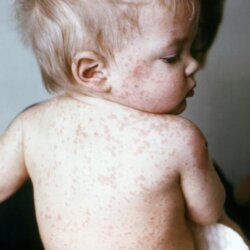



The report, written by CDC experts and their state partners, notes that officials confirmed 325 measles cases in West Texas from January 20 to March 18 last year, with 60 patients (18.5%) needing hospital care. They reviewed 54 of the hospital cases for which medical records were available.
Forty-nine (91%) were children, and 48 (89%) had no underlying medical conditions. All 54 were either not vaccinated against measles or had an unknown vaccination status.
The authors write, “Hospitalized patients were admitted for a median of 2 days (range = 0–20 days) and many experienced complications, including pneumonia (39; 72.2%), dehydration (25; 46.3%), hepatitis [liver inflammation] (one; 1.9%), and febrile seizures (one; 1.9%).”
Thirty-eight patients (70.4%) required supplemental oxygen, four (7.4%) needed intensive care, two (3.7%) required mechanical ventilation, and one (1.9%) died.
The authors conclude, “Measles infection can result in serious complications, hospitalization, and death. Vaccination remains a critical tool for the prevention of measles infection and severe disease.”
We are worried about measles because it is so contagious, and for some people, it can result in severe disease and complications.
At the IDSA briefing, Ruth Lynfield, MD, Minnesota state epidemiologist, said, “We are worried about measles because it is so contagious, and for some people, it can result in severe disease and complications, including severe dehydration, pneumonia, encephalitis or brain inflammation, and even death. Measles can attack immune memory cells and may increase susceptibility to other infections for a period of time after the acute measles infection.
“People at high risk for complications include infants and those who are immunocompromised. A person who is pregnant is at high risk for severe disease, including pneumonia. But there is also a higher risk of miscarriage, stillbirth, low birth weight and prematurity for the baby.”
Jim Wappes is the CIDRAP editorial director and has more than 30 years’ experience as a manager, web-content publisher, and medical editor and writer. Find Jim on X @canoester
A version of this article was originally posted at the Center for Infectious Disease Research and Policy (CIDRAP) at the University of Minnesota and is reposted here. Any reposting should credit both the GLP and original article. Find CIDRAP on X @CIDRAP