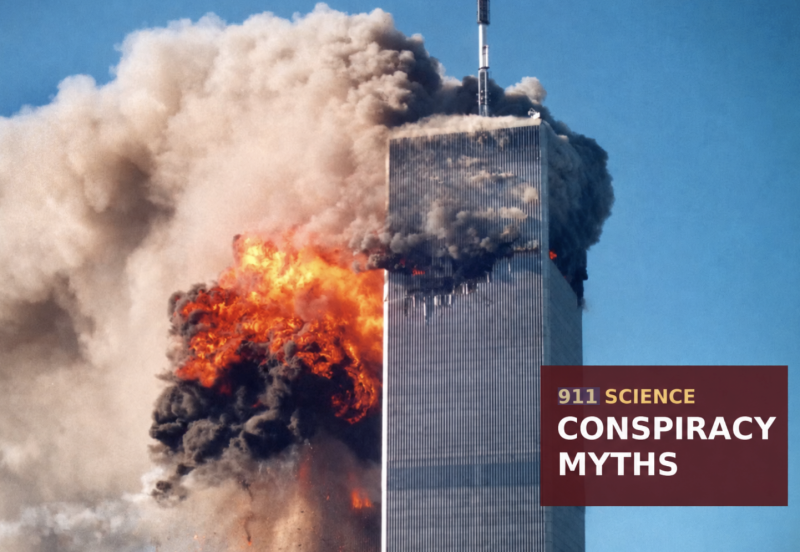
‘Jet fuel didn’t melt the steel’: 9/11 conspiracy theories debunked

Twenty-five years after the September 11 attacks, conspiracy theories about the World Trade Center’s collapse still circulate — but as Popular Mechanics reports in a piece revisiting its long-running fact-check of the attacks, the physics never supported the “controlled demolition” claim truthers keep repeating.

Steel didn’t need to melt to fail

Jet fuel burns at 800 to 1,500 degrees Fahrenheit, well short of steel’s 2,750-degree melting point — a gap truthers cite as proof of planted explosives. But structural steel doesn’t need to melt to give way. “Steel loses about 50 percent of its strength at 1,100 degrees,” notes AISC senior engineer Farid Alfawakhiri, and the fires were fed for hours by furniture, paper, and diesel long after the jet fuel itself burned off.

Mis- and disinformation are distorting science and public policy. Subscribe to our Daily and Weekly Digests for incisive coverage of ‘disruptive’ innovations in AI, agricultural biotechnology, food, chemicals, nuclear energy, vaccines, and other disruptive innovations.

Other claims fall apart under the same scrutiny: seismologist Arthur Lerner-Lam called the “seismic spike” theory “categorically incorrect,” the dust clouds seen during collapse were just air and pulverized concrete ejected by pancaking floors, and the National Institute of Standards and Technology traced WTC 7’s collapse to undocumented debris damage and an unusual column design — not hidden charges.


Two decades of independent engineering analysis keep landing on the same answer: fire and structural damage, not bombs, brought the towers down.

AI chatbot icon
Related on the SLP
Are chatbots sophisticated enough to debunk conspiracy theories?

Read the original article here

Related Articles

Infographic: Global regulatory and health research agencies on whether glyphosate causes cancer

Infographic: Global regulatory and health research agencies on whether glyphosate causes cancer

Does glyphosate—the world's most heavily-used herbicide—pose serious harm to humans? Is it carcinogenic? Those issues are of both legal and ...

Most Popular

ChatGPT-Image-Mar-10-2026-01_39_01-PM
Viewpoint—“Miracle molecule” debunked: Why acemannan supplements don’t work
Wave Crest Over Red Cross
Viewpoint: Here are the election-inspired Trump administration healthcare policy reversals expected in the coming months
Aerial Sprayer Over Gradient Fields
Farming, food, and chemicals: Post-midterms, the MAHA alliance between Democrats and MAGA Republicans is bruised but not cowed. What comes next?
Supplement Rain Wellness Illustration
Viewpoint: Bedeviled by “toxic inflammation”? How wellness grifters turn this scientific gray zone into a supplement jackpot
Teal Hexagon Technology Icons
4 key ways the Blue Wave will upend science policy
Confident Doctor in Clinical Setting
More than 80% of ‘pro-science’ candidates were swept into office. Will they have a policy impact?
Stacked Protest Signs on Concrete Ledge
Voters hate AI data centers, yet they are crucial to establishing a critical technology. So what’s next?
Microscopic IVF Egg Injection
With technical barriers to human embryo editing falling, ethical concerns escalate
Democratic Donkey Plowing at Sunset
Viewpoint: Democratic tsunami: As the red tide recedes, here are the most likely shifts in food and agricultural policy
Protect-Womens-Sports-at-the-Capitol
Blue, purple and red states passed or reaffirmed bans on trans females competing in women’s sports
Screenshot-2026-11-05-at-1.20.54-PM
$7.35 billion PFAS settlement: 3M to pay people who blame health problems on ‘forever chemicals’ phased out of firefighting foam for more than 20 years
Prescription Capsules Scattered on Twenty-Dollar Bills
Facts & Fallacies podcast: America's health care system is broken. A doctor explains how to fix it, Part 2
glp menu logo outlined

Get news on human & agricultural genetics and biotechnology delivered to your inbox.