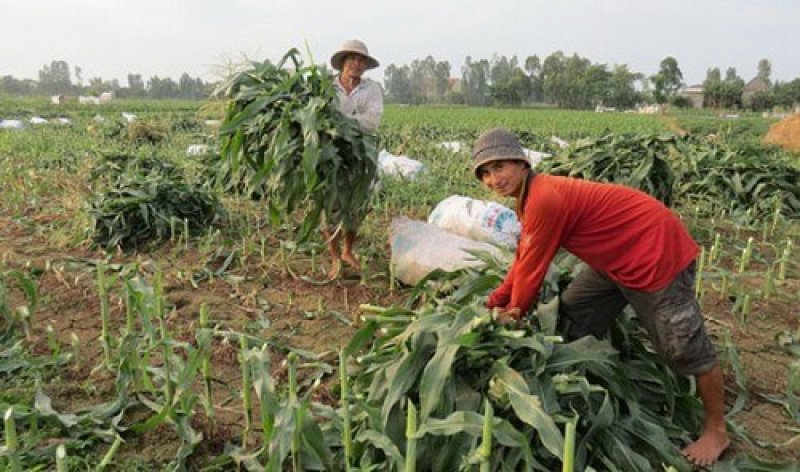
Vietnam approves GM corn as animal feed to reduce dependence on imports

Nxt BSrL

Vietnamese farmers nationwide are now able to plant three varieties of genetically-modified (GM) corn from the Swiss firm Syngenta, according to a new government’s rule.

The three varieties are NK66 BT, NK66 GT and NK66 BT/GT and will be supplied to corn farms nationwide with each variety being distributed to specific regions, said the decision from the Ministry of Agriculture and Rural Development.

Pham Dong Quang, director of the Department of Crop Production, said the three varieties can resist pest and herbicide as well as produce higher yields.

“GM corn will be used for animal feed only and thus, it does not require special labeling,” he said.

Kumar Datta, Syngenta Vietnam country director, said the company will coordinate with provincial agricultural agencies on plans to widely spread the varieties for better income of the farmers.

‘Jumping the gun’

Those developments were in line with a 2006 ambitious plan to develop biotech crops as part of a “major program for the development and application of biotechnology in agriculture and rural development.”

The plan aimed to cultivate Vietnam’s first GM crops by 2015 and have 30-50 percent of the country’s farmland covered with genetically modified organisms by 2020.

An increasing number of Vietnamese officials and scientists have touted the need to grow GM corn to reduce Vietnam’s dependence on imports.

Vietnam currently imports 1.5 million tons of corn for feeding animals every year from Brazil, Argentina, and the US, including GM varieties, according to the agriculture ministry.

Read full, original article: Vietnam approves commercial crops of GMO corn to cut imports

{{ reviewsTotal }}{{ options.labels.singularReviewCountLabel }}
{{ reviewsTotal }}{{ options.labels.pluralReviewCountLabel }}
{{ options.labels.newReviewButton }}
{{ userData.canReview.message }}

Related Articles

Infographic: Global regulatory and health research agencies on whether glyphosate causes cancer

Infographic: Global regulatory and health research agencies on whether glyphosate causes cancer

Does glyphosate—the world's most heavily-used herbicide—pose serious harm to humans? Is it carcinogenic? Those issues are of both legal and ...

Most Popular

ChatGPT-Image-May-7-2026-12_32_36-PM
Viewpoint: The state of U.S. vaccine policy? Dismal nationally, but some states are stepping up.
Screenshot-2026-04-13-at-1.39.26-PM
Viewpoint: ‘Safer for children?’ Stonyfield yogurt under fire for deceptive organic marketing
Screenshot-2026-04-22-at-10.46.29-AM
Viewpoint: How to counter science disinformation? Science journalist offers 12 practical tips
ChatGPT-Image-May-7-2026-12_16_37-PM-2
Viewpoint: Are cancer rates ‘skyrocketing’ as RFK, Jr. and MAHA claim? The evidence says mostly the opposite
ChatGPT-Image-May-7-2026-01_23_27-PM-2
Viewpoint: Will AI democratize personalized cancer treatment or fuel medical misinformation?
Defense_Secretary_Ash_Carter_tours_the_Microsoft_Cybercrime_Center_in_Seattle_March_3_2016
How criminals are using AI to target social media users and steal their money and confidential data
the magic of mRNA
Viewpoint: Anti-vax fake ‘turbo cancer’ claims threaten cancer treatment breakthroughs
ChatGPT-Image-May-12-2026-08_39_41-PM
GLP podcast: Big Pharma, Big Ag, Big Food—health harming industries or life-saving innovators?
artificial intelligence brain think illustration md
Viewpoint — Digital gods and human extinction: Will we be the first species ever to design our own descendants?
Screenshot-2026-04-23-at-11.00.36-AM
Regulators' dilemma: Thalidomide, Metformin, and the cost of getting drug approvals wrong
RFKjr-Tech-Vax-Misinfo
As U.S. officials spread medical misinformation, scientists fact check online
Picture1-1
Cooling the planet with balloons: Could a geoengineering gamble slow global warming?
glp menu logo outlined

Get news on human & agricultural genetics and biotechnology delivered to your inbox.