China’s 30-year agricultural miracle: How 21 million Chinese boosted yields and cut fertilizer use

eca bd e f c c e

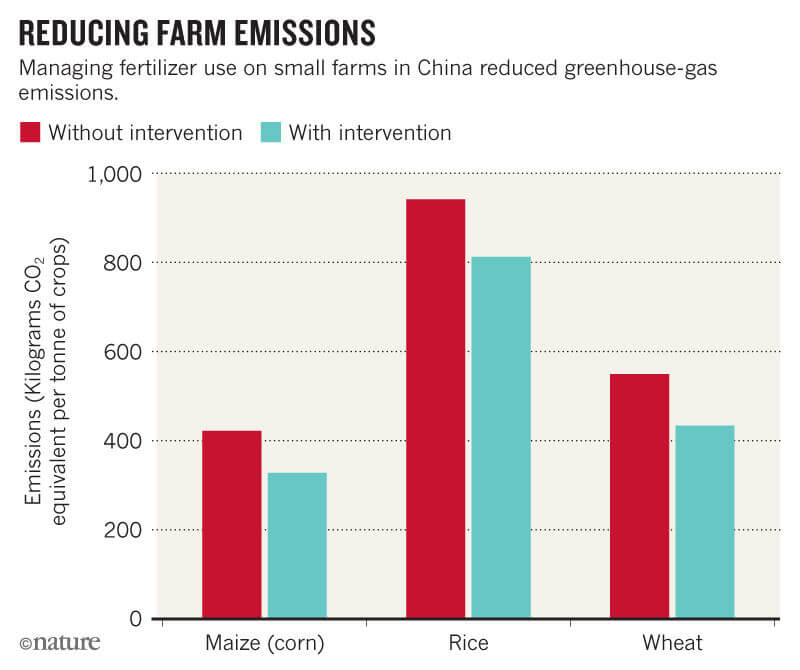
A landmark project to make agriculture more sustainable in China has significantly cut fertilizer use while boosting crop yields on millions of small farms across the country, researchers report in Nature.

As part of a decade-long study, scientists analysed vast amounts of agricultural data to develop improved practices, which they then passed on to smallholders. Through a national campaign, about 20.9 million farmers adopted the recommendations, which increased productivity and reduced environmental impacts. As a result of the intervention, farmers were together US$12.2 billion better off.

From 2005 to 2015, the project team conducted 13,123 field studies at maize (corn), rice and wheat farms across the country, from the subtropical south to the frigid north. The researchers tested how yields varied with different crop varieties, planting times, planting densities, fertilizer and water use.

Almost 21 million farmers adopted the group’s recommendations between 2006 and 2015. In that period, crop production for each grain increased by an average of around 11%. The study’s collaborators also recorded a surprising drop in fertilizer use — about 15% per crop — saving 1.2 million tonnes of nitrogen.

“The demonstration that reducing inputs can actually boost agricultural, environmental and economic performance at scale is very important,” says [Charles Godfray, a population biologist at the University of Oxford, UK].
d

Editor’s note: Read the full study (behind paywall)

Read full, original post: Millions of Chinese farmers reap benefits of huge crop experiment

{{ reviewsTotal }}{{ options.labels.singularReviewCountLabel }}
{{ reviewsTotal }}{{ options.labels.pluralReviewCountLabel }}
{{ options.labels.newReviewButton }}
{{ userData.canReview.message }}

Related Articles

Infographic: Global regulatory and health research agencies on whether glyphosate causes cancer

Infographic: Global regulatory and health research agencies on whether glyphosate causes cancer

Does glyphosate—the world's most heavily-used herbicide—pose serious harm to humans? Is it carcinogenic? Those issues are of both legal and ...

Most Popular

Picture1
The FDA couldn’t find a vaccine safety crisis, so it buried its own research
Screenshot-2026-04-22-at-12.21.32-PM
Viewpoint: Why the retracted Monsanto glyphosate study doesn’t change the science—the world’s most popular herbicide is safe 
ChatGPT-Image-May-7-2026-12_32_36-PM
Viewpoint: The state of U.S. vaccine policy? Dismal nationally, but some states are stepping up.
placebo
Viewpoint — Alternative medicine and the placebo effect: Selling a reassuring illusion of health
_20250221_nib_rfk_trump
Viewpoint: 'Crisis of public trust': Autism support community shocked RFK continues to peddle false claims about the danger of vaccines
ChatGPT-Image-May-18-2026-01_45_05-PM-2
Newest hantavirus conspiracy: Online disinformation turns outbreak into latest ivermectin grift
Screenshot-2026-04-13-at-1.39.26-PM
Viewpoint: ‘Safer for children?’ Stonyfield yogurt under fire for deceptive organic marketing
ChatGPT-Image-May-18-2026-12_06_18-PM-2
Defying death: The immortality movement goes mainstream
Defense_Secretary_Ash_Carter_tours_the_Microsoft_Cybercrime_Center_in_Seattle_March_3_2016
How criminals are using AI to target social media users and steal their money and confidential data
glp menu logo outlined

Get news on human & agricultural genetics and biotechnology delivered to your inbox.