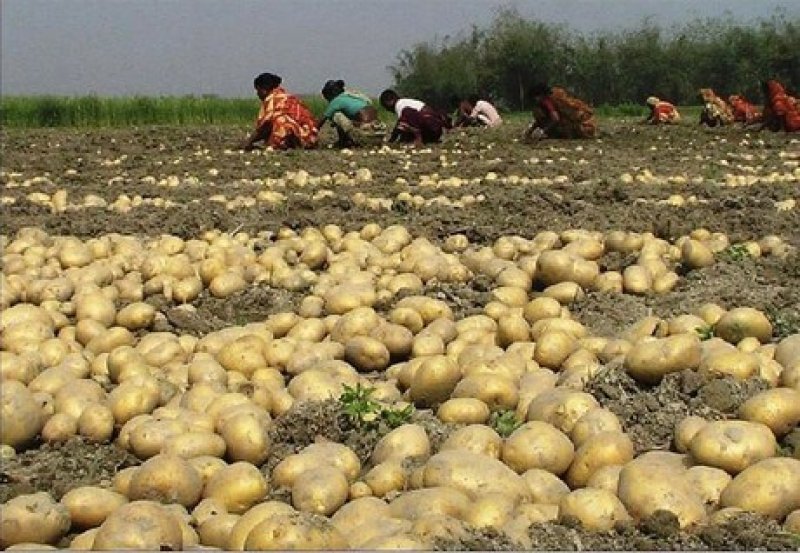
Bangladeshi farmers may be able to start growing GMO blight-resistant potatoes this year

bang

Researchers from the U.S., Indonesia and Bangladesh are embracing genetic engineering in hopes of increasing food security.

The team is creating a genetically-engineered potato to fight the late blight disease that caused the 19th-century Irish potato famine. The disease remains an issue for farmers worldwide, especially in Bangladesh, where many struggle with hunger.

“Late blight is the number one constraint for potato production, and Bangladesh has a perfect environment for this disease,” said Jim Bradeen, co-director of the [University of Minnesota’s] Stakman-Borlaug Center and a scientific advisor for the project.

The researchers are working to implement durable disease resistance in potatoes using three disease-resistant genes, Bradeen said. Since the pathogen that causes late blight disease can evolve and become resistant to the genes designed to protect the crop, researchers hope using three genes will be an adequate defense.

They hope to introduce the potato in Bangladesh in the next six months to a year, Bradeen said.

Bangladesh has already approved one genetically-modified organism (GMO) to improve crop performance: a genetically-engineered, insect-resistant eggplant.

While GMOs are highly debated in the U.S. and Europe, Bangladesh has embraced GMO technology, Bradeen said. However, the GMOs must meet many government regulations, which can be difficult for crop developers.

Read full, original post: Researchers turning to GMOs to solve food insecurity

{{ reviewsTotal }}{{ options.labels.singularReviewCountLabel }}
{{ reviewsTotal }}{{ options.labels.pluralReviewCountLabel }}
{{ options.labels.newReviewButton }}
{{ userData.canReview.message }}

Related Articles

Infographic: Global regulatory and health research agencies on whether glyphosate causes cancer

Infographic: Global regulatory and health research agencies on whether glyphosate causes cancer

Does glyphosate—the world's most heavily-used herbicide—pose serious harm to humans? Is it carcinogenic? Those issues are of both legal and ...

Most Popular

ChatGPT-Image-May-7-2026-12_32_36-PM
Viewpoint: The state of U.S. vaccine policy? Dismal nationally, but some states are stepping up.
Screenshot-2026-04-13-at-1.39.26-PM
Viewpoint: ‘Safer for children?’ Stonyfield yogurt under fire for deceptive organic marketing
Screenshot-2026-04-22-at-10.46.29-AM
Viewpoint: How to counter science disinformation? Science journalist offers 12 practical tips
the magic of mRNA
Viewpoint: Anti-vax fake ‘turbo cancer’ claims threaten cancer treatment breakthroughs
ChatGPT-Image-May-7-2026-12_16_37-PM-2
Viewpoint: Are cancer rates ‘skyrocketing’ as RFK, Jr. and MAHA claim? The evidence says mostly the opposite
ChatGPT-Image-May-7-2026-01_23_27-PM-2
Viewpoint: Will AI democratize personalized cancer treatment or fuel medical misinformation?
Defense_Secretary_Ash_Carter_tours_the_Microsoft_Cybercrime_Center_in_Seattle_March_3_2016
How criminals are using AI to target social media users and steal their money and confidential data
artificial intelligence brain think illustration md
Viewpoint — Digital gods and human extinction: Will we be the first species ever to design our own descendants?
Picture1-1
Cooling the planet with balloons: Could a geoengineering gamble slow global warming?
Screenshot-2026-04-23-at-11.00.36-AM
Regulators' dilemma: Thalidomide, Metformin, and the cost of getting drug approvals wrong
ChatGPT Image May 12, 2026, 01_21_30 PM
How big health brands are funding online medical misinformation 
glp menu logo outlined

Get news on human & agricultural genetics and biotechnology delivered to your inbox.