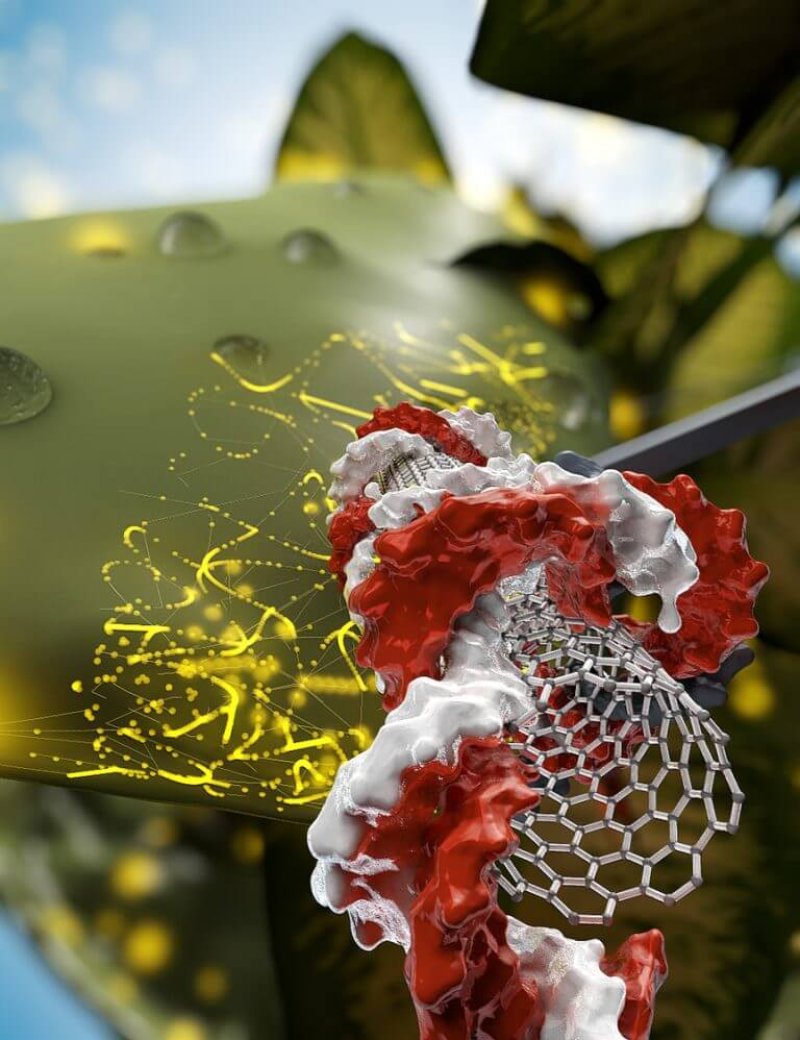
Nanotubes and CRISPR gene editing could make producing disease-resistant crops faster and cheaper

nanotubes x
Credit: UC Berkeley graphic by Ella Marushchenko

Inserting or tweaking genes in plants is more art than science, but a new technique developed by University of California, Berkeley, scientists could make genetically engineering any type of plant—in particular, gene editing with CRISPR-Cas9—simple and quick.

To deliver a gene, the researchers graft it onto a carbon nanotube, which is tiny enough to slip easily through a plant’s tough cell wall. To date, most genetic engineering of plants is done by firing genes into the tissue—a process known as biolistics—or delivering genes via bacteria. Both are successful only a small percentage of the time, which is a major limitation for scientists seeking to create disease- or drought-resistant crops….

The nanotube not only protects the DNA from being degraded by the cell, but also prevents it from being inserted into the plant’s genome. As a result, the technique allows gene modifications or deletions that in the United States and countries other than the European Union would not trigger the designation “genetically modified,” or GMO.

“….I think the major advances are going to be the ability to quickly and efficiently deliver genes to plants across species and in a way that could enable the generation of transgenic plant lines without integration of foreign DNA into the plant genome,” [said Markita Landry, a UC Berkeley assistant professor of chemical and biomolecular engineering.]

Read full, original article: With nanotubes, genetic engineering in plants is easy-peasy

{{ reviewsTotal }}{{ options.labels.singularReviewCountLabel }}
{{ reviewsTotal }}{{ options.labels.pluralReviewCountLabel }}
{{ options.labels.newReviewButton }}
{{ userData.canReview.message }}

Related Articles

Infographic: Global regulatory and health research agencies on whether glyphosate causes cancer

Infographic: Global regulatory and health research agencies on whether glyphosate causes cancer

Does glyphosate—the world's most heavily-used herbicide—pose serious harm to humans? Is it carcinogenic? Those issues are of both legal and ...

Most Popular

Picture1
The FDA couldn’t find a vaccine safety crisis, so it buried its own research
Screenshot-2026-04-22-at-12.21.32-PM
Viewpoint: Why the retracted Monsanto glyphosate study doesn’t change the science—the world’s most popular herbicide is safe 
ChatGPT-Image-May-7-2026-12_32_36-PM
Viewpoint: The state of U.S. vaccine policy? Dismal nationally, but some states are stepping up.
placebo
Viewpoint — Alternative medicine and the placebo effect: Selling a reassuring illusion of health
_20250221_nib_rfk_trump
Viewpoint: 'Crisis of public trust': Autism support community shocked RFK continues to peddle false claims about the danger of vaccines
ChatGPT-Image-May-18-2026-01_45_05-PM-2
Newest hantavirus conspiracy: Online disinformation turns outbreak into latest ivermectin grift
ChatGPT-Image-May-18-2026-12_06_18-PM-2
Defying death: The immortality movement goes mainstream
Screenshot-2026-04-13-at-1.39.26-PM
Viewpoint: ‘Safer for children?’ Stonyfield yogurt under fire for deceptive organic marketing
Screenshot-2026-04-22-at-10.46.29-AM
Viewpoint: How to counter science disinformation? Science journalist offers 12 practical tips
Defense_Secretary_Ash_Carter_tours_the_Microsoft_Cybercrime_Center_in_Seattle_March_3_2016
How criminals are using AI to target social media users and steal their money and confidential data
glp menu logo outlined

Get news on human & agricultural genetics and biotechnology delivered to your inbox.