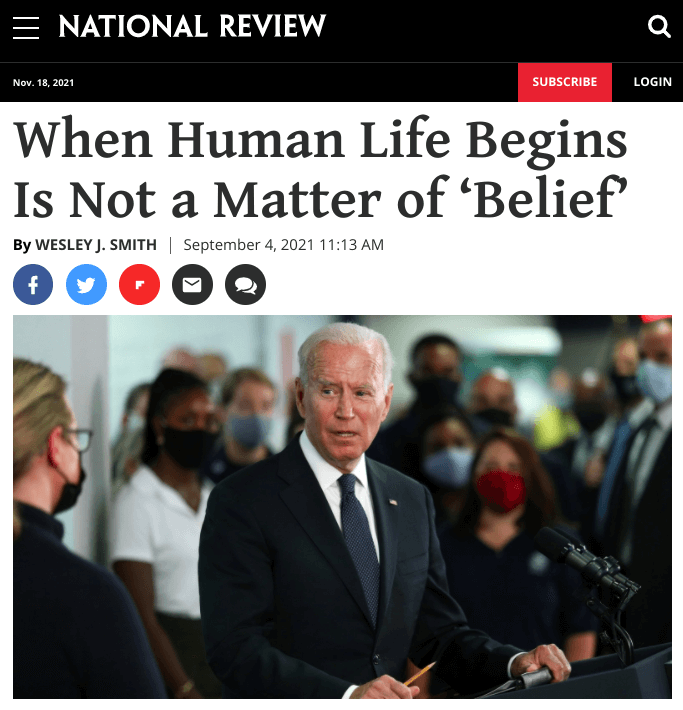
A particularly intriguing example appeared in a recent article by Wesley J. Smith in National Review entitled, “When Human Life Begins Is Not a Matter of ‘Belief.’” Smith suggests that President Biden was being irrational when he said, “I respect those who believe life begins at the moment of conception. I don’t agree, but I respect that.” The author contends that the moment at which life begins is not a question of “belief” but of “biological fact,” to which science has already provided the definitive answer. That just isn’t true. I’m not taking a stand here on the question of abortion, per se. I’m saying that a bioethical issue as complex as this one cannot be resolved simply by appealing to the “facts” of biology, even though people on both sides seem to think it can.
Smith’s article begins by conflating the question of when “life” begins with the question of when “human” life begins. These are different questions. So, let’s start with the former.
What is life?
The first chapter of every introductory biology textbook I’ve ever used includes a page (usually at the very beginning) entitled something like “What Is Life?” The page generally features about half-a-dozen pictures of plants and animals, each labeled with one of the (putative) definitive characteristics of all living things. These usually include: highly ordered structures, reproduction, growth and development, responses to the environment, energy processing, evolutionary adaptation, and systems regulation.
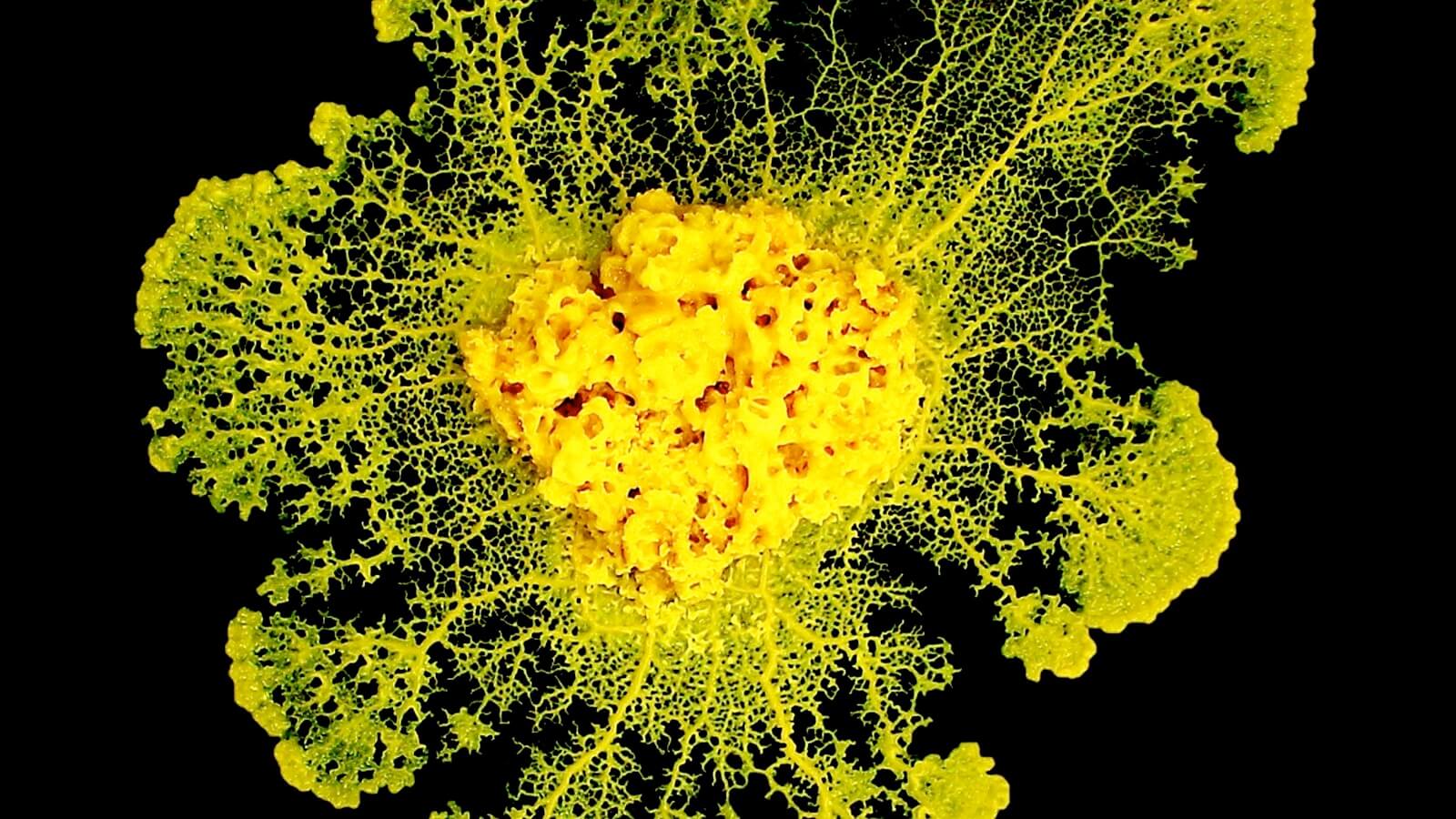
As I explain to my students, the problem is that some living things do not manifest all of these characteristics, and some things that are clearly not alive manifest most of them. For instance, some living organisms—sterile hybrids like mules, for instance—do not reproduce. But no one would say that a mule isn’t alive, right? Some organisms do not have highly ordered structures. Slime molds spend part of their lives as single-celled amoeba-like creatures. However, periodically, thousands of these cells merge to create a large, slug-like animal that crawls around looking for ground rich in nutrients. If you separate these individual free-living cells as they are merging, they will crawl back toward each other in an attempt to reform. Similarly, some sponges (which are definitely alive), can be completely dismantled into individual cells which will crawl back together and “rebuild” new sponges. Even the sponge itself, once reconstituted, is more like a colony of cells rather than an intact organism. This is not easily described as “orderly.” I’m not even sure whether to call these creatures “animals” or loosely organized “colonies.”
Conversely, many highly sophisticated robots display a number of the so-called characteristics of life (highly ordered structures, responses to the environment, energy processing, adaptation to the environment, regulation), but are clearly not “alive” as commonly understood. Although, based on a spate of recent articles dealing with the ethics of robotics, and the burgeoning field of Artificial Consciousness, the line is becoming harder to identify. Even more intriguing is research in the field of Synthetic Biology that is producing artificial cells that sit somewhere between living and nonliving systems, and are difficult to classify as either. These artificially created cells manifest most—if not all—of the characteristics that we generally use to define life. Are they alive? They could be.
When I pose these questions to my students, they arrive at two insightful conclusions. The first is that being “alive” is actually an “emergent” property of a complex “dynamic system,” not a rigidly defined characteristic of some specific entity. Put simply, as systems become more complex, they display new characteristics that aren’t evident in their component parts (or ingredients). So, when you take a bunch of dead ingredients and combine them in a particular way, you can end up with an artificial cell that displays all of the properties that we (even biologists) use to define life. But is the artificial cell only alive if it has all seven of the characteristics listed in my textbooks? What if it has only six? What if it has just a few, like a virus? Some scientists say viruses are dead because they can’t reproduce on their own (they need another living cell to do the genetic work for them). However, parasites can’t reproduce on their own either. They need other living hosts, too. But parasites are alive, aren’t they? So what’s the answer? Clearly, it doesn’t reside in the biology, per se. I know a lot about biology. I pretty much know the difference between a squirrel and a rock. However, I don’t see the bright line that separates the various entities that sit at the ambiguous edges of the concept, “alive,” such as viruses or artificially created cells with all of the constituents of a “naturally” derived cell.
It’s the same in robotics. If you watch a complex robot (it’s not alive, right?) interact with a human for a while, you will start to identify with the robot because of its behavior. You may even begin to feel sorry for it if a human is pushing it around. That is, you’ll automatically start to ascribe the characteristics of a living being to the robot despite the fact that you know full well it is not “alive.” Could a robot ever become sufficiently sophisticated to be self-conscious or “alive”? This remains a hotly debated question within the robotics field. I’m not sure.
The second conclusion my students offer is that there will always be ambiguity in edge cases. It can’t be avoided. As systems (whether they are cells or robots) become more complex, they will display emergent properties. When we see a sufficient number of these emergent properties, we make a somewhat arbitrary (and often very idiosyncratic) determination as to whether or not the system is “alive.”
We find the same problem at the other end of the spectrum when deciding whether or not a human being is dead. Here, we are deciding whether or not a sufficient number of emergent properties have disappeared to make the call. Is the person still breathing on their own, is there any electrical activity in the cerebral cortex, is the person responding to external stimuli? How many of these emergent properties have to disappear before we can say definitively that a person is dead? At some point we can be sure that they are not dead. At some point we can be sure that they are. However, there will always be some uncertainty between these two points.
Consequently, there will be differences of opinion on these matters. Whether we like it or not, the ambiguities are unavoidable. Some people will assess the laboratory-created artificial cell as alive because it does all the things that a biologically derived cell does. Some will not agree simply because it’s not a product of random biological (“natural”) events. I’m neutral on this point. But, what I do know, and what my students come to realize, is that the answer does not exist in the system itself. No matter how much the artificial cell is analyzed, dissected, probed, prodded, or debated, it will not provide a definitive answer. Nor will the robot.
When does human life begin?
The second and more interesting argument made in Smith’s article is that there is an unambiguous moment at which a fertilized living cell becomes an actual “human life.” That is, he claims to pinpoint the instant at which two cells that are clearly alive (the sperm and egg) combine to form something unequivocally identifiable as “human.” To repeat, I am not taking sides in the abortion debate here. But I want to take issue with the mistaken notion that such a clearly definable moment exists.
Of course, I fully understand the difference between a sperm and egg, on the one hand, and my 20-year-old son, Ben, on the other. At some point, the transition to an intact human being did indeed occur. However, I can’t tell you when exactly. Analogously, I can’t tell you the exact moment at which Ben became an adult. Clearly, it was not on the day of his 18th birthday. I’m fairly sure of that. Ben disagrees, and no amount of bickering about Ben’s biology is going to resolve that disagreement. The same situation pertains in the realm of human embryology. A transition from cells to intact human does indeed occur. But examining the facts of biology does not help us to determine when. That transition point is indeterminate along some dynamic continuum, just like Ben maturing over the years.
This reality notwithstanding, appealing to biology is a seductive strategy. In Smith’s National Review article, he offers a handful of quotes from a couple of embryology textbooks in support of his view. One quote states that human development is a “continuous process” which begins when a female’s egg is fertilized by a sperm, and the “embryo begins to develop as soon as the site is fertilized. … Human development begins at fertilization.” Another textbook advises that “life is a continuous process, fertilization [gives rise to] … a genetically distinct human organism” and “a zygote [fertilized egg] is the beginning of a new human being.” This seems pretty straightforward, doesn’t it? But where is the exact point along this “continuous process” at which the transition occurs?

The attempt to match the facts of biology with the inherent vagaries of language is always a no-win debate. Put simply, if you claim a particular biological event (“fertilization”) is the point at which human life begins, anyone with a different opinion and a more sophisticated understanding of biology can mount a pretty convincing argument to the contrary. In return, the even more sophisticated and knowledgeable biologist could counter. Hence, the unending debate will continue with no chance of resolution.
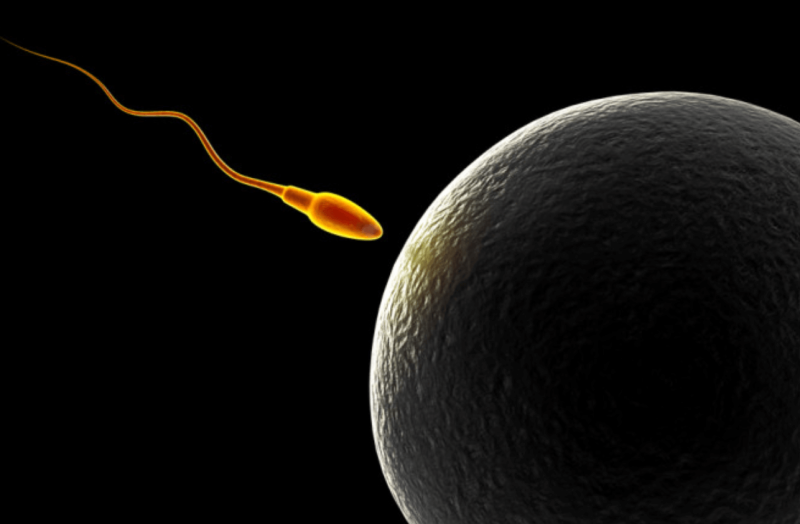
Let’s make the argument more concrete by looking at a few stages of the “fertilization” process. Of the several million human sperm that begin the journey to an egg, only a couple of hundred reach the site of fertilization in the fallopian tube. Once they find an egg, the sperm must migrate through the layer of follicle cells that surround it and bind to the egg’s outer coat, the zona pellucida. Is this the point of fertilization? Is it a human now? Maybe not. A sperm still has to make its way to, and bind with, the egg’s plasma membrane. Now? Not yet.
After fusion with the egg’s outer coat, the entire sperm is drawn head-first into the egg. Now we have what’s called a zygote. This is the stage we were confidently told “is a beginning of a new human being.” But fertilization is not complete yet. The egg, now with the sperm inside it, cannot produce a human being at this point. It has twice the proper amount of chromosomes, with which it cannot become a viable human embryo. First, it will have to divide in two and jettison half of its chromosomes. (This is called the extrusion of the second polar body.) Now is it human? Well, no. The sperm and egg nuclei haven’t fused yet.
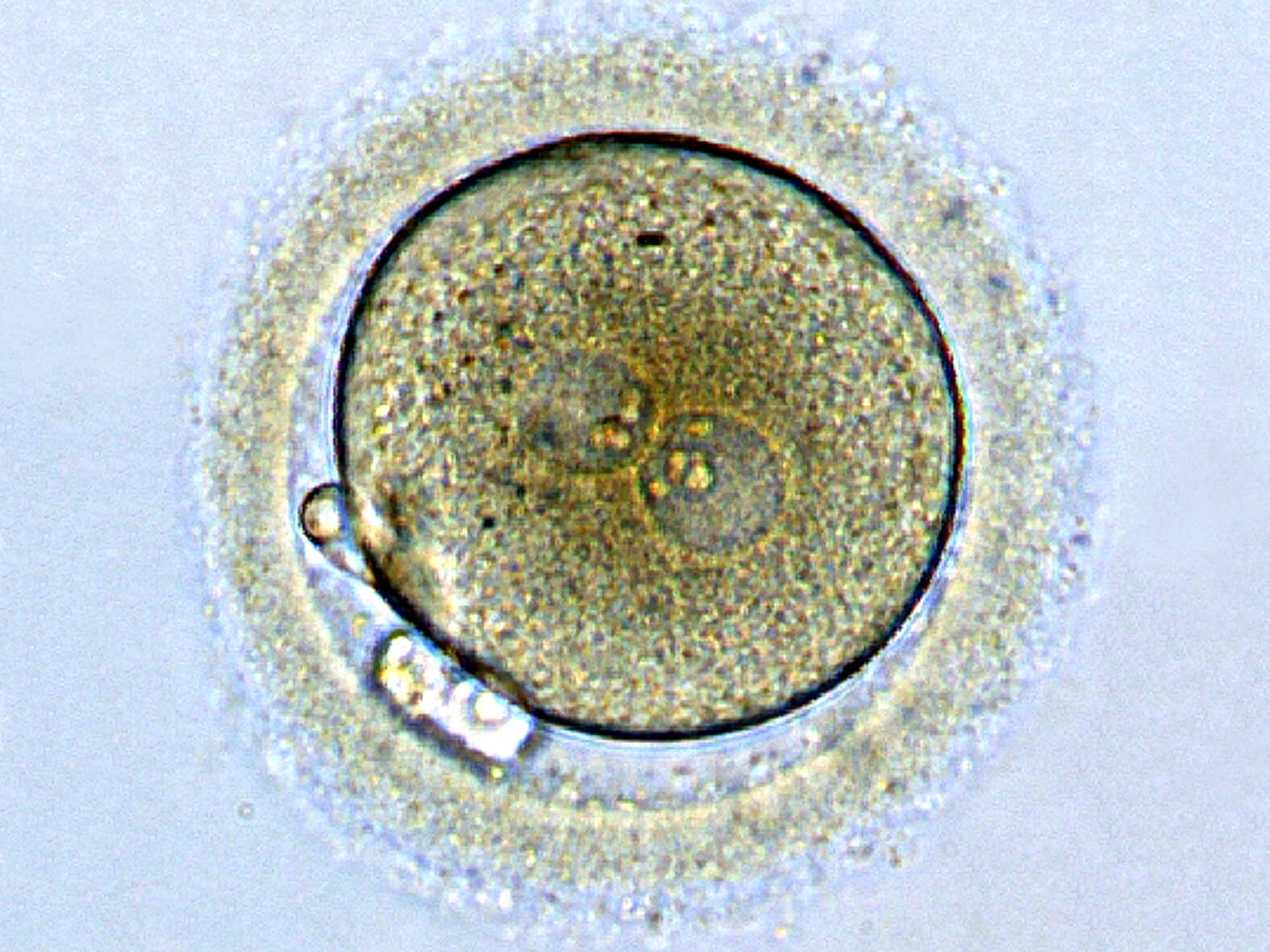
If this fertilized egg (at whatever point in time we want to claim fertilization is complete) doesn’t travel down the fallopian tube and implant in the uterus, it’s not going to develop into a viable human being. Can we still say it’s the beginning of human life even though it’s not going to develop? Let’s say it does successfully implant in the uterus but as the cells continue to multiply there’s an error in one cell’s division and part of a chromosome breaks off leading to a rapid deterioration of the fetus. At the point at which this genetic error (or lethal aneuploidy) occurs, has it lost its human status?
These are hard questions. Interestingly, even if the zygote implants successfully in the uterus, a large proportion of those cells are not going to be part of the infant, per se. They will become umbilical cord, placenta, and all of the extra-embryonic tissues that are the life-support system for the embryo. Since all of those other cells have exactly the same genetics as all of the cells in the embryo, and the embryo can’t live without them, do they share in the personhood ascribed to that smaller patch of cells that will eventually become the infant, sensu stricto?
This line of reasoning can be continued almost ad nauseam. Every arbitrary time point or criteria held to unequivocally establish “human life” can be met with objections justified with reference to biological “facts.” And the more details a participant in this debate knows about biology, the longer he can keep the argument going.
This is the same problem fueling the controversy over the so-called Texas Heartbeat Act. In this case, the inflection point has moved from the hypothetical moment of fertilization to the hypothetical moment that a “true heartbeat” is audible. But, is it a “heartbeat” or is it a “cardiac rhythm,” “fetal cardiac activity,” “a cluster of pulsing cells,” “a group of cells with electrical activity,” or “fetal pole cardiac activity”? Well, take your pick. All have some truth to them. All are arbitrary at some level. All can be nitpicked to death if you know enough about biology. In the end though, whatever you decide to call it does not settle the core issue.
Although, like Biden, I understand and respect Smith’s view, I do not agree with his claim that “The scientific fact [is] that life begins at conception.” Most of us would probably agree that both the sperm and the egg are “alive” prior to conception. As I’ve argued, however, the precise moment of conception is more ambiguous. I do, however, agree with his claim that knowing approximately when conception occurs “doesn’t settle the moral question of abortion.” That’s my point.
Conclusion
Biology cannot and does not reveal unambiguous truths that conveniently or reliably correspond to our political and ethical beliefs. There is always going to be ambiguity in defining precisely what “life” is, or the precise moment that “human life” begins. In fact, there are always going to be unresolvable ambiguities around the borders of all concepts. For instance, is a beanbag chair really a “chair”? It doesn’t have legs, but a person can sit in it. So, maybe. But maybe not. Is my son Ben a full-fledged adult? Well, it depends on which one of us you ask.
Claiming that biological terms are authoritative and unambiguous is either a misunderstanding of biology or a failure to appreciate the difficulties inherent in applying linguistic categories to natural phenomena. Biologists encounter the same difficulties when they try to define terms such as “species,” or “phylum.” And, of course, a similar controversy now revolves around “sex.”
The upshot is that appeals to some set of biological “facts” will never resolve the abortion issue or any analogous controversy. Biology is important, to be sure, and it can offer important guidance to our thinking. However, it simply cannot supply the definitive truths to which people then anchor their sociopolitical or ethical belief systems. If you look at a morula—a ball of 64 cells that may develop into a viable human—you may see something precious and divine with moral standing, or you may feel that under certain circumstances it can be removed from its biological moorings and discarded. Whichever position you adopt, no set of biological facts will change your mind.
Appealing to an ever-more detailed and obscure set of biological facts is both a fool’s errand and quite beside the point. And, to paraphrase Smith, it makes actual, meaningful debate impossible.
Frederick R. Prete is on the Biology faculty at Northeastern Illinois University. He studies the neurobiology of vision, and the use of haptics in mobility aids for children with visual impairments.
A version of this article was originally posted at Quillette and is reposted here with permission. Quillette can be found on Twitter @Quillette