Viewpoint: ‘I live in India and I am launching a civil disobedience movement against the moratorium on GMO insect resistant eggplant.’ Here’s why

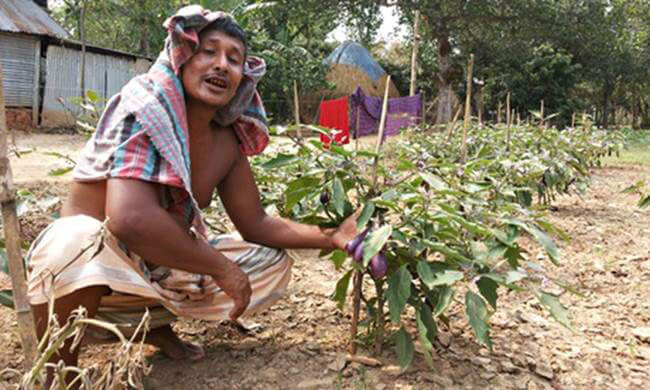
Credit: Arif Hossain

India’s farmers… need technological freedom. In my letter, I asked PM Modi to lift the 2010 moratorium on genetically modified (GM) crops by 16 February 2022.

Since that has not happened, today I will plant insect-resistant brinjal seedlings that incorporate Bacillus thuringiensis (Bt) genes on my farm to launch the ‘Feed India civil disobedience movement’ with the slogan: “biotechnology to feed India, natural farming to starve India”. I will also issue today a rationale in the form of a paper.

Follow the latest news and policy debates on sustainable agriculture, biomedicine, and other ‘disruptive’ innovations. Subscribe to our newsletter.

It’s no exaggeration to say that almost all Indians have consumed GM food at some point in their lives. Every year, over 1 million tonnes of cottonseed oil from GM-based Bt cotton (which constitutes 95 per cent of the cotton grown in India) is consumed domestically without any harmful effect. Farmers in Bangladesh have been growing Bt brinjal for the past seven years and consumers have benefited.

What, then, is the obstacle? Obscurantist forces — some funded by Greenpeace and others, our home-grown Ganesha-as-cosmetic-surgery fruitcakes — continue to spread lies. But India should know and understand that these people are implicated in millions of children going blind and dying early, and the continuing malnutrition in millions of Indians.


This is an excerpt. Read the original post here.

{{ reviewsTotal }}{{ options.labels.singularReviewCountLabel }}
{{ reviewsTotal }}{{ options.labels.pluralReviewCountLabel }}
{{ options.labels.newReviewButton }}
{{ userData.canReview.message }}

Related Articles

Infographic: Global regulatory and health research agencies on whether glyphosate causes cancer

Infographic: Global regulatory and health research agencies on whether glyphosate causes cancer

Does glyphosate—the world's most heavily-used herbicide—pose serious harm to humans? Is it carcinogenic? Those issues are of both legal and ...

Most Popular

ChatGPT-Image-May-7-2026-12_32_36-PM
Viewpoint: The state of U.S. vaccine policy? Dismal nationally, but some states are stepping up.
Screenshot-2026-04-13-at-1.39.26-PM
Viewpoint: ‘Safer for children?’ Stonyfield yogurt under fire for deceptive organic marketing
Screenshot-2026-04-22-at-10.46.29-AM
Viewpoint: How to counter science disinformation? Science journalist offers 12 practical tips
ChatGPT-Image-May-7-2026-12_16_37-PM-2
Viewpoint: Are cancer rates ‘skyrocketing’ as RFK, Jr. and MAHA claim? The evidence says mostly the opposite
the magic of mRNA
Viewpoint: Anti-vax fake ‘turbo cancer’ claims threaten cancer treatment breakthroughs
ChatGPT-Image-May-7-2026-01_23_27-PM-2
Viewpoint: Will AI democratize personalized cancer treatment or fuel medical misinformation?
Defense_Secretary_Ash_Carter_tours_the_Microsoft_Cybercrime_Center_in_Seattle_March_3_2016
How criminals are using AI to target social media users and steal their money and confidential data
artificial intelligence brain think illustration md
Viewpoint — Digital gods and human extinction: Will we be the first species ever to design our own descendants?
Picture1-1
Cooling the planet with balloons: Could a geoengineering gamble slow global warming?
Screenshot-2026-04-23-at-11.00.36-AM
Regulators' dilemma: Thalidomide, Metformin, and the cost of getting drug approvals wrong
ChatGPT Image May 12, 2026, 01_21_30 PM
How big health brands are funding online medical misinformation 
glp menu logo outlined

Get news on human & agricultural genetics and biotechnology delivered to your inbox.