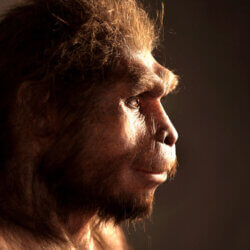
How climate chaos shaped human evolution

How chaotic climate impacted early humans
Credit: Shutterstock

Researchers have produced what they say is one of the first-ever continuous climate records from a proven habitat of ancient Homo sapiens.

The new 620,000-year history of hydroclimate at Chew Bahir, a playa lake in southern Ethiopia, showed that the local climate swung dramatically between wet and dry extremes. Shifts in the intensity and frequency of those swings seem to have occurred alongside, and perhaps even driven, major events in hominin evolution. The results were published in Nature Geoscience.

Follow the latest news and policy debates on sustainable agriculture, biomedicine, and other ‘disruptive’ innovations. Subscribe to our newsletter.

Chew Bahir’s climate 620,000 years ago was wet and mostly stable, punctuated by a handful of dry periods that each lasted about a thousand years. The team thought this pattern would have fractured early human habitats and isolated small groups, which could have driven the increase in anatomical diversity of hominins seen during this time.

Then, starting about 275,000 years ago, the swings between wet and dry conditions grew more frequent and intense. This chaotic climate would have changed too swiftly for biological evolution to keep pace—but cultural innovation could have. This period roughly corresponds to the emergence of better tools, long-distance transport, and symbolic use of pigment among local Homo sapiens populations.

This is an excerpt. Read the full article here

{{ reviewsTotal }}{{ options.labels.singularReviewCountLabel }}
{{ reviewsTotal }}{{ options.labels.pluralReviewCountLabel }}
{{ options.labels.newReviewButton }}
{{ userData.canReview.message }}

Related Articles

Infographic: Global regulatory and health research agencies on whether glyphosate causes cancer

Infographic: Global regulatory and health research agencies on whether glyphosate causes cancer

Does glyphosate—the world's most heavily-used herbicide—pose serious harm to humans? Is it carcinogenic? Those issues are of both legal and ...

Most Popular

Picture1
The FDA couldn’t find a vaccine safety crisis, so it buried its own research
Screenshot-2026-04-22-at-12.21.32-PM
Viewpoint: Why the retracted Monsanto glyphosate study doesn’t change the science—the world’s most popular herbicide is safe 
ChatGPT-Image-May-7-2026-12_32_36-PM
Viewpoint: The state of U.S. vaccine policy? Dismal nationally, but some states are stepping up.
Screenshot-2026-04-22-at-10.46.29-AM
Viewpoint: How to counter science disinformation? Science journalist offers 12 practical tips
Screenshot-2026-04-13-at-1.39.26-PM
Viewpoint: ‘Safer for children?’ Stonyfield yogurt under fire for deceptive organic marketing
the magic of mRNA
Viewpoint: Anti-vax fake ‘turbo cancer’ claims threaten cancer treatment breakthroughs
ChatGPT-Image-May-7-2026-12_16_37-PM-2
Viewpoint: Are cancer rates ‘skyrocketing’ as RFK, Jr. and MAHA claim? The evidence says mostly the opposite
placebo
Viewpoint — Alternative medicine and the placebo effect: Selling a reassuring illusion of health
Defense_Secretary_Ash_Carter_tours_the_Microsoft_Cybercrime_Center_in_Seattle_March_3_2016
How criminals are using AI to target social media users and steal their money and confidential data
ChatGPT-Image-May-18-2026-01_45_05-PM-2
Newest hantavirus conspiracy: Online disinformation turns outbreak into latest ivermectin grift
_20250221_nib_rfk_trump
Viewpoint: 'Crisis of public trust': Autism support community shocked RFK continues to peddle false claims about the danger of vaccines
artificial intelligence brain think illustration md
Viewpoint — Digital gods and human extinction: Will we be the first species ever to design our own descendants?
glp menu logo outlined

Get news on human & agricultural genetics and biotechnology delivered to your inbox.