
[B]ased on a survey of 37 000 consumers in 40 countries, [r]espondents are generally most interested in natural, locally produced, eco-friendly and organic claims. Trust and broader attitudes and beliefs regarding the environment play an important role in shaping consumers’ willingness to pay more for products with a sustainability claim. For most claims, willingness to pay is also higher among consumers with higher incomes and education. Even after controlling for these factors, there are significant differences among countries. In some countries, people are generally distrustful of claims, while in others people have greater trust. This suggests that consumer trust may be shaped less by the specifics of a claim and more by country-specific factors. This interpretation is consistent with data suggesting that consumers have only a limited understanding of what different claims mean.
- Changes in consumer behaviour could play an important role in improving the environmental sustainability of food systems, but there are many open questions around consumers’ beliefs,attitudes, and behaviours. This paper presents new cross-country evidence on how consumers interact with sustainability claims and labels on food products, based on survey responses of 37 000 consumers in 40 countries.
- Even well-known claims such as organic or natural tend to have a relatively low prevalence, when looked at across all food products and countries. However, some studies suggest that the market share for food products with environmental sustainability claims may be growing. Among the different food product claims that consumers may perceive as involving environmental sustainability, consumers in the surveys are generally most interested in natural, locally produced, eco-friendly (environmentally friendly), and organic claims.
- Several factors make it less likely that consumers will purchase products with sustainability claims. These are a lack of affordability (a high price of sustainable products relative to alternatives), confusion (e.g. unclear labeling) and a lack of understanding (consumers are not sure what sustainability features to look for), a lack of availability in the places where consumers typically shop, a lack of trust in the claims made on products, and broader attitudes and beliefs (e.g. a lack of interest in sustainable products).
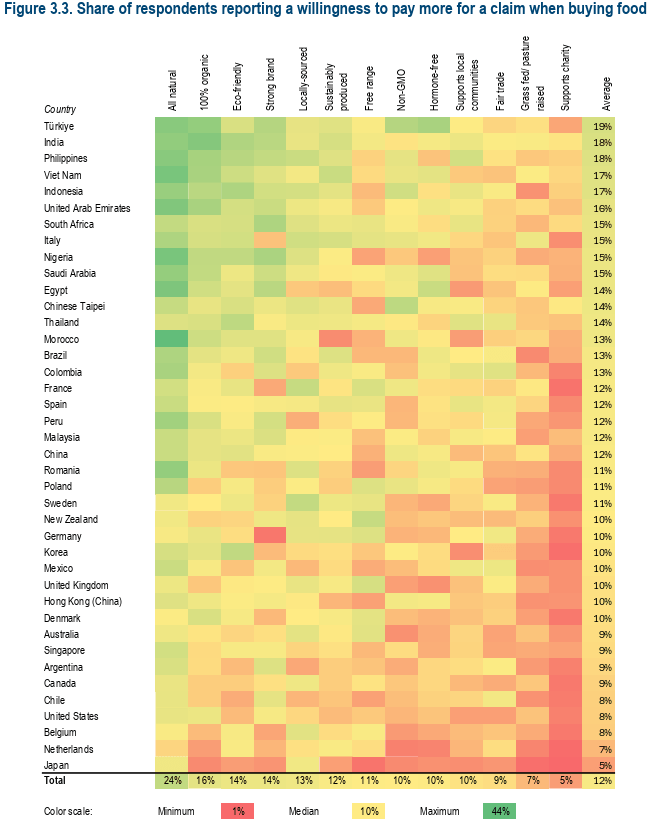
- Statistical analysis on survey responses of 37 000 consumers in 40 countries confirms that trust and broader attitudes and beliefs regarding the environment play an important role in shaping consumers’ willingness to pay more for products with a sustainability claim. For most claims, willingness to pay is also higher among consumers with higher incomes and education. Age differences were found for some but not all claims, while gender effects are generally quite small. Even after controlling for these factors, there are significant differences among countries.
- Consumers’ trust in claims is highly correlated within a country: in some countries, people are generally distrustful of claims, while in other countries people have greater trust. These findings suggest that consumer trust may be shaped less by the specifics of a label or assurance scheme and more by country-specific factors. This interpretation is consistent with data suggesting that consumers have only a limited understanding of what different claims mean.
Conclusion
The consumer survey used here asks which claims consumers look for when buying food, and for which claims they would be willing to pay more. On both questions, consumers are generally more interested in natural, locally produced, eco-friendly (environmentally friendly), and organic claims, as well as strong or well-known brands (as perceived by the respondent). There is much less interest in claims around support to charitable causes or grass fed production.




…
[T]he high correlation across the 40 countries of average levels of trust in organic claims and trust in natural claims (85%), despite the fact that organic claims are usually strictly regulated while natural claims are usually not regulated at all. These findings suggest that stricter standards, stricter audits or other actions by individual labels/assurance schemes play only a limited role in shaping consumer trust (and hence willingness to pay); trust may be shaped more by general factors in a country. This interpretation is consistent with data suggesting that consumers have only a limited understanding of what different claims mean.