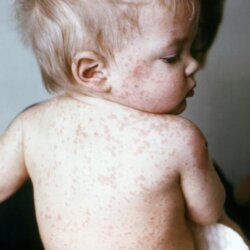
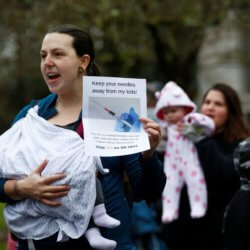
The ongoing measles outbreak in the U.S. has fueled intense speculation about how politics influences vaccine hesitancy. With over 1,200 confirmed cases reported across 37 jurisdictions by mid-2025, the outbreak underscores the reemergence of a disease once eliminated in the U.S. in 2000, largely due to declining vaccination rates. According to recent data from a Kaiser Family Foundation (KFF) Tracking Poll, a significant portion of Americans, particularly Republicans, are encountering and accepting misinformation about the measles, mumps, and rubella (MMR) vaccine. The poll indicates that 20 percent of Republicans and 21 percent of independents believe or lean toward the notion that the MMR vaccine is more dangerous than measles itself, compared to just 11 percent of Democrats. This dichotomy is also evidenced by 35 percent of Republicans and 26 percent of independents accepting the false link between the shot and autism, against only 10 percent of Democrats.
While these numbers suggest that partisanship is a useful metric for measuring vaccine hesitancy, zooming out and considering a broader context paints a different picture. The same polling data shows that, despite widespread exposure to false claims—such as the idea that vitamin A can prevent measles—83 percent of adults and 78 percent of parents remain confident in the MMR vaccine’s safety.
Moreover, less than five percent of adults say it’s “definitely true” that the MMR vaccine has been proven to cause autism, or that getting the measles vaccine is more dangerous than a measles infection. Finally, “much larger shares [of the public] say those same claims are ‘definitely false,'” KFF reported. Most Americans, whatever their political affiliation, are not anti-vaccine, with about half falling in the “malleable middle,” meaning they can be convinced to immunize their children.
This points to a potential but serious issue with politicized vaccine messaging. Research shows that amplifying vaccine hesitancy tends to encourage more of it; if the media reports that vaccine skepticism is commonplace, Americans are more likely to adopt that perspective. “The most powerful way to convince students to get vaccinated for influenza was telling them that a large proportion of fellow students had also opted for vaccination,” one analysis of vaccine-promotion strategies concluded. “There is considerable evidence that letting people know what other people do is one of the most effective ways of increasing that behavior,” the authors added.
In other words, since large majorities of the public and parents are “very” or “somewhat confident” that the MMR vaccine is safe, those facts should be stressed to the minority who are scared or skeptical of vaccines. Bottom line: politicizing vaccine hesitancy is a PR faux pas. Public health experts, physicians, and journalists should be encouraging all Americans to vaccinate their kids.
Join Dr. Liza Dunn and Cam English on this episode of Facts and Fallacies as they discuss the link between political partisanship and vaccine hesitancy.

Podcast: Play in new window | Download
Subscribe: RSS
Dr. Liza Dunn is a medical toxicologist and the medical affairs lead at Bayer Crop Science. Follow her on X @DrLizaMD
Cameron J. English is the director of bio-sciences at the American Council on Science and Health. Follow him on X @camjenglish