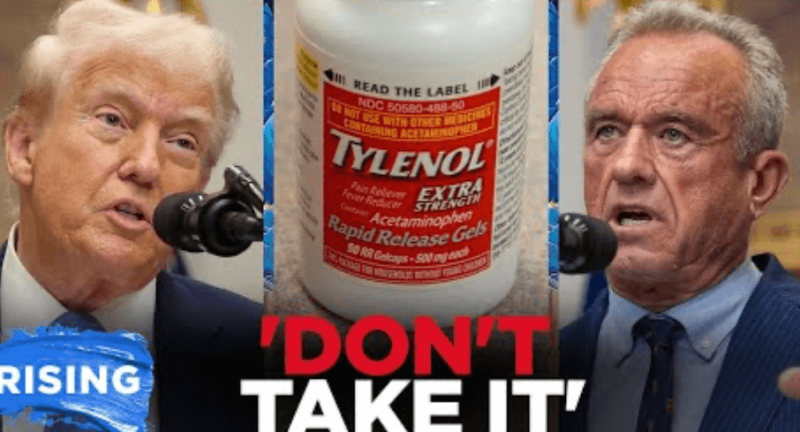
The past few weeks have been bruising for public health. First, Health and Human Services Secretary Robert F. Kennedy Jr., side-by-side President Trump — wrongly claimed that taking Tylenol during pregnancy has triggered an “autism epidemic.”
As if that weren’t damaging enough, just days later, in a talk at the United Nations, Kennedy rudely brushed aside the U.N. proposed declaration on cancer, diabetes, and non-communicable diseases, using the stage to push MAHA talking points.
“The United States will walk away from the declaration, but we will never walk away from the world or our commitment to end chronic disease,” he said. Spouting MAGA healthcare priorities, Kennedy then bashed the delegates and the U.N. for promoting abortion and “radical gender ideology.” He ended by torpedoing the declaration.
It was pure theater. The UN had not broached reproductive rights, let alone abortion or gender ideology. Kennedy’s solution for preventing diseases such as cancer and cardiovascular illnesses? Eat less ultra-processed food and ban synthetic dyes.
This is familiar territory. Earlier this year, Trump pulled the U.S. from the U.N.’s World Health Organization, accusing it of mishandling the coronavirus pandemic and of its supposed “failure to adopt urgently needed reforms.”
Such unwarranted abdications of science-based policy and international cooperation have left a significant gap in the United States’ ability to track and respond in a timely way to public health threats.
Filling the federal void
The dysfunction of U.S. domestic public health policy — and Washington’s resistance to international coordination — is poised to cost millions of lives. In response, a collection of professional societies has formed the Vaccine Integrity Project (VIP) to fill the leadership vacuum.
Led by independent experts such as University of Minnesota epidemiologist Professor Michael Osterholm, VIP has assumed the kind of data synthesis and risk-benefit analysis traditionally performed by the CDC’s Advisory Committee on Immunization Practices. In its first public session, the VIP walked thousands of physicians and state health officers through presentations about COVID-19, influenza, and RSV vaccines across age groups and pregnancy. Its conclusion was unequivocal: The benefits of vaccination far outweigh the risks, and no credible autism signal emerges from the data.
“We needed an analysis that wasn’t going to change because the politics changed,” Dr. Osterholm said.
With the project’s output — slides, transcripts, Q&A — the VIP has quickly become the de facto reference point for public health leaders who cannot wait for a politicized federal advisory committee to regain its footing. CIDRAP
During an August VIP webinar viewed by more than 9,000 people, researchers presented analyses of updated COVID-19 vaccines.
“What you’re about to hear is an analysis typically done by CDC,” Dr. Osterholm said.
State health officials tuned in to gauge whether Kennedy’s changes to guidance had any merit. “There weren’t new safety concerns,” said California’s public health director, Dr. Erica Pan, whose state is endorsing the recommendations of the American Academy of Pediatrics, the American College of Obstetricians and Gynecologists, and other professional groups, rather than the knee-capped CDC.
Budding initiatives
The backlash against the Trump administration has triggered one of the most consequential shifts ever in modern American public health: the rise of decentralized, science-first initiatives that operate outside and sometimes contradict the federal apparatus. Groups such as the VIP now provide practical, evidence-based guidance on disease prevention and other urgent health issues. States, too, are moving independently or banding together to fill the gap. Here are some examples:




| Coalition / Region | States Involved | What They’re Doing / How They Differ |
| West Coast Health Alliance | California, Oregon, Washington, Hawaii | Issued joint vaccine recommendations (for COVID-19, influenza, RSV) that go beyond or depart from CDC guidance. |
| Northeast Public Health Collaborative | Connecticut, Maine, Massachusetts, New York, New Jersey, Pennsylvania, Rhode Island (and NYC) | Voluntary coalition to coordinate vaccine recommendations, public health planning, data sharing, etc. |
| Individual States Breaking from FDA / CDC Restrictions | New York, Pennsylvania, Massachusetts, Colorado, New Mexico | These states have taken steps to maintain broader vaccine access (e.g., allowing pharmacists to vaccinate more broadly) even when federal restrictions would limit that access. |
The most decisive action has come from states intent on guaranteeing continuity. California, for example, enacted a statute requiring insurers to cover any vaccines endorsed by its own health department and empowering the department to publish state-level immunization schedules — explicitly “to protect access amid federal uncertainty.”
Within days, the department posted an updated page that directly countered Washington: reaffirming routine vaccines, clarifying RSV guidance, and pledging to “stand together” with the medical community to keep coverage intact. However, many states are unlikely to safeguard their populations so proactively and aggressively.
The response isn’t limited to state action. Academic centers are now live-streaming evidence reviews in real time, openly sharing their methods and warnings. Specialty societies are writing clinical guidance that pharmacies and pediatric practices can implement immediately.
A few individual academics are even helping to fill the void. Caitlin Collins, a professor at the Johns Hopkins Bloomberg School of Public Health and the director of the Center for Outbreak Response Innovation, has done a heroic job with her newsletter, Force of Infection. For the October 4th issue, for example, she and her team painstakingly searched state by state to check on the current activity of influenza, Covid-19, and RSV.
What was once, in effect, a single national operating manual — crafted by federal advisory committees and agency scientists and copied everywhere — is becoming a mosaic. For now, that diversity is a feature rather than a flaw.
In addition, organizations across the country are drafting contingency plans, anticipating that Kennedy may restructure the U.S. Preventive Services Task Force — whose recommendations determine which screenings insurers must cover. Without those guardrails, coverage for mammograms, colonoscopies, lung-cancer scans, and other tests could no longer be assured under private insurance, Medicare, or Medicaid.
In the era of Trump, Kennedy, FDA Commissioner Martin Makary, and their acolytes, the nation is witnessing the rise of state-driven and health professionals-led alternatives to federal healthcare recommendations and policies. These emerging networks—rooted in state health departments and professional societies — are becoming indispensable for physicians and patients who no longer trust and rely on federal pronouncements.
Fragmented future
The rise of a parallel public health-guidance system is unprecedented in modern U.S. history. It signals not only a collapse of trust in Washington’s leadership but also the resilience of professional networks determined to preserve evidence-based care.
Yet, fragmentation carries risks of its own. Patients may be forced to navigate conflicting messages from Washington, state agencies, newly-created independent health advisory associations, and their own doctors. Uneven access to trustworthy guidance could widen health disparities, leaving the most vulnerable populations exposed to preventable harm.
Still, a messy parallel system is preferable to passivity in the face of unscientific — and potentially dangerous — advice from federal officials. “If the official voice of public health is compromised, then the responsibility falls on us,” said one physician involved in the Vaccine Integrity Project.
The stakes are high. Vaccination schedules, cancer screenings, and even guidance on treating fevers during pregnancy may seem like narrow clinical issues, but they are among the cornerstones of modern preventive medicine. If they are undermined, the consequences could echo for decades. And they are only a symptom of a deeper government malaise: the failure to entrust public policy to evidence-driven leaders.
The parallel universe of public health may not yet match the federal government in scale, but its influence is growing. For doctors and patients searching for reliable guidance, it may offer the best hope in an era when science itself has become contested terrain.
Henry I. Miller, a physician and molecular biologist, is the Glenn Swogger Distinguished Fellow at the Science Literacy Project. A veteran of the NIH and FDA, he was the founding director of the FDA’s Office of Biotechnology. Find him on his website: henrymillermd.org