Neuroscience: What’s going on in your brain when you read Harry Potter?

nomabar guesswho harrypotter

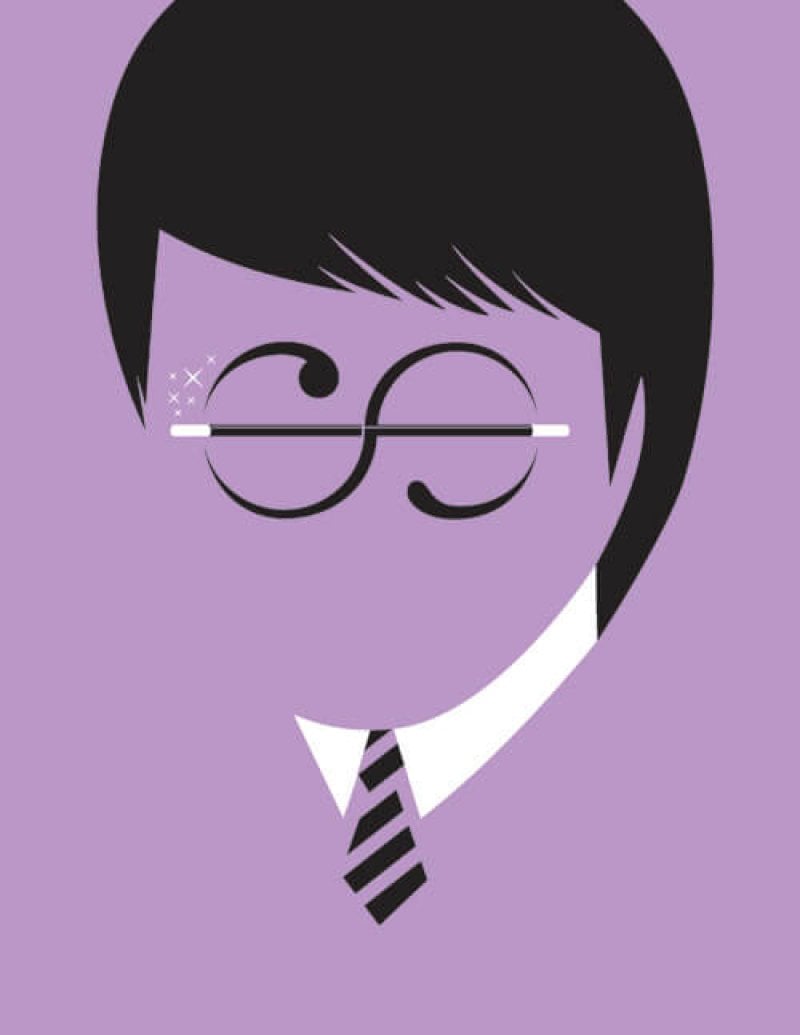
When reading about Harry Potter’s adventures fighting Lord Voldemort or flying around the Quidditch field on his broomstick, we can become so absorbed in the story that the characters and events start to feel real. And according to neuroscientists, there’s a good reason for this.

Researchers in the Machine Learning Department at Carnegie Mellon University scanned the brains of Harry Potter readers, and found that reading about Harry’s adventures activates the same brain regions used to perceive people’s intentions and actions in the real world.

The researchers performed fMRI scans on a group of eight study participants while they read chapter nine of Harry Potter and the Sorcerer’s Stone, which describes Harry’s first flying lesson. Then, they analyzed the scans, one cubic millimeter at a time, for four-word segments of the chapter in order to build the first integrated computational model of reading. The researchers created a technique such that for each two-second fMRI scan, the readers would see four words. And for each word, the researchers identified 195 detailed features that the brain would process. Then, an algorithm was applied to analyze the activation of each millimeter of the brain for each two-second scan, associating various word features with different regions of the brain.

Using the model, the researchers were able to predict which of two passages the subjects were reading with a 74 percent accuracy rate.

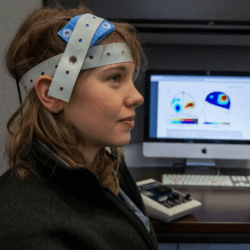
“It turns out that movement of the characters — such as when they are flying their brooms — is associated with activation in the same brain region that we use to perceive other people’s motion,” researcher Leila Wehbe, a Ph.D. student in the Machine Learning Department, said in a statement. “Similarly, the characters in the story are associated with activation in the same brain region we use to process other people’s intentions.”

Read full, original article: What Harry Potter Can Teach Us About Neuroscience

{{ reviewsTotal }}{{ options.labels.singularReviewCountLabel }}
{{ reviewsTotal }}{{ options.labels.pluralReviewCountLabel }}
{{ options.labels.noReviewsLabel }}
{{ options.labels.newReviewButton }}
{{ userData.canReview.message }}

Related Articles

Infographic: Global regulatory and health research agencies on whether glyphosate causes cancer

Infographic: Global regulatory and health research agencies on whether glyphosate causes cancer

Does glyphosate—the world's most heavily-used herbicide—pose serious harm to humans? Is it carcinogenic? Those issues are of both legal and ...

Most Popular

ChatGPT-Image-Jul-22-2026-09_13_07-AM
Viewpoint—The Strategic Litigation boom: Understanding the tightening coalition among NGOs, foundations, journalists, and tort lawyers
ChatGPT-Image-Mar-10-2026-01_39_01-PM
Viewpoint—“Miracle molecule” debunked: Why acemannan supplements don’t work
Screenshot-2026-07-07-at-12.55.44-PM
Viewpoint: Yes, we can adapt to a changing climate without devastating the environment and the economy
close up arabica coffee farmer s hands picking beans plant his farm colombia
Viewpoint: Why do so many ‘mainstream’ and ‘respected’ media outlets exaggerate climate change threats?
ChatGPT-Image-May-22-2026-10_26_09-AM
Trump-RFK, Jr. National Science Board firings: Accountability vs. partisan meddling
How to Include More Strawberries in Your Diet
Strawberries are berries—and 35 other surprising food and drink myths
diversity
We are entering a new era of personalized medicine—if you’re white
ChatGPT-Image-Jun-25-2026-12_23_17-PM
No, Bill Gates did not secretly engineer ticks to promote veganism
organic scaled
Facts & Fallacies podcast: Organic food cuts pesticide exposure? A response to Dr. Rhonda Patrick
ChatGPT-Image-Jul-6-2026-02_25_26-PM
40 million Americans take glucosamine. If you have memory loss, it could accelerate cognitive decline.

Sorry. No data so far.

glp menu logo outlined

Get news on human & agricultural genetics and biotechnology delivered to your inbox.