Slate: Anti-GMO activists say the darnedest things

When activist organizations issue over-the-top press releases or make non-scientific claims, I just shake my head, but unless I’m writing at length on a topic I don’t set out to debunk their claims. Activists gonna activate — and often that involves hyperbole, or outright distortion. Also, it’s risky for a journalist to spend time fact-checking activists, because it looks like you are shooting at the ambulance. A journalist is supposed to comfort the afflicted and afflict the comfortable, as Finley Peter Dunne put it.

As a result, the errors of NGOs go uncorrected, and the misstatements of activists unchecked. Until someone like Will Saletan comes and lays it out for everyone to see. Saletan has a barn-burner of a piece in Slate detailing how anti-GMO groups have flip-flopped their claims as the evidence changes.

For instance: anti-GMO groups first dismissed golden rice (engineered to deliver beta carotene and stop illness caused by vitamin A deficiencies) for having too little beta carotene. Then, when scientists fixed that problem, they warned that there was too much.

No doubt there’s plenty more to say. If Saletan turns this into a book, he should investigate those issues in full. I hope that he might also spend the time to detail the ways in which the pro-GMO lobby has been caught making ridiculous claims — I found one clear example of that.
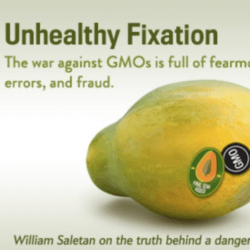

But I think the most valuable part of Saletan’s jeremiad is to clearly lay out the contradictory claims activists have made over the years. This piece is a chastening reminder that activists aren’t always driven to expose the facts, wherever those facts might lead. For some activists, the cause can trump the evidence.

The GLP aggregated and excerpted this blog/article to reflect the diversity of news, opinion and analysis. Read full, original post: Slate: Anti-GMO activists say the darnedest things

Related Articles

Infographic: Global regulatory and health research agencies on whether glyphosate causes cancer

Infographic: Global regulatory and health research agencies on whether glyphosate causes cancer

Does glyphosate—the world's most heavily-used herbicide—pose serious harm to humans? Is it carcinogenic? Those issues are of both legal and ...

Most Popular

Weed Killer, Gavel, and Cash on Wood Table
Who were the biggest winners in Bayer’s $7.25 billion glyphosate settlement? The tort lawyers, natch
Donkey Symbol Meets Speaking Politician
Democrats’ bid to win over MAHA voters faces a hard limit: Their loyalty to RFK Jr.
ChatGPT-Image-Mar-10-2026-01_39_01-PM
Viewpoint—“Miracle molecule” debunked: Why acemannan supplements don’t work
Screenshot-2026-11-24-at-11.07.44-AM
Here's a sure way to increase testosterone levels and jack up your sex drive
Screenshot 2026-11-23 at 11.51
Calley Means’ demonization of glyphosate is ‘just craziness’. Farmers are responding with science.
Glassy Molecules Above Floral Pads
Viewpoint: ‘Forever' PFAS chemicals in panty liners? The only ‘forever’ truth is endless lawsuits that do not protect women’s health 
Florida Varicella Vaccine Syringe Scene
Chickenpox, Hib, Pneumococcus, Hepatitis B: Florida poised to drop requirements for 4 life-protecting vaccines
Screenshot 2026-11-24 at 1.51
Viewpoint: Embrace aging and reject the longevity industry’s eternal-life delusion
Screenshot-2026-11-16-at-2.37.32-PM
30 years of GMO farming: Is the boom in glyphosate and glufosinate use harming the environment? Data show they’re the most sustainable choice
PFAS Molecules and Hazard Icons
Viewpoint: $$$ Billions of reasons why environmental activists are trying to slap a ‘killer PFAS’ label on many safe and essential ‘forever chemicals’
Pastel Breakfast Pedestals with Yogurt Bowl
RFK Jr. is about to issue an edict defining ultra-processed foods. What could go wrong?
Neon-AI-Globe-Network
Viewpoint: The three biggest threats posed by AI hyper-intelligence
glp menu logo outlined

Get news on human & agricultural genetics and biotechnology delivered to your inbox.