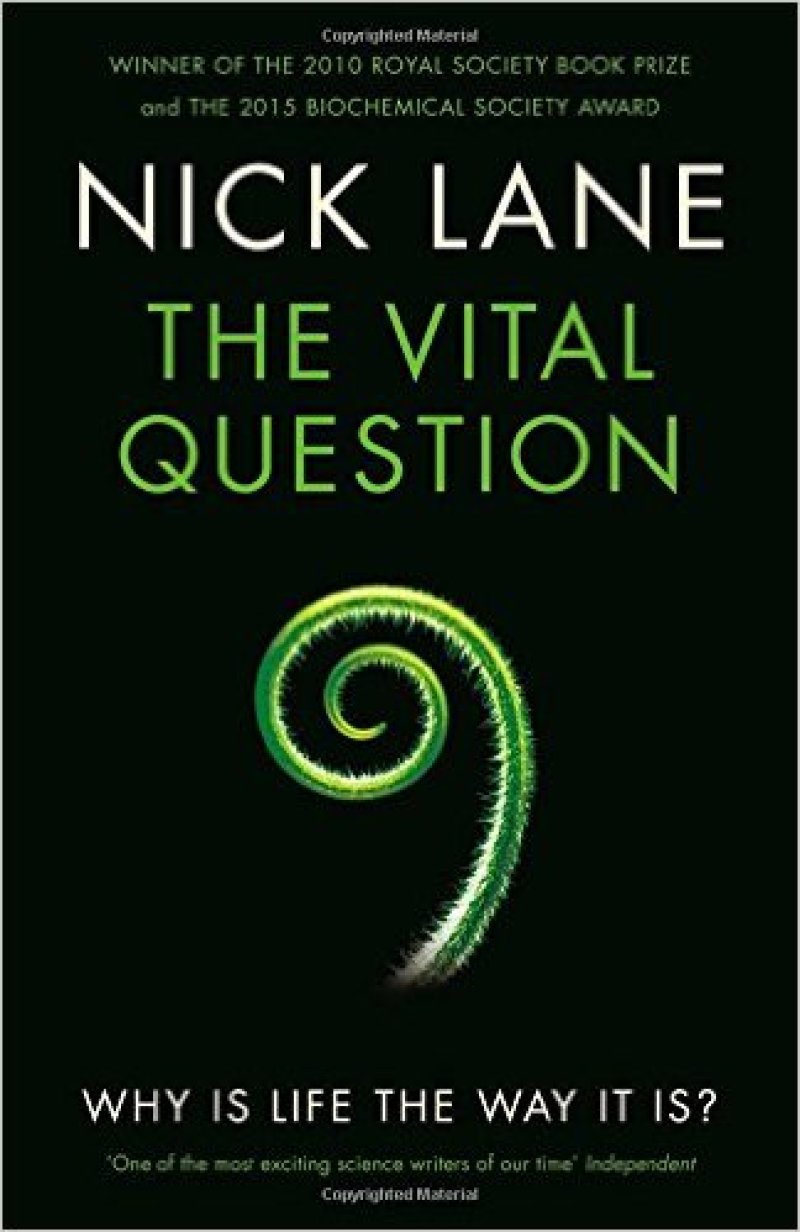
“The Vital Question” book explores evolutionary origins of life

m swNgFaL SX BO

How did rocks, air and water coalesce into the first living creatures on the primordial Earth? Why did complex life like animals and plants arise from a single ancestor only once in the history of our planet?

Why two sexes and not three or four or 12? Why do we age and die?

In “The Vital Question: Energy, Evolution, and the Origins of Complex Life,” Nick Lane sets out to answer these questions and many more with a novel suite of ideas about life’s emergence and evolution. Dr. Lane, a biochemist at University College London, argues that with just a few principles of physics, we can predict why life is the way it is — on Earth and in the rest of the cosmos.

Lane’s most surprising idea concerns how complex life arose. For most of Earth’s history, he notes, life was microbial: no trees, no mushrooms, no mammals. While microbes display astonishing biochemical diversity, thriving on anything from concrete to battery acid, they’ve never evolved into anything more complicated than a single cell.

So what made the great blooming of biodiversity possible?  Lane, building on ideas developed with the evolutionary biologist William Martin, traces its origins to a freak accident billions of years ago, when one microbe took up residence inside another. This event was not a branching of the evolutionary tree but a fusion with, he argues, profound consequences.

The GLP aggregated and excerpted this blog/article to reflect the diversity of news, opinion and analysis. Read full, original post:Taking on ‘The Vital Question’ About Life


{{ reviewsTotal }}{{ options.labels.singularReviewCountLabel }}
{{ reviewsTotal }}{{ options.labels.pluralReviewCountLabel }}
{{ options.labels.newReviewButton }}
{{ userData.canReview.message }}

Related Articles

Infographic: Global regulatory and health research agencies on whether glyphosate causes cancer

Infographic: Global regulatory and health research agencies on whether glyphosate causes cancer

Does glyphosate—the world's most heavily-used herbicide—pose serious harm to humans? Is it carcinogenic? Those issues are of both legal and ...

Most Popular

ChatGPT-Image-May-7-2026-12_32_36-PM
Viewpoint: The state of U.S. vaccine policy? Dismal nationally, but some states are stepping up.
Screenshot-2026-04-13-at-1.39.26-PM
Viewpoint: ‘Safer for children?’ Stonyfield yogurt under fire for deceptive organic marketing
Screenshot-2026-04-22-at-10.46.29-AM
Viewpoint: How to counter science disinformation? Science journalist offers 12 practical tips
the magic of mRNA
Viewpoint: Anti-vax fake ‘turbo cancer’ claims threaten cancer treatment breakthroughs
ChatGPT-Image-May-7-2026-12_16_37-PM-2
Viewpoint: Are cancer rates ‘skyrocketing’ as RFK, Jr. and MAHA claim? The evidence says mostly the opposite
Defense_Secretary_Ash_Carter_tours_the_Microsoft_Cybercrime_Center_in_Seattle_March_3_2016
How criminals are using AI to target social media users and steal their money and confidential data
artificial intelligence brain think illustration md
Viewpoint — Digital gods and human extinction: Will we be the first species ever to design our own descendants?
Picture1-1
Cooling the planet with balloons: Could a geoengineering gamble slow global warming?
ChatGPT-Image-May-7-2026-01_23_27-PM-2
Viewpoint: Will AI democratize personalized cancer treatment or fuel medical misinformation?
Screenshot-2026-04-23-at-11.00.36-AM
Regulators' dilemma: Thalidomide, Metformin, and the cost of getting drug approvals wrong
ChatGPT Image May 12, 2026, 01_21_30 PM
How big health brands are funding online medical misinformation 
glp menu logo outlined

Get news on human & agricultural genetics and biotechnology delivered to your inbox.