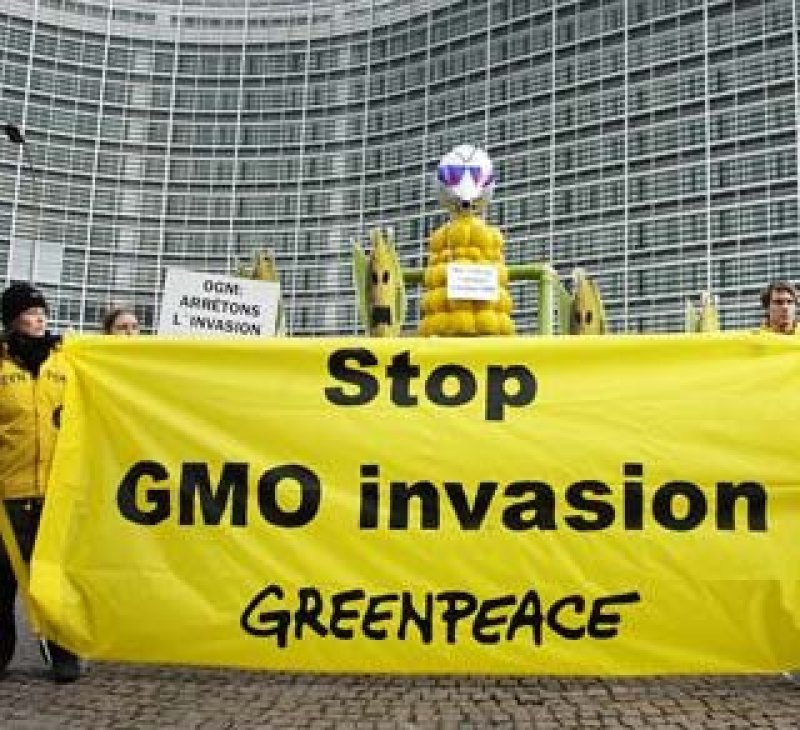
Nobel Laureate Richard Roberts: Greenpeace, green lobby spread ‘lies’ about GMOs to raise money

greenpeace stop gmo invasio e

Editor’s Note: This article discusses a recent talk by Sir Richard Roberts, awarded a Nobel Prize in Medicine for his contribution to the discovery of gene splicing, at Amity University. 

Activist organisations like Greenpeace and Vandana Shiva’s Navdanya have successfully blocked the introduction of genetically modified crops around the world. Bt Brinjal was banned in India, and activists are working to stop the introduction of genetically modified mustard.

Anti-GMO activists claim this process is unnatural and could produce unanticipated mutations that could be devastating for the planet.

But that’s not the case, said Sir Richard Roberts, Nobel Laureate. And banning GMOs means farmers can’t get access to the tools they need to cope with changing climate conditions, like hotter temperatures and droughts.

[India needs] better crops, you know? The monsoons are changing, you’re not getting the same rains you used to have, you’re going to need drought resistant crops, you’re going to need a lot of changes being made. You can’t do that through traditional breeding.

We now have 30 years of experience, we now know that it’s perfectly safe. There has not been one documented case of any problem, and there have been thousands upon thousands upon thousands of hectares of these crops. Not one incident.

These activists should admit that the science overwhelmingly indicates that GMOs are necessary to address the world’s agricultural and nutritional challenges, said Roberts.

The GLP aggregated and excerpted this blog/article to reflect the diversity of news, opinion, and analysis. Read full, original post: Greenpeace Lies About GMOs: Nobel Laureate Richard Roberts


{{ reviewsTotal }}{{ options.labels.singularReviewCountLabel }}
{{ reviewsTotal }}{{ options.labels.pluralReviewCountLabel }}
{{ options.labels.newReviewButton }}
{{ userData.canReview.message }}

Related Articles

Infographic: Global regulatory and health research agencies on whether glyphosate causes cancer

Infographic: Global regulatory and health research agencies on whether glyphosate causes cancer

Does glyphosate—the world's most heavily-used herbicide—pose serious harm to humans? Is it carcinogenic? Those issues are of both legal and ...

Most Popular

vax-misinformation-main
Facts & Fallacies Podcast: Limit free speech to blunt social media misinfo?
Picture1
The FDA couldn’t find a vaccine safety crisis, so it buried its own research
ChatGPT-Image-May-7-2026-01_23_27-PM-2
Viewpoint: Will AI democratize personalized cancer treatment or fuel medical misinformation?
ChatGPT-Image-Apr-16-2026-02_56_53-PM
Financial incentives, over diagnosis, and weak oversight: Autism claims are driving up Medicare costs
ChatGPT-Image-May-12-2026-11_27_01-AM-2
AI likely to improve health care, research shows—but not for blacks and ethnic minorities
Screenshot-2026-04-22-at-12.21.32-PM
Viewpoint: Why the retracted Monsanto glyphosate study doesn’t change the science—the world’s most popular herbicide is safe 
modi visit sikkim
Viewpoint: Indian PM wants farmers to switch to 50% organic. It would take at least 10 years, likely won’t work, and isn’t more sustainable
newborn infant baby mother
Sharp rise in number of parents refusing newborn vitamin K shots, putting babies at 81-fold higher risk of severe bleeding
Screenshot-2026-05-19-at-11.23.34-AM
West-originated vaccine disinformation sparks murders of health care workers across Africa
ChatGPT-Image-May-20-2026-04_53_21-PM-2
Viewpoint: Doctors can fight health misinformation — if hospitals let them
ChatGPT-Image-May-7-2026-12_32_36-PM
Viewpoint: The state of U.S. vaccine policy? Dismal nationally, but some states are stepping up.
Screenshot-2026-05-18-at-3.04.37-PM-2
Social media’s health advice red flags
Screenshot-2026-04-13-at-1.39.26-PM
Viewpoint: ‘Safer for children?’ Stonyfield yogurt under fire for deceptive organic marketing
glp menu logo outlined

Get news on human & agricultural genetics and biotechnology delivered to your inbox.