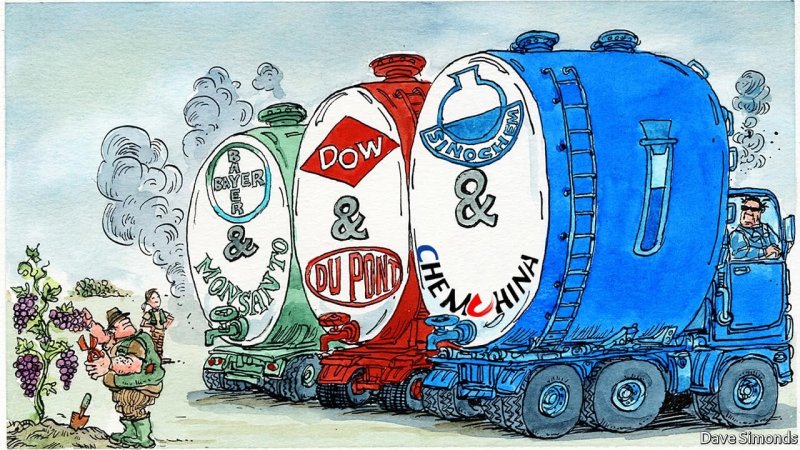
What’s driving the wave of agrichemical company mergers?

WBD

After a decade without any big deals, since 2015 three mega-mergers, collectively worth around $240bn, have been proposed. When they were first announced, many doubted that regulators would allow the mergers because of competition worries. If all three proceed, as now seems likely, four companies will produce 70% of the world’s pesticides instead of six today.

Dealmaking has now spread from agrichemicals to the rest of the industry, particularly to “specialty” firms that make chemicals for niche uses.

The main impetus has been a dramatic slowdown in the growth of demand across all types of chemicals, says P.J. Juvekar of Citigroup, a bank. In the 2000s sales expanded at a rate of 6-7% a year, but last year the industry grew by just 2%, with demand from China very weak. Executives are hoping to use scale to cut costs.

The soaring cost of developing and testing new chemicals is another factor, says Kurt Bock, CEO of BASF, a German chemicals giant. The average cost of developing a new active substance has shot up from $150m in 1995 to over $500m in Europe today; most of that goes on testing for safety.

The GLP aggregated and excerpted this blog/article to reflect the diversity of news, opinion, and analysis. Read full, original post: Why companies in the chemicals industry are mixing

{{ reviewsTotal }}{{ options.labels.singularReviewCountLabel }}
{{ reviewsTotal }}{{ options.labels.pluralReviewCountLabel }}
{{ options.labels.noReviewsLabel }}
{{ options.labels.newReviewButton }}
{{ userData.canReview.message }}

Related Articles

Infographic: Global regulatory and health research agencies on whether glyphosate causes cancer

Infographic: Global regulatory and health research agencies on whether glyphosate causes cancer

Does glyphosate—the world's most heavily-used herbicide—pose serious harm to humans? Is it carcinogenic? Those issues are of both legal and ...

Most Popular

Screenshot-2026-07-09-at-1.09.25-PM
Anti-vaccine myths rattle health care
ChatGPT-Image-Mar-10-2026-01_39_01-PM
Viewpoint—“Miracle molecule” debunked: Why acemannan supplements don’t work
Picture1
Hiroshima at 81: America’s new nuclear bomb, a buried Iranian target, and a question no one wants to ask
ChatGPT-Image-Jul-10-2026-12_21_03-PM
Viewpoint: Is there new evidence that the animal deworming drug ivermectin decreases the risk of Covid and cancer? Don’t waste your money.
ChatGPT-Image-Jun-25-2026-12_23_17-PM
No, Bill Gates did not secretly engineer ticks to promote veganism
leeteam
How Kennedy and his family could pocket millions from Merck’s $50 million vaccine injury settlement that he oversaw
ChatGPT Image Jul 29, 2026, 05_50_04 PM
Fear, science, and the law: If talc powder is unlikely to cause cancer and J&J was winning in court, why did it pay more than $5.5 billion to settle?

Sorry. No data so far.

glp menu logo outlined

Get news on human & agricultural genetics and biotechnology delivered to your inbox.