3D printed brain-like tissue made from stem cells offers hope to address neurological disorders

x large
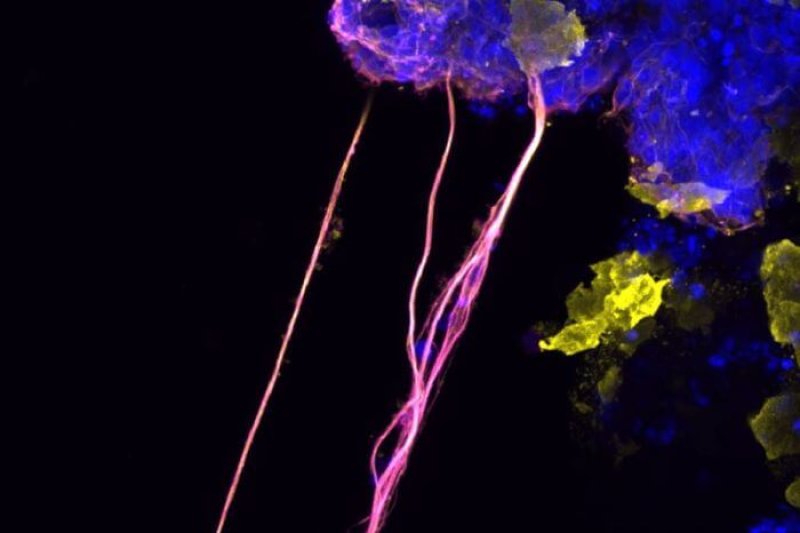
Delicate neurones created by 3D printing/Advanced Healthcare Materials)

Scientists in Australia have used a 3D printer to create nerve cells found in the brain using a special bio-ink made from stem cells.

The research takes us a step closer to making replacement brain tissue derived from a patient’s own skin or blood cells to help treat conditions such as brain injury, Parkinson’s disease, epilepsy and schizophrenia.

The bio-ink is made of human induced pluripotent stem cells (iPSC), which have the same power as embryonic stem cells to turn into any cell in the body, and possibly form replacement body tissues and even whole organs.

x large x
3D printing with bio-ink (ABC News)
[Jeremy Crook from the University of Wollongong stated] many neuropsychiatric disorders result from an imbalance of key chemicals called neurotransmitters…For example, he said, defective serotonin and GABA-producing nerve cells are implicated in schizophrenia and epilepsy…[Thus] the team used 3D printing to make neurones involved in producing GABA and serotonin….

Apart from providing customized transplants, 3D printed tissue could be useful for medical research.

For example, tissue from a patient with epilepsy or schizophrenia could be created, specifically to study their particular version of the condition.

“You can compare how neuronal networks form differently compared to healthy patient,” said Dr Crook.

[Read the full study here]

The GLP aggregated and excerpted this blog/article to reflect the diversity of news, opinion, and analysis. Read full, original post: Scientists create 3D-printed brain-like tissue from stem cells

{{ reviewsTotal }}{{ options.labels.singularReviewCountLabel }}
{{ reviewsTotal }}{{ options.labels.pluralReviewCountLabel }}
{{ options.labels.newReviewButton }}
{{ userData.canReview.message }}

Related Articles

Infographic: Global regulatory and health research agencies on whether glyphosate causes cancer

Infographic: Global regulatory and health research agencies on whether glyphosate causes cancer

Does glyphosate—the world's most heavily-used herbicide—pose serious harm to humans? Is it carcinogenic? Those issues are of both legal and ...

Most Popular

Screenshot-2026-05-01-at-1.29.41-PM
Viewpoint: What happens when whole grains meet modern food manufacturing? Labels don’t tell the whole story.
S
As vaccine rejectionism spreads, measles may be taking a more dangerous turn
Screenshot 2026-05-06 at 2.56
Singularity crisis ahead? Can super babies save us from rogue AI geniuses?
Screenshot-2026-05-06-at-2.07.43-PM
Manufacturing a conspiracy: The timeline of how  the White House embraced the fringe claim that scientists are being mysteriously murdered
Screenshot-2026-04-20-at-2.26.27-PM
Viewpoint — Food-fear world: The latest activist scientists campaign: Cancer-causing additives
Screenshot-2026-03-13-at-12.14.04-PM
The FDA wants to make many popular prescription drugs OTC—a great idea. Here’s why it’s unlikely to happen
Screenshot-2026-04-30-at-2.19.37-PM
5 myths about summer dehydration that could damage your health — or even kill you
ChatGPT-Image-May-6-2026-03_41_05-PM
‘Protecting the integrity of science’: Kennedy’s FDA blocks release of taxpayer-funded studies finding COVID and shingles vaccines safe
Screenshot-2026-05-01-at-11.56.24-AM
‘Science moves forward when people are willing to think differently’: Memories of DNA maverick Craig Venter
Screenshot-2026-04-03-at-11.15.51-AM
Paraben panic: How a flawed study, media hype, and chemophobia convinced the public of the danger of one of the safest classes of preservatives
79d03212-2508-45d0-b427-8e9743ff6432
Viewpoint: The Casey Means hustle—Wellness woo opportunism dressed up as medical wisdom
glp menu logo outlined

Get news on human & agricultural genetics and biotechnology delivered to your inbox.