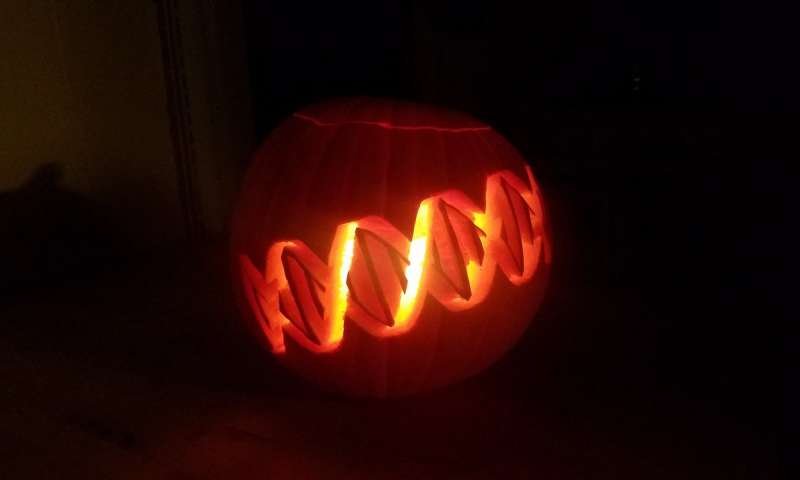
Just in time for Halloween: Scientists successfully sequence pumpkin genomes

pumpkingenom
Credit: Alexa Schmitz

Scientists … have sequenced the genomes of two important pumpkin species, Cucurbita maxima and Cucurbita moschata.

The finished genomes appear in the October issue of Molecular Plant, which highlights the work on its cover.

“Pumpkins are used as a staple food in many developing countries and are cultivated all over the world for their culinary and ornamental uses,” said Zhangjun Fei, associate professor at [Boyce Thompson Institute], Cornell adjunct associate professor of plant pathology and a senior author of the paper. Over two-thirds of the world’s pumpkins, squash and gourds are produced in Asia alone.

The researchers sequenced the two different pumpkin species to better understand their contrasting desirable traits: Cucurbita moschata is known for its resistance to disease and other stresses, such as extreme temperatures, while C. maxima is better known for its fruit quality and nutrition.

Once deciphered, the genome sequences are an important resource for further scientific research and breeding of Cucurbita crops. By analyzing the genomes, researchers will be able to identify many genes associated with the pumpkin’s desirable traits, and better understand the genetics behind the extreme phenotypes of the ‘Shintosa’ hybrid.
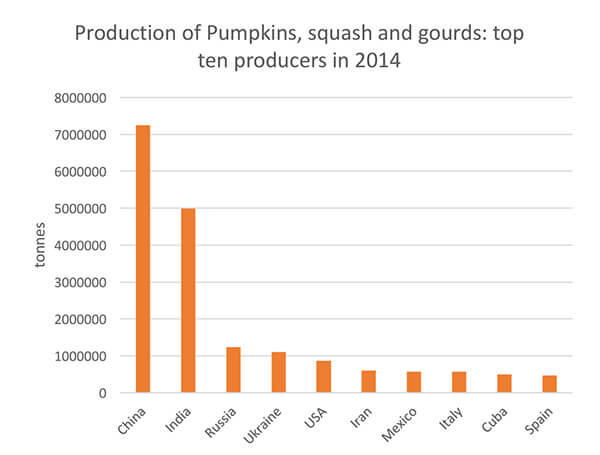
Pumpkin graph

The GLP aggregated and excerpted this article to reflect the diversity of news, opinion and analysis. Read full, original post: Pumpkin genomes sequenced revealing uncommon evolutionary history

{{ reviewsTotal }}{{ options.labels.singularReviewCountLabel }}
{{ reviewsTotal }}{{ options.labels.pluralReviewCountLabel }}
{{ options.labels.newReviewButton }}
{{ userData.canReview.message }}

Related Articles

Infographic: Global regulatory and health research agencies on whether glyphosate causes cancer

Infographic: Global regulatory and health research agencies on whether glyphosate causes cancer

Does glyphosate—the world's most heavily-used herbicide—pose serious harm to humans? Is it carcinogenic? Those issues are of both legal and ...

Most Popular

Screenshot-2026-05-01-at-1.29.41-PM
Viewpoint: What happens when whole grains meet modern food manufacturing? Labels don’t tell the whole story.
S
As vaccine rejectionism spreads, measles may be taking a more dangerous turn
ChatGPT-Image-Apr-13-2026-02_20_22-PM
Viewpoint: Misinformation infodemic? Why assessing evidence is so challenging 
Screenshot-2026-04-20-at-2.26.27-PM
Viewpoint — Food-fear world: The latest activist scientists campaign: Cancer-causing additives
ChatGPT-Image-Mar-27-2026-11_47_30-AM-2
FDA’s expedited drug reviews are hailed in some quarters but other approval practices are problematic
Screenshot-2026-03-13-at-12.14.04-PM
The FDA wants to make many popular prescription drugs OTC—a great idea. Here’s why it’s unlikely to happen
bigstock opioids on chalkboard with rol
GLP podcast: 'Safe injection sites': enabling drug addiction or saving lives?
circular-bioeconomy-should-focus-on-sustainable-wellbeing
GLP podcast: What's wrong with 'doomsday' environmentalism? It's false.
Farmers can talk to plants
Farmers are a major source of misinformation—about farming

Sorry. No data so far.

glp menu logo outlined

Get news on human & agricultural genetics and biotechnology delivered to your inbox.