What’s the most sustainable cover crop? It’s not mixture but monoculture

species cover crop mixture

Research thus far has consistently found that cover crop polycultures are not necessarily better than cover crop monocultures. This is now reaffirmed by a large study, done in Pennsylvania, published [late last] year (Finney et al. 2016).

The big idea behind cover crop mixtures is that the increased biodiversity will result in increased productivity, increased ecosystem services, or both. The Finney group tested both hypotheses. They found that the mixtures produced less biomass than the best monocultures … They also found that mixtures did not provide increased ecosystem services…. Finney et al. found that most of the ecosystem services which we want cover crops to provide are related to biomass production. … From this they concluded that “a mixture may not be necessary” and “a single cover crop species may be sufficient and more economical than a mixture.”

Mixtures do have one advantage, they can provide more services (multifunctionality) than a monoculture. However, in mixtures, the level of individual services provided is less than with a monoculture.

. . . .

Why don’t cover crop mixes work better than monocultures? Well, first, some ecological theory. The idea that biodiversity is better than monoculture comes from ecologists studying natural habitats. In nature, they observe niche differentiation (Connor et al. 2011). The idea is that a diverse mix of organisms can better use the available resources because of their different use characteristics. When their resource use does not overlap much, they are complementary.

The authors of this paper ask, “how can species be ‘complementary’ in their use of resources and production of biomass, and yet, a diverse community not perform processes any more efficiently than its most efficient species?” The simple answer is that there is no complementarity in these diverse mixes. …. Rather than complementarity, there are simple tradeoffs.

Any cover crop can do some good. If you like planting polycultures, do it. But don’t let the appeal of the silver bullet, of the secret solution, cloud your judgement. Novelty entices the most sober-minded of us into thinking “this is it.” …  as science is confirming, cover crop mixes are not the restore-everything-to-as-it-should-be final solution we hope for.

The GLP aggregated and excerpted this blog/article to reflect the diversity of news, opinion and analysis. Read full, original post: Cover crop best bet is monoculture, not mixture

Greenpeace’s ‘populist’ anti-GMO campaign is ‘post-truth’

Unknown
[Editor’s Note: This excerpt was translated into English by Google Translate and lightly edited for clarity.]

This year the Foundation of Urgent Spanish (Fundeu) has chosen “populism” as the word of the year. [Environmentalists’ anti-GMO policy] could be described as populist, but in the worst meaning of the term, the one that connects it with demagogy. Not for nothing other candidate words have been “cuñadismo” (pretend to know everything and want to impose your opinion) and post-truth  (that objective data are less important than your vision). It seems that this year Fundeu has been inspired by the Greenpeace transgenics campaign, since “populism” and many of the finalists can be used to define it. …

…[T]he tactics they have used GMO in these 20 years is to ignore reality and convey a message that is absolutely false…. You can see all the figures here, the GMO industry is transparent like few others. You will see that if we consider the global acreage of the last 20 years, the area planted this year is the third highest. Looking at it as a whole the trend is still bullish.  So the only ones who have the power to dictate the end of GMOs are not Greenpeace … but farmers. …  And I have predicted that GMOs will only leave the field when better varieties appear, possibly using CRISPR /Cas9.

The GLP aggregated and excerpted this blog/article to reflect the diversity of news, opinion and analysis. Read full post translated into English by Google Translate: Greenpeace, transgenics and after truth

Read full post in original Spanish: Greenpeace, transgénicos y posverdad

Ghana’s new guidelines on GMOs could speed release of water-efficient rice, pest-resistant cowpea

Screen Shot at PM

Ghana’s National Biosafety Authority (NBA) … issued guidelines for the release of genetically modified organisms (GMOs) [in December], a landmark step forward for modern biotechnology in the country.

“With these guidelines issued, Ghana can become a model in Africa,” said Eric Okoree, chief executive officer of the NBA. “We are telling the world, and Ghanaians, that we have opened the door and we are making ourselves open and ready to receive and consider applications for GMO use.”

. . . .

The document is the result of over six months of extensive consultation with partner institutions and technical experts in biosafety and biotechnology. …The guidelines seek to eliminate the uncertainties around GMO use by providing a clearer process for application, review, and approval/rejection by the NBA. …

To date, no GM crops have been approved or registered for cultivation, import, or marketing in Ghana. Field tests are ongoing for some transgenic crops, such as Nitrogen-Use Efficient, Water-Use Efficient and Salt-Tolerant (NEWEST) rice and Bt cowpea. The guidelines could provide a basis for finally releasing them to the public.

The GLP aggregated and excerpted this blog/article to reflect the diversity of news, opinion and analysis. Read full, original post: Ghana’s bold bet on biosafety

Talking Biotech: Kentucky’s Paul Vincelli, Florida’s Kevin Folta: Drop ‘GMO’ to improve public discourse on biotech

OCA to Warren Udall Voluntary GMO labeling helps biotech industry not consumers

I’ll always remember 2016 as an eclectic mix of hell and success.  We learned a lot about how to engage the public and got lots of practice. We took a lot of heat, suffered lots of personal and professional damage and defamation. We got through it by telling the truth, being soft, and enjoying a conversation about science with the world’s experts. Ultimately the efforts led to wonderful recognition that maybe provided a better conduit for the message.

But what can we do better in 2017? Today’s podcast provides that guidance. What are the resolutions we can make now that can serve as helpful guidelines in improved communications in the new year? With guest Paul Vincelli @Pvincell

Follow Kevin Folta on Twitter and Facebook

Stitcher | iTunes | Player FM | TuneIn

Visit Kevin Folta’s Talking Biotech

Farmers criticize use of non-GMO labels

non gmo label e

I’ve committed myself to the same job that tens of thousands of other farmers have committed to as well. It is about pride of care, quality and constant betterment. But most of all, it’s about pride in the product that goes out of my driveway.

That means that I’m willing to back up everything that leaves this farm. Whether that’s a wagon full of soybeans, truck full of a corn, or tanker full of milk. All of it, I stand behind.

On the livestock side, farmers choose to give a sick animal an antibiotic to help it get healthy, and then wait a set number of days, weeks or months before sending it to market to ensure that none of the antibiotic residue is still there….For hormones, only one animal in this country can use growth hormones, a beef animal. If a farmer chooses to do that, they’ve chosen to implant a small tic-tac sized pill under the animal’s ear several months before sending it to market, so that it will take less feed and less water to produce every pound of beef. That also means greenhouse gas emissions are reduced. (I’ve talked about these in more detail in the past, available here.)

Bottom line, I trust these tools that have been used for decades and I trust the farmers that use it.

As for the GMO debate, we too grow some GMO crops. If I didn’t, I’d have to cultivate my soil more often in order to reduce weeds from taking over a healthy food crop. I save hundred of litres of diesel fuel from burning with that move. Some then worry about pesticides being sprayed on GMO crops. Unfortunately for them, the fact is almost every crop, whether it is a GMO or not, organic or not, livestock feed or human food, all gets sprayed with a pesticide. If we didn’t, weeds would strangle out some of the crop, insects would feast on what did grow, and fungal diseases would kill out what was left….Plus, hundreds of organizations from the World Health Organization to the Food & Drug Administration…agree that through the approval process that is in place to get GMO seeds to market, they are proving to be as safe as non-GMO seeds and do not pose a public health concern….

The GLP aggregated and excerpted this blog/article to reflect the diversity of news, opinion, and analysis. Read full, original post: Why Farmers Take the “Non-GMO Project Verified” Label Personally

Crops raised for industrial meat production contribute to unsustainable agriculture practice

cattle feed lot hero e

The way we eat in the industrialized world is unhealthy, unjust, and unsustainable. Far too much of the meat we consume is produced under questionable ecological, ethical, and social conditions….

Meat production is a tremendously inefficient use of agricultural land, because considerably more plant-based food is needed to feed livestock than we would need to feed ourselves directly through a plant-based diet.

[T]he production of soy – the world’s most important animal-feed grain … [for] animal-feed production, and the intensive cultivation of agricultural land that it requires, is not only destroying ecosystems and reducing biodiversity; it is also fueling climate change.

We can no longer ignore the external costs of this system. If we are serious about addressing climate change and securing every human being’s right to proper nutrition and food security, we must challenge the presumption that an industrial agricultural model, let alone meat, is necessary to feed the world….

The UN Environment Programme estimates that, by 2050, an area between the size of Brazil and India will have to be repurposed into cropland if current food-consumption trends continue. But if [the world population] were to have a plant-based diet…all of them could be fed without the need for any additional agricultural land….

The GLP aggregated and excerpted this blog/article to reflect the diversity of news, opinion, and analysis. Read full, original post: The Plant-Based Solution to Hunger

Could sustainable weeding provide alternative to pesticides in herbicide resistant plants?

The Ecological Effects of Organic Farming e

Farmers are concerned about weeds becoming resistant to herbicides used on crops that have been genetically modified to withstand herbicides

Lee Briese, crop consultant has been with Centrol Inc. of Twin Valley, N.D., pushes crop rotation, alternative crops and other tools to suppress weeds, in addition to the chemical tools farmers often lean on too heavily. “I’m talking about actually using tools that we’re doing anyway with that are intended as weed management, and adding in cover crops and residue and other things we know that work for weed control, and using them in an agricultural system,” he said.

Briese advocates soil health-focused biological system.

“The idea is to use more plants to compete with weeds in multiple situations in multiple times of the year and use not only the living plant but the dead tissue — the mulch, the residue — to avoid the weed’s ability to get what it needs, such as nutrients, water and sunlight,” he said.

Some farmers are concerned about other crops — cover crops in the system — being competitive with the primary crop, and yield threats.

“However, there are a lot of times during the year where it is not a significant threat,” Briese said. “We need to change that idea that a beautiful cornfield isn’t one that just has corn in it….”

The GLP aggregated and excerpted this blog/article to reflect the diversity of news, opinion, and analysis. Read full, original post: Consultant: Adopt new, sustainable practices for weeds

Incoming Trump Administration faces key food policy challenges

Trump

Here are some stories [to track] in the coming year:

Mind-bending agribusiness deals. For more than a decade, the global market for seeds and pesticides was dominated by five massive companies. Very quickly after taking power, Trump’s Department of Justice will be tasked with vetting two mind-bendingly complicated deals that  could reduce that number to three: German chemical giant Bayer’s takeover of US seed titan Monsanto and the Dow-DuPont merger. If the deals pass regulatory muster here and in Europe, three behemoths—the above two combined firms, plus Syngenta (itself recently taken over by a Chinese chemical conglomerate)—would sell about 59 percent of the globe’s seeds and 64 percent of its pesticides. Here in the United States, the concentration would be even more intense. Bayer-Monsanto alone would own nearly 60 percent of the US cottonseed market; between them, Bayer-Monsanto and Dow-DuPont would sell 75 percent of the corn seeds planted by US farmers and 64 percent of soybean seeds.

CRISPR Unleashed….In a momentous decision in August, the Obama US Department of Agriculture declared it did not have the authority to regulate new crops designed with the technology, opening the door to a barrage of CRISPR-derived products to enter US farm fields without oversight….This is one Obama policy that the Trump administration is unlikely to challenge.

Researchers have already used CRISPR to develop mushrooms that don’t brown as quickly when sliced and tomatoes that ripen on the vine two weeks earlier than normal. In September, Monsanto signed a licensing agreement with the Broad Institute—the MIT-Harvard research group that claims to have developed CRISPR—allowing the agribiz giant the right to use the technology on crops. But despite the regulatory free-for-all, recent research suggests that CRISPR may not be quite as precise as its champions claim.
The GLP aggregated and excerpted this blog/article to reflect the diversity of news, opinion, and analysis. Read full, original post: The Rise of Pesticide Giants and Other Food Stories to Watch Next Year

Scientists say Séralini’s latest GM corn study contained faulty experimental design

cornx x

Editor’s Note: This article discusses a study published in Scientific Reports entitled “An integrated multi-omics analysis of the NK603 Roundup-tolerant GM maize reveals metabolism disturbances caused by the transformation process” which claims that genetically modified corn is not substantially equivalent to non-GM corn. The GLP posted scientists initial reactions to the study: “Séralini paper: Molecular analysis shows GMO corn differs from non-GMO–Is difference meaningful?

Plant biologists have said this research doesn’t show what it claims to.

…the main point that has been made is that they haven’t found what the typical range of amounts of each protein is first, and without that you can’t tell if the differences they found are unexpected or not—the results end up hanging the air, neither here nor there.

The authors are an international group of scientists, the best known who would be Gilles-Eric Séralini whose previous work has been widely criticised.

Some expert comments are available at the UK Science Media Centre:

Dan MacLean, Head of Bioinformatics at The Sainsbury Laboratory. The Sainsbury Laboratory is one of the biggest (if not the biggest) plant laboratories in the UK. They have a lot of experience studying plants.

A big issue with this analysis is that materials were collected under potentially quite different conditions. Different parts of the same farm, potentially different chemical makeups in the soil, different water contents, different elevations, exposures and temperatures. Under tight laboratory conditions the metabolome and proteome are very variable and the statistics presented here do not go anywhere near controlling for those factors.

Another source of commentary are the comments following the research paper itself.

It’s worth reading a blog post at the  Genetic Literacy blog post as a companion piece to my own, one that delves into a little more detail.

Kevin Folta, who has long been involved in communicating about genetic modification, particularly of crops, has expressed a few thoughts in the comments –

My favorite part of the paper is that they did NOT detect glyphosate on plants sprayed with glyphosate. However, activists claim to detect it in food.

The rest of this paper confirms well that the products are essentially the same. The differences observed are not much more than you’d expect from small environmental variations in plant biology. I would have liked to have seen a comparison within samples from the control group (the isoline). I have a funny feeling you’d see variation there too. Small differences in moisture, etc could account for the differences.

On the other hand there could be small collateral changes induced by a transgene. No surprise there. The question is, is there any reason to believe the changes observed in metabolites are problematic? No. Not at all. Other plants make the same polyamine compounds in mountains relative to corn.

The title and discussion were completely inappropriate for a scientific journal and should have been revised. But obviously soft reviewers and editor that let it slide.

The GLP aggregated and excerpted this blog/article to reflect the diversity of news, opinion, and analysis. Read full, original post: Is GM corn really different to non-GM corn?

Hunt’s slammed for ‘No GMOs in sight’ tomato marketing ploy

Screen Shot at PM

“No matter how far afield you look, you won’t find a single genetically modified tomato among our vines,” Hunt’s, the iconic company that makes preserved tomato products like ketchup, tomato paste and barbecue sauce, announced on December 26th. A video accompanying the announcement:

Sure, slapping a no GMOs claim on a product might be an easy way to capitalize on a popular trend. But companies need to look at the bigger picture, and realize that anti-GMO marketing contributes to consumer rejection of genetic engineering…

[I]t’s an accepted fact that agricultural genetic engineering is safe—nary a sniffle or stomach ache has resulted from it. As the AAAS report puts it, “consuming foods containing ingredients derived from GM crops is no riskier than consuming the same foods containing ingredients from crop plants modified by conventional plant improvement techniques…”

A statement … from … Conagra, which owns Hunt’s;

While it’s true that all tomatoes are non-GMO, there are tomato products that contain GE ingredients. We recently updated many of our Hunt’s tomato products including diced and crushed to meet Non-GMO Project Verification standards, so look for the seal at shelf.

The GLP aggregated and excerpted this blog/article to reflect the diversity of news, opinion, and analysis. Read full, original post: There Are No ‘GMO’ Tomatoes: Backlash Erupts After Hunt’s Marketing Blunder

Cure for gluten intolerance feasible with synthetic enzymes

intestines

Research to create a cure for celiac disease that started [at the University of Washington] is now moving to the next level with a start-up company.

“This has the potential to be used orally to break down gluten before it can reach the intestines,” said Ingrid Swanson Pultz, Ph.D., who co-founded PVP Biologics.

When this work started [in 2011], Pultz said, the students treated it almost like a video game — a competition to build the best synthetic protein to break down gluten.

“It worked. It didn’t work extremely well, but it worked,” said Pultz. So well in fact, that the students’ prototype won a global competition that fall….

“And we further developed the enzyme, and now we have something that’s really, really powerful,” she said.

Grant money only goes so far for research, so now the university welcomes Pultz and her partners in PVP Biologics to Fluke Hall, which is designed specifically for these types of startups.

The GLP aggregated and excerpted this blog/article to reflect the diversity of news, opinion, and analysis. Read full, original post: Potential cure for celiac advances at the UW

Sex and the gender spectrum: How genetics help determine gender identity

gender symbol governane wonkhe

That genes have anything to do with the determination of sex, gender, and gender identity is a relatively new idea in our history.

If the Y chromosome carried all the information to determine maleness, then that chromosome had to carry genes to make an embryo male…Yet, the Y chromosome is an inhospitable place for genes…It is the most vulnerable spot in the human genome.

In genetic terms, this suggests a peculiar paradox. Sex, one of the most complex of human traits, is unlikely to be encoded by multiple genes. Rather, a single gene, buried rather precariously in the Y chromosome, must be the master regulator of maleness.

It is now clear that genes are vastly more influential than virtually any other force in shaping sex identity and gender identity…[T]he growing consensus in medicine is that…children should be assigned to their chromosomal (i.e., genetic) sex regardless of anatomical variations and differences—with the option of switching, if desired, later in life.

d e dac f e fb c d ca f
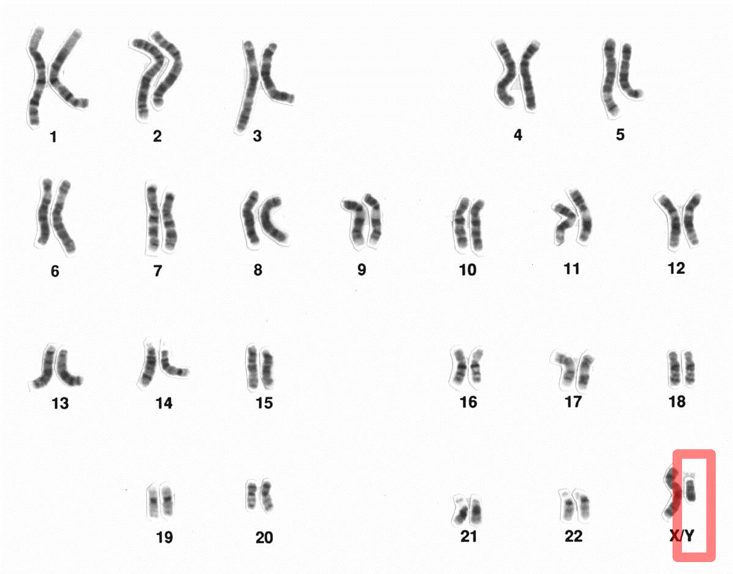
Biological gender in humans is determined by one chromosomal pair, outlined here in red. Credit: Nautilus

In an anatomical and physiological sense, sex identity is quite binary: Just one gene governs sex identity, resulting in the striking anatomical and physiological dimorphism that we observe between males and females. But gender and gender identity are far from binary.

The GLP aggregated and excerpted this blog/article to reflect the diversity of news, opinion, and analysis. Read full, original post: Why Sex Is Mostly Binary but Gender Is a Spectrum

Do assumptions about race in genetics research promote the Alt-Right agenda?

lead
[On the Internet, there are] pages after pages of Stormfront discussions on the reliability of 23andMe ancestry results and whether Neanderthal interbreeding is the reason for the genetic superiority of whites. Obsession with racial purity is easily channeled, apparently, into an obsession with genetics.


Modern geneticists now take pains to distance their work from the racist assumptions of eugenics. Yet since the dawn of the genomic revolution, sociologists and historians have warned that even seemingly benign genetics research can reinforce a belief that different races are essentially different….

If a genetic test can identify you as 78 percent Norwegian, 12 percent Scottish, and 10 percent Italian, then it’s easy to assume there is such thing as white DNA.

The problem is not with the science per se, but with the set of an underlying assumptions about race that we always imprint on the latest science…[Like] its predecessors, genetics is vulnerable to misuse by those with racist agendas.

“White supremacists are kind of the tip of the iceberg when it comes to beliefs about race,” says [Ann Morning, a sociologist at New York University]. Their rhetoric is extreme, of course, but the idea that race represents real biological differences is pervasive. Genetics are just the latest frontier.

The GLP aggregated and excerpted this blog/article to reflect the diversity of news, opinion, and analysis. Read full, original post: Will the Alt-Right Promote a New Kind of Racist Genetics?

Ties to biotech corporations within Congress’s biotech panel could skew crucial policies

us congress

The National Academies of Sciences, Engineering and Medicine are assigned by Congress to provide policy guidance to the government…One of [the scientific] committees, though, is facing questions about how its members were selected. The concerns focus on a panel studying biotechnology….

Critics say that several committee members have financial ties to biotech businesses that could color the panel’s report, expected to be published soon, potentially giving short shrift to health and environmental worries.

The criticism adds to the heated debate about how federal regulators are handling the fast development of biotechnology.

The National Academies have defended the panel…as well as the current panel on biotechnology, saying that the type of expertise needed to staff them is limited and thus some conflict must be tolerated.

But people with ties to the academies say any perceived conflicts of interest may undermine some of the group’s authority.

“There’s often a lot riding on what the academies say, and so their ability to act with objectivity and independence defines any value they have,” said Dr. Harvey Fineberg, a former leader of what is now the medical division of the National Academies.

The GLP aggregated and excerpted this blog/article to reflect the diversity of news, opinion, and analysis. Read full, original post: National Biotechnology Panel Faces New Conflict of Interest Questions

Celebrity deaths in 2016 reveal genetic diseases that remain unconquered

American actor Gene Wilder as Willy Wonka in Willy Wonka The Chocolate Factory

The year 2016 may be remembered for important medical advances, but a glance at the headlines also offers a grim reminder of the many diseases that remain unyielding adversaries for science.

Parkinson’s disease claimed tens of thousands of Americans, including former US Attorney General Janet Reno; Maurice White (founder of Earth, Wind & Fire); and, quite possibly, Muhammad Ali…Pancreatic cancer claimed the actor Alan Rickman, author Pat Conroy, and singer Sharon Jones. And former first lady Nancy Reagan was among the many who were felled by congestive heart failure.

Here are some other reminders of the hills medicine has yet to climb.

Gene Wilder, 83, Alzheimer’s disease

The beloved film star quietly carried his diagnosis for three years before his death in August. His family said he’d been reluctant to sadden young fans, especially, by publicly disclosing his condition…Earlier [in 2016], the Alzheimer’s community was crushed by the failure of yet another once-promising experimental treatment.

Gwen Ifill, 61, uterine cancer

Ifill, a pioneering journalist, was the first African-American woman to anchor a major news program…The most common form of uterine cancer, endometrial cancer, strikes around 60,000 women annually, and the death rate is roughly the same as it was in 1985.

The GLP aggregated and excerpted this blog/article to reflect the diversity of news, opinion, and analysis. Read full, original post: A year of lives lost to diseases science has yet to tame

America’s refusal to embrace gene editing could start the next Cold War

image

Unlike other epic scientific advances…the immediate effect of genetic editing technology is not dangerous. Yet, it stands to be just as divisive to humans as the 70-year proliferation of nuclear weaponry.

The playing field of geopolitics is pretty simple: If China or another country vows to increase its children’s intelligence via genetic editing, and America chooses to remain “au naturel” because they insist that’s how God made them, a conflict species-deep will quickly arise.

This type of idea takes racism and immigration to a whole new level. Will America close off its borders, its jobs, its schools, and its general openness to the world to stay pure, old-fashioned human?

In short, will genetic editing start a new cold war? One that bears much finger pointing and verbal reprimands, including the use of derogatory terms like mutants, cyborgs, and transhumanists.

If we’re too closed-minded about such radical science, we might find ourselves embroiled in a state of hostile speciation, where another new cold war swallows a generation.

The GLP aggregated and excerpted this blog/article to reflect the diversity of news, opinion, and analysis. Read full, original post: Genetic Editing Could Cause the Next Cold War