Viewpoint: ‘Heritage’ of emotional decision-making fuels EU’s opposition to biotech crops

AP
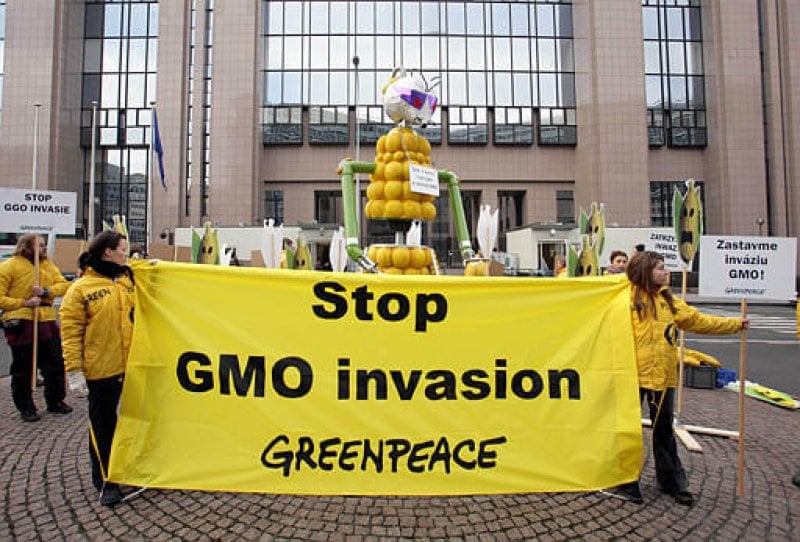
Greenpeace protesters demonstrate with banners on Thursday, March 10, 2005 in front of the European Union Ministers' Council Building in Brussels, Belgium. Image Credit: AP Photo/LUXPRESS/Jean-Claude Ernst)

As Daniel Patrick Moynihan, American politician and diplomat famously put it, โ€œYou are entitled to your opinion. But you are not entitled to your own facts.โ€ย But it seems to me that opinions …. have held sway in a series ofย recent decisions by Europeโ€™s regulators and judges.

In July this year, judges at the European Court of Justice ruled that the new and highly controllable Crispr techniques of gene editing must be treated as if they were the equivalent of older and far less controllable genetic engineering methodsย  ….ย The ruling will prevent the use of Crispr in targeted development of new crop plants with desirable traits.

Exposure and risk, the fruits of toxicological knowledge developed over centuries through the application of reason, are not considered …. Despite countless high quality studies demonstrating its safety, glyphosate remains under threat, following the International Agency for Research on Cancerโ€™s deeply flawed hazard-based assessment.

Many observers may take the view that these decisions are simply an expression of the spirit of the European people ….ย The problems emerge when precautionary steps replace considered risk evaluations and the consequences of decisions are not fully considered …. It is troubling that Europeโ€™s willingness to impair …. innovation is at least partly dependent on the assumption that …. feelings, opinions, and conjecture are of equal value with reason and knowledge.

Read full, original article: Viewpoint: With European risk management at a crossroads, can reason prevail?


{{ reviewsTotal }}{{ options.labels.singularReviewCountLabel }}
{{ reviewsTotal }}{{ options.labels.pluralReviewCountLabel }}
{{ options.labels.newReviewButton }}
{{ userData.canReview.message }}

Related Articles

Infographic: Global regulatory and health research agencies on whether glyphosate causes cancer

Infographic: Global regulatory and health research agencies on whether glyphosate causes cancer

Does glyphosateโ€”the world's most heavily-used herbicideโ€”pose serious harm to humans? Is it carcinogenic? Those issues are of both legal and ...

Most Popular

Screenshot-2026-04-22-at-12.21.32-PM
Viewpoint: Why the retracted Monsanto glyphosate study doesnโ€™t change the scienceโ€”the worldโ€™s most popular herbicide is safeย 
ChatGPT-Image-Apr-16-2026-02_56_53-PM
Financial incentives, over diagnosis, and weak oversight: Autism claims are driving up Medicare costs
Picture1
The FDA couldnโ€™t find a vaccine safety crisis, so it buried its own research
ChatGPT-Image-May-1-2026-11_42_59-AM-2
Viewpoint: NAD is the wellness grifters latest evidence-lite longevity fad. At least the mice are impressed.
global warming
โ€˜Implausibleโ€™: Top climate scientists reject worst-case scenarioโ€”soaring temperatures and fast-rising sea levels
Screenshot-2026-05-21-at-12.15.17-PM
UK gene-editing milestone: Livestock barley that increases ruminant value and reduces methane emissions is first-approved CRISPR crop
Screenshot-2026-05-21-at-3.15.53-PM
Chiropractors may no longer be modern-day snake oil salesmen, but the benefits of their therapy are limitedโ€“at best

Sorry. No data so far.

glp menu logo outlined

Get news on human & agricultural genetics and biotechnology delivered to your inbox.