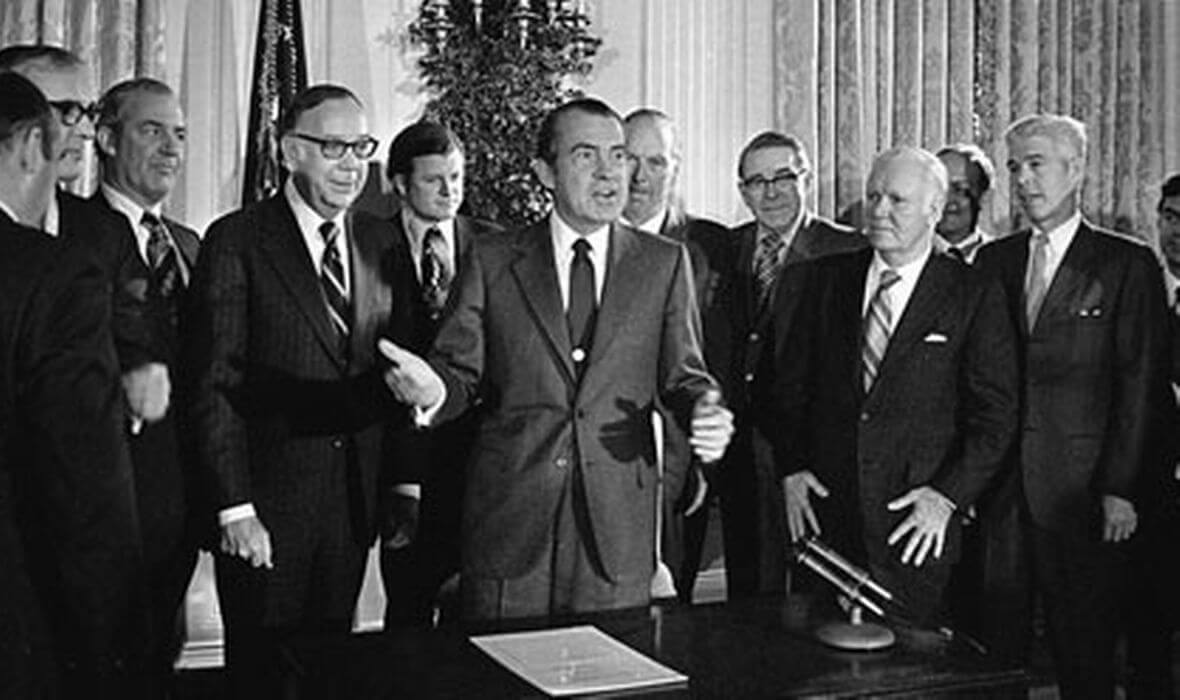
This unconventional “war” on cancer was declared when Richard Nixon signed the National Cancer Act of 1971. The bill strengthened existing federal research agencies and established new initiatives to find a cure for what was then the second-leading cause of death in the United States. Unfortunately, despite very real advances in some areas, cancer mortality rates remain stubbornly high, and cancer has not budged from its #2 spot on the list of things most likely to kill you.
Cancer affects us all—it’s a cliché at this point, but it’s true. Those who haven’t been diagnosed personally almost always know somebody who has. Being staunchly anti-cancer is just about the least controversial position you can take (1). Politicians, in their never-ending search for cheap applause lines, have littered their campaigns with pledges to not just fight cancer but eradicate it. Within the last few weeks, presidential candidates from both sides of the aisle have gone so far as to promise a cancer cure if elected.
The reason we don’t have a cure for cancer is not a lack of leadership, motivation, or funding (2). Federal dollars for biomedical research are always appreciated, but no one person—including the President—can flip the “cure cancer” switch. We have no clue where it is. And the more we learn about the intricacies of cancer biology, the more likely it seems as if it doesn’t exist at all.
Scientists are ruthlessly pragmatic creatures. It doesn’t matter how elegant a hypothesis may be—if the data say that it’s wrong, then it’s wrong. Optimism has its place, but hope should always defer to the results of a properly designed and executed experiment.
All of this rigor helps to counter cognitive biases that are as powerful as they are pervasive. Even worse, their effects can be especially strong when your own ideas are at stake. As the great physicist Richard Feynman (known to his students at Cal Tech as God) once put it, “the first principle is that you must not fool yourself—and you are the easiest person to fool.”
Over the next several weeks, I’ll dive into many of the scientific realities that stand in the way of a universal cure for cancer, such as drug resistance, tumor heterogeneity, and others. It’s a sobering story, but it’s one that’s rooted in fact and nuance.




Though I consider myself to be an optimist, one thing I can’t stand is blind optimism, especially coming from those with power—it’s wasteful at best and actively destructive at worst. Maybe that makes me a technocrat, but I just see it as good scientific practice.
NOTES:
(1) I can’t imagine that a “pro-cancer” contingent actually exists, but humanity has shown no limit in its capacity to perplex and disappoint. There’s probably some Malthusian corner of the Dark Web where these people congregate. I’m looking at you, Thanos!
(2) I should also address an appallingly common conspiracy theory that purports to explain our lack of progress against cancer. Few things make drug hunters’ blood boil more than the idea that pharmaceutical companies are “hiding” cures for diseases like cancer. Not only would this be morally abhorrent, but it would also be financially idiotic. Companies routinely charge tens of thousands of dollars for drugs that extend the lives of cancer patients by a few months. An actual cure for cancer? That would be a license to print money.
Dr. Christopher Gerry was recently awarded a Ph.D. from the Department of Chemistry & Chemical Biology at Harvard University, where he studied the science of therapeutics using a combination of synthetic organic chemistry, chemical biology, and small-molecule screening. At Harvard, Dr. Gerry contributed over 30 articles to the Science in the News blog, and he served as its Co-Editor-in-Chief from 2017-2019. His writing has also been featured in CCB Magazine. Follow him on Twitter @ChristopherG92
A version of this article was originally published on the American Council on Science and Health’s website as “Rethinking Our Goals In The ‘War On Cancer’“ and has been republished here with permission.