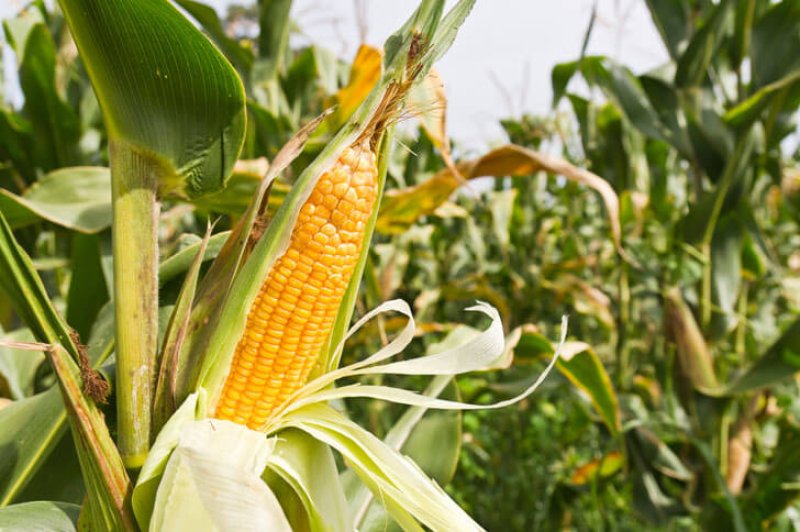
Farmers in Paraguay see major yield increases with GMO corn, despite degraded soil

corn cob
Credit: Inhabitat

10 years ago, a group of 14 peasant farmers in the San Juan Nepomuceno region of Caazapá took the challenge of ensuring their livelihoods through the use of biotechnology, according to a report from the Institute of Agricultural Biotechnology (Inbio).

Caazapá is a region with many riches, but in some areas its soils are very degraded. A group of producers is achieving success through work, permanent technical assistance, the introduction of sustainable practices and the correct use of biotechnology, with the support of the Institute of Agricultural Biotechnology (INBIO), reported Fabio Vega, extension specialist with the Ministry of Agriculture and Livestock (MAG).

“When we started, [farmer] Don Trifón Ruiz Díaz had a yield of tupi pytá corn of 800 kilograms per hectare, his cotton was around 680 kilograms per hectare, and chipá corn at 700 kilograms per hectare, in a highly degraded soil,” [Vega] recalled.

Díaz stressed that farmers were taught the correct use of biotechnology. “We learned about the varieties and their management, through which we were able to achieve better results …. [in 2019], when we had optimal weather conditions, we achieved significant yields,” said the producer.

On that occasion, [Díaz ] corn yielded 7,000 kilograms per hectare; cotton, 2,970 kilograms per hectare.

[Editor’s note: This article was published in Spanish and has been translated and edited for clarity.]


Read the original post

{{ reviewsTotal }}{{ options.labels.singularReviewCountLabel }}
{{ reviewsTotal }}{{ options.labels.pluralReviewCountLabel }}
{{ options.labels.noReviewsLabel }}
{{ options.labels.newReviewButton }}
{{ userData.canReview.message }}

Related Articles

Infographic: Global regulatory and health research agencies on whether glyphosate causes cancer

Infographic: Global regulatory and health research agencies on whether glyphosate causes cancer

Does glyphosate—the world's most heavily-used herbicide—pose serious harm to humans? Is it carcinogenic? Those issues are of both legal and ...

Most Popular

Screenshot-2026-07-09-at-1.09.25-PM
Anti-vaccine myths rattle health care
ChatGPT-Image-Mar-10-2026-01_39_01-PM
Viewpoint—“Miracle molecule” debunked: Why acemannan supplements don’t work
Picture1
Hiroshima at 81: America’s new nuclear bomb, a buried Iranian target, and a question no one wants to ask
ChatGPT-Image-Jul-10-2026-12_21_03-PM
Viewpoint: Is there new evidence that the animal deworming drug ivermectin decreases the risk of Covid and cancer? Don’t waste your money.
ChatGPT-Image-Jun-25-2026-12_23_17-PM
No, Bill Gates did not secretly engineer ticks to promote veganism
leeteam
How Kennedy and his family could pocket millions from Merck’s $50 million vaccine injury settlement that he oversaw
Screenshot-2026-07-30-at-3.07.42-PM
Controversy over WNBA star Sophie Cunningham’s comment opposing trans females in women’s sports reinvigorates the culture wars

Sorry. No data so far.

glp menu logo outlined

Get news on human & agricultural genetics and biotechnology delivered to your inbox.