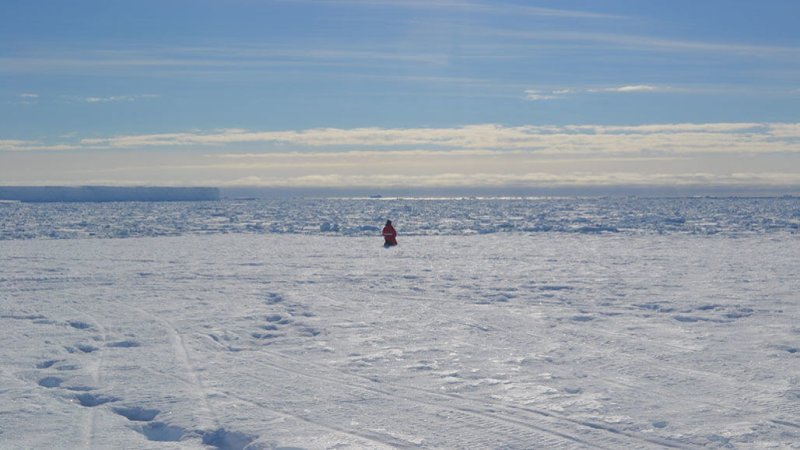
Video: Antarctica research shows how isolation changes the brain

ac antarctica feat x
Credit: Alexander Stahn/University of Pennsylvania

As humans grapple with pandemic-induced isolation, science is starting to offer insight into what may be happening in our brains when our social contact with others is dramatically reduced.

That insight happens to come from a place with more penguins than people.

Tim Heitland of the Alfred Wegener Institute Helmholtz Center for Polar and Marine Research in Germany spent 14 months in Antarctica between 2016 and 2018. When he returned, daily life felt overwhelming—everything from the colors and vegetation to all the other people. Part of the shock may have come from returning with a different brain than the one he left with.

Follow the latest news and policy debates on sustainable agriculture, biomedicine, and other ‘disruptive’ innovations. Subscribe to our newsletter.

While the members of Heitland’s crew conducted research on the earth’s iciest continent, they themselves were also being studied by researchers interested in how extreme work environments trigger neurological changes. The investigation showed that most of the people in Heitland’s team lost volume in parts of their hippocampus, a brain region involved in spatial navigation, learning and emotional processing. The phenomenon is similar to what scientists believe happens to prisoners in solitary confinement, where social isolation and sensory deprivation can lead to post-traumatic stress disorder.

This research appears particularly relevant now, when vast numbers of people are spending more and more time alone. Some scientists hope the work will lead to interventions that counteract the damage of isolation before it causes long-term problems.


Read the original post

{{ reviewsTotal }}{{ options.labels.singularReviewCountLabel }}
{{ reviewsTotal }}{{ options.labels.pluralReviewCountLabel }}
{{ options.labels.newReviewButton }}
{{ userData.canReview.message }}

Related Articles

Infographic: Global regulatory and health research agencies on whether glyphosate causes cancer

Infographic: Global regulatory and health research agencies on whether glyphosate causes cancer

Does glyphosate—the world's most heavily-used herbicide—pose serious harm to humans? Is it carcinogenic? Those issues are of both legal and ...

Most Popular

Screenshot-PM-24
Viewpoint: The herbicide glyphosate isn’t perfect. Banning it would be far worse.
d-b
Blocked arteries, kidney stones, nausea, constipation, fatigue: Long list of health problems caused by too much vitamin D 
Screenshot-2026-04-27-at-12.22.38-PM
Running ‘wild’: Last year, RFK, Jr. was given a green light to ‘reform’ chemical policies. Glyphosate illustrates how Trump now has him on a tight leash, and MAHA is furious
bayer-supremecourt-lt
EPA concludes glyphosate is not carcinogenic. Missouri courts say Monsanto failed to warn it might be. SCOTUS weighs in.
ChatGPT-Image-Apr-22-2026-11_06_18-AM
Wellness influencer nonsense: No, nicotine does not boost cognition and productivity, but it can damage your health 
ChatGPT-Image-Feb-16-2026-01_57_31-PM
Viewpoint: ‘Science-as-Satan’ unites the MAHA—MAGA movements. Is a breakup in the works?
Screenshot-2026-04-27-at-1.40.55-PM
With federal funding for scientific research already reeling, Trump fires the entire apolitical National Science Board
glp menu logo outlined

Get news on human & agricultural genetics and biotechnology delivered to your inbox.