How business is battling employee vaccine denialism and doubt

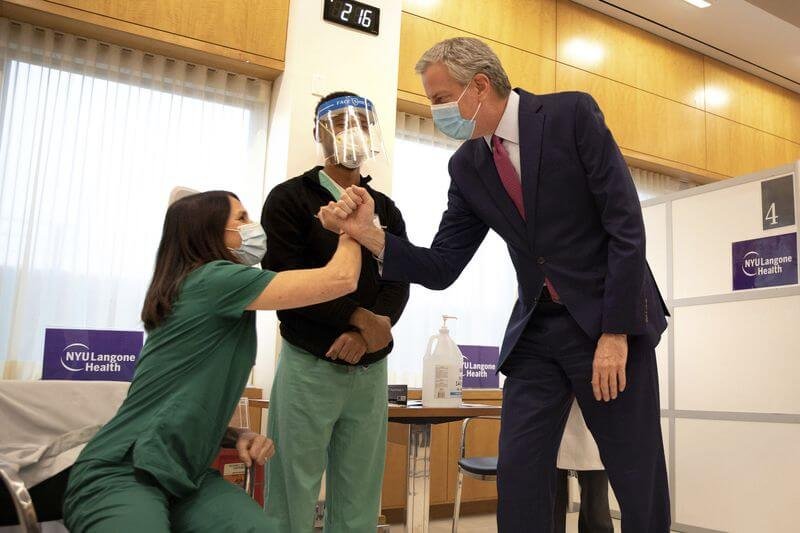
Mayor Bill de Blasio bumps forearms with Tara Easter, a registered nurse at NYU-Langone Hospital. Credit: Kevin Hagen/AP

Across industries, business leaders are turning to all-hands staff meetings, video memos and other workplace forums to address skepticism about the Covid-19 vaccine and encourage employees to get it when they can.

Food-services and facilities-management company Sodexo is asking managers to listen for signs of vaccine hesitancy among staff and launching a social-media campaign to encourage employees to get the shots. Benchmark Senior Living LLC, an operator of assisted-living facilities, is blasting “myth-buster” emails to its workforce and turning on-site vaccination clinics into mini parties, complete with cake and games, to lend a celebratory air. Technology company VMware Inc. is discussing bringing in doctors to answer staff questions about the vaccine in virtual company meetings.

Mis- and disinformation are distorting science and public policy. Subscribe to our Daily and Weekly Digests for incisive coverage of ‘disruptive’ innovations in AI, agricultural biotechnology, food, chemicals, nuclear energy, vaccines, and other disruptive innovations.

Getting a critical mass of employees vaccinated is crucial to reopening offices and returning workplaces to a semblance of normal, executives say. Yet overcoming vaccine skepticism could prove tough. A recent Siena College Research Institute survey of New York state residents found more than a quarter said they don’t plan to get the shot.


“How do you cancel all of that horrible, negative messaging that seems to infect social media these days?” says Simon Scrivens, a senior vice president at Sodexo who chairs the company’s medical advisory council. “We’ve got a responsibility as a large employer.”


Read the original post

Related Articles

Infographic: Global regulatory and health research agencies on whether glyphosate causes cancer

Infographic: Global regulatory and health research agencies on whether glyphosate causes cancer

Does glyphosate—the world's most heavily-used herbicide—pose serious harm to humans? Is it carcinogenic? Those issues are of both legal and ...

Most Popular

ChatGPT-Image-Mar-10-2026-01_39_01-PM
Viewpoint—“Miracle molecule” debunked: Why acemannan supplements don’t work
Screenshot-2026-09-17-at-1.07.08-PM
'We are dangerously addicted to antidepressants': Should we heed RFK Jr.’s sobering warning?
ChatGPT-Image-Sep-22-2026-10_32_46-AM
There has been a slew of recent reports of food recalls and foodborne outbreaks. Do we face an escalating problem?
ChatGPT-Image-Sep-2-2026-02_03_32-PM
How much of a problem is AI’s water use?
Screenshot-2026-09-03-at-10.51.20-AM
Viewpoint: Why do online health lies outlive the evidence that debunks them? Read "Everyone Else Is Lying to You"
ChatGPT-Image-Aug-26-2026-12_46_16-PM
Viewpoint: The fake controversy over whether combining childhood vaccines is dangerous— a debate science resolved 25 years ago
ChatGPT-Image-Sep-23-2026-01_52_03-PM
Viewpoint: 4 very real AI doomsday scenarios
Screenshot-2026-09-23-at-11.55.01-AM
How can we know if social media bans actually help teens?
Screenshot-2026-09-22-at-11.40.28-AM
After Idaho criminalized abortion providers in 2022, one-third of obstetricians fled. Health care advocates are making rural health the case for repealing the ban
Screenshot-2026-09-23-at-3.15.09-PM
Anti-GMO activists in Pakistan rev up their campaign of dire warnings
Screenshot-2026-09-17-at-12.00.30-PM
Investigative group ProPublica finds links between ectopic pregnancy deaths and abortion bans
ChatGPT-Image-Sep-17-2026-12_28_43-PM
Vitamin D, omega-3 fish oil and glucosamine supplements could cause brain damage 
glp menu logo outlined

Get news on human & agricultural genetics and biotechnology delivered to your inbox.