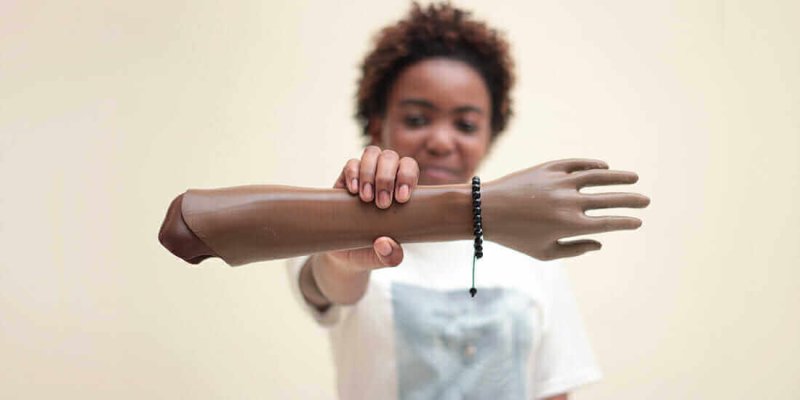
Do people with artificial limbs come to see their prostheses as a natural part of the body — or just a tool?

Credit: LimbForge
Credit: LimbForge

[How do] humans’ wealth of sensory inputs—including the touch and visual perception involved in manipulating a tool—modify the sense of one’s physical self? Embodiment implies that when one holds a screwdriver, for example, the brain morphs its representation of a “hand” until that representation reaches all the way to the very tip of the tool.

But is this what really happens? Why should the brain somehow give up, even temporarily, its conception of a dexterous hand for that of a blunt instrument? 

[Neuroscientist Tamar Makin] examined whether people with prostheses—or London street cleaners wielding litter-grabbing metal poles—do, in fact, merge their identities with such tools. So far the results of Makin’s studies contradict… some modern research that had suggested using an implement alters internalized body maps.

Follow the latest news and policy debates on sustainable agriculture, biomedicine, and other ‘disruptive’ innovations. Subscribe to our newsletter.

“Embodiment is a multifaceted phenomenon. If you ask the brain, or at least the visual cortex, of the people who use the prosthesis more, their organs embody the prosthesis less. But if you ask people about their subjective experience of how they perceive the prosthesis after long periods of use, the more they use it, the more they say it feels like part of their body,” [Makin said.]


Read the original post

{{ reviewsTotal }}{{ options.labels.singularReviewCountLabel }}
{{ reviewsTotal }}{{ options.labels.pluralReviewCountLabel }}
{{ options.labels.newReviewButton }}
{{ userData.canReview.message }}

Related Articles

Infographic: Global regulatory and health research agencies on whether glyphosate causes cancer

Infographic: Global regulatory and health research agencies on whether glyphosate causes cancer

Does glyphosate—the world's most heavily-used herbicide—pose serious harm to humans? Is it carcinogenic? Those issues are of both legal and ...

Most Popular

ChatGPT-Image-May-7-2026-12_16_37-PM-2
Viewpoint: Are cancer rates ‘skyrocketing’ as RFK, Jr. and MAHA claims? The evidence says mostly the opposite
Screenshot-2026-04-22-at-10.46.29-AM
Viewpoint: How to counter science disinformation? Science journalist offers 12 practical tips
images
The never-ending GMO debate: Pros and cons

Sorry. No data so far.

glp menu logo outlined

Get news on human & agricultural genetics and biotechnology delivered to your inbox.