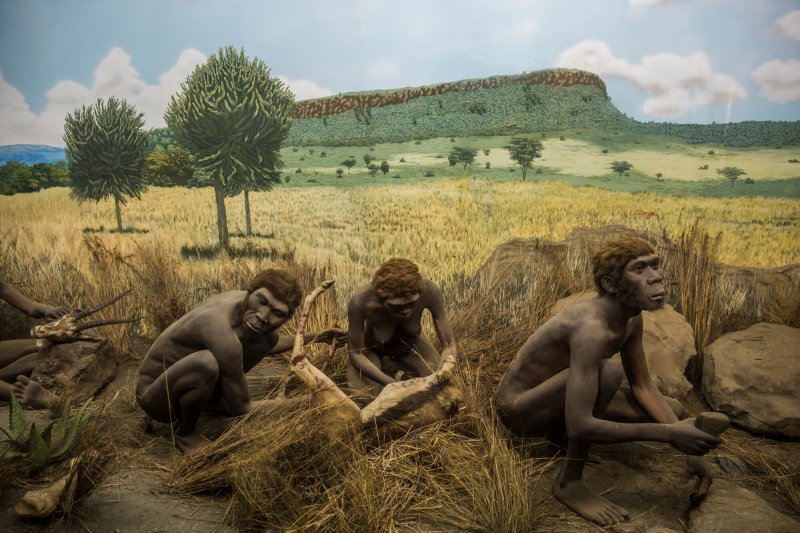

When paleontologists and anthropologists look back at the history of hominin evolution, they find a veritable Gordian Knot, one that weaves back into itself, with innumerable dead ends. For a clear example, consider our quest to learn who the ancestors of our closest relatives, the Neanderthals and Denisovans, were.
The Neanderthals are probably our most famous cousins: short, stocky humans who went extinct around 40,000 years ago, with some surprising theories as to why.
But who were the hominins that gave rise to the Neanderthals and the Denisovans? University of Utah anthropologist Alan Rogers, who specializes in population genetics and evolutionary ecology, has been working on this problem for over a decade.
…



What if ancient hominins, likely H. erectus, had colonized Eurasia as early as 2 million years ago — not just traveling there and dying out, but forming sustainable populations? Then the ancestors of the Neanderthals and Denisovans, the “Neandersovans,” as Rogers calls them, interbred with those hominins around 750,000 years ago. “Suddenly everything fit,” he and his co-authors wrote in their paper.
…
Further complicating the picture are discoveries of yet more hominins, and long-standing debates about how to even classify them.