Genetically modified (GM) crops have increased global food, feed and fiber production by nearly 1 billion tonnes (1 tonne equals 1.10231 tons) since their introduction in 1996. Farmers who grow these crops also reduced the environmental footprint associated with their crop protection practices by more than 17 percent according to my peer-reviewed research published in October1,2.
The research focused on farming practices with GM crops between 1996 and 2020 and on the socio-economic and environmental impact associated with pesticide use.
By increasing crop yields, the technology reduced pressure to bring new land into agriculture. This is vital if the world is to successfully feed a growing population without resorting to practices like deforestation. It is also crucial for maintaining and restoring the natural habitats and vegetation that are best for many species of plants and animal life and key for storing carbon.
How GM technology increased output
GM crop technology increased yields primarily through improved control of pests and weeds. Insect resistant (IR) crop technology used in cotton and corn has, between 1996 to 2020 across all users of this technology, increased yields by an average of 17.7 percent for IR corn and 14.5 percent for IR cotton relative to conventional production systems. Farmers who grow IR soybeans commercially in South America have seen an average 9.3 percent increase in yields since 2013.

The impact of the higher yields on production has been considerable. It resulted in additional global production of 330 million tonnes of soybeans, 595 million tonnes of corn, 37 million tonnes of cotton lint, 15.8 million tonnes of canola and 1.9 million tonnes of sugar beet since 1996.
This allows farmers to grow more without needing to use additional land. For example, if crop biotechnology had not been available to farmers in 2020, maintaining global production levels that year would have required the planting of an additional 11.6 million hectares (ha — 1 hectare is equal to 2.4711 Acre) of soybeans, 8.5 million ha of corn, 2.8 million ha of cotton and 0.5 million ha of canola. This 23.4 million ha total is equivalent to the combined agricultural area of Philippines and Vietnam.
Environmental footprint
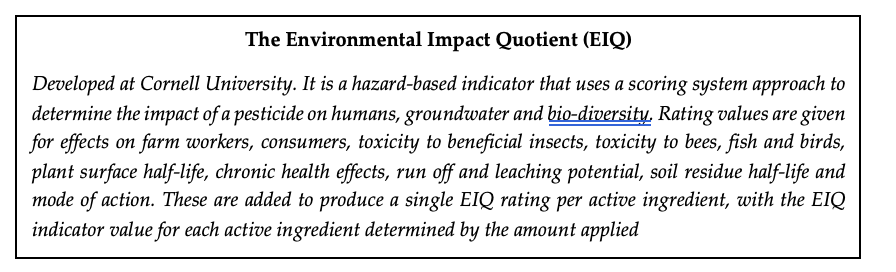
GM crop technology has also helped farmers who grow these crops to reduce the environmental impact associated with their crop protection practices. In the 25-year period from 1996 to 2020, crop biotechnology reduced the application of crop protection products by 748.6 million kilograms, a global reduction of 7.2 percent on the area planted to GM crops. This is equal to 1.5 times China’s total annual crop protection product use. As a result, farmers who grow GM crops have reduced the environmental impact associated with their crop protection practices by a larger 17.3 percent, as measured by an indicator known as the Environmental Impact Quotient (EIQ)3.
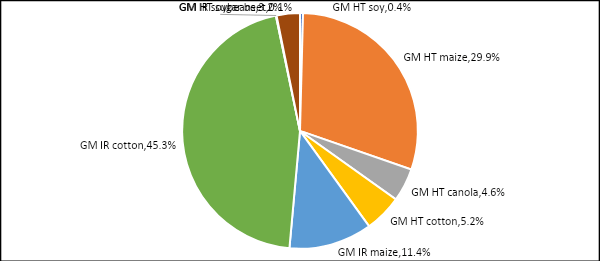
This reduction in pesticide use has been largely driven by crops modified to be tolerant to specific herbicides (HT) so as to facilitate improved weed control and crops resistant to a range of crop insect pests (IR) that otherwise damage crops or typically require the application of insecticides to control them.
The largest share of the reduction in terms of amount of pesticide active ingredient applied was accounted for by GM IR cotton (45%) followed by GM HT maize (30%).
Share of aggregate active ingredient usage (reductions) by trait 1996-2020 (baseline total 748.6 million kg)

In terms of the environmental impact associated with herbicide and insecticide use on these crops, as measured by the EIQ indicator, the largest share of these improvements was also delivered by GM IR cotton, at about 40% of the total, followed by GM HT soybeans (26%).
Share of aggregate EIQ changes (improvements) by trait 1996-2020

At the country level, US farms have seen the largest environmental improvements, with a 322 million kg reduction in pesticide active ingredient use, 43% of the total. This is not surprising given that US farmers were first to make widespread use of GM crop technology and since the early 2000s, the GM adoption levels in all four of these US crops have exceeded 80%. Also, insecticide/herbicide use had, before the availability of GM crop technology, been the primary method of weed and pest control.
The widespread adoption of IR cotton in China and India also drove a reduction in insecticide active ingredient use between 1996 and 2020 of more than 304 million kg.
There have been some problems associated with GM crops, but they are manageable. Over reliance on the use of glyphosate with HT crops by farmers, especially in the early years after the introduction of the technology, has contributed to the development of weed resistance. As a result, farmers have, over the last 20 years, adopted more integrated weed management strategies incorporating a mix of herbicides and non-herbicide-based weed control practices. These changes resulted in a reduction in the magnitude of the original environmental gains associated with changes in herbicide use.
In addition, the magnitude of carbon emission savings each year associated with the facilitating role of GM HT crops in the adoption of no tillage and reduced tillage systems likely decreased as some farmers reverted to plowing as part of weed control practices to control herbicide tolerant weeds.
Overall, these findings are consistent with analysis by other researchers such as the global meta-analysis of Klumper W and Qaim M in 20144 and the US-specific analysis of Fernando-Cornejo J, et. al., also in 20145.
The adoption of GM herbicide tolerant (HT) crop technology continues to deliver net environmental gains and together with GM IR technology, continues to provide substantial net environmental benefits.
References:
- Brookes G. Genetically modified crop use, 1996-2020: Environmental impacts associated with pesticide use change. 2022. GM Crops and Food, 13, issue 1. DOI: 10.1080/21645698.2022.211849.
- Brookes G. Farm income and production impacts from the use of GM crop technology 1996-2020. 2022. DOI: 10.1080/21645698.2022.2105626.
- Kovach J. Petzoldt C. Degni J. Tette J. A method to measure the environmental impact of pesticides. New York’s Food and Life Sciences Bulletin. NYS Agriculture. Exp. Sta. Cornell University, Geneva, NY, 139. 8 pp. 1992 and annually updated. Available on the Worldwide Web:
- Klumper W and Qaim M. A meta-analysis of the impacts of genetically modified crops. PLOS One. 2014.
- Fernandez-Cornejo J, Wechsler S, Livingston M and Mitchell L. Genetically engineered crops in the United States. 2014. USDA Economic Research Service report ERR 162.
Graham Brookes, agricultural economist with PG Economics, UK, has more than 35 years’ experience of analyzing the impact of technology use and policy change in agriculture, and has authored many papers in peer reviewed journals on the impact of regulation, policy change and GM crop technology. Email: [email protected]