


Our genus Homo evolved over the past 3 million years – a period of increasing warm/cold climate fluctuations. How early human species have adapted to the intensification of climate extremes, ice-ages, and large-scale shifts in landscapes and vegetation remains elusive. Did our ancestors adjust to local environmental changes over time, or did they seek out more stable environments with diverse food resources? Was our human evolution influenced more by temporal changes in climate, or by the spatial character of the environment?
To test these fundamental hypotheses on human evolution and adaptation quantitively, the research team used a compilation of more than three thousand well-dated human fossil specimens and archeological sites, representing six different human species, in combination with realistic climate and vegetation model simulations, covering the past 3 million years. The scientists focused their analysis on biomes – geographic regions which are characterized by similar climate, plants, and animal communities (e.g., savannah, rainforest, or tundra).
“For the archeological and anthropological sites and corresponding ages, we extracted the local biome types from our climate-driven vegetation model. This revealed which biomes were favored by the extinct hominin species H. ergaster, H. habilis, H. erectus, H. heidelbergensis, and H. neanderthalensis and by our direct ancestors – H. sapiens.”, said Elke Zeller, PhD student from the IBS Center for Climate Physics at Pusan National University, South Korea, and lead author of the study.
According to their analysis, the scientists found that earlier African groups preferred to live in open environments, such as grassland and dry shrubland. Migrating into Eurasia around 1.8 million years ago, hominins, such as H. erectus and later H. heidelbergensis and H. neanderthalensis developed higher tolerances to other biomes over time, including temperate and boreal forests. “To survive as forest-dwellers, these groups developed more advanced stone tools and likely also social skills”, said Prof. Pasquale Raia, from the Università di Napoli Federico II, Italy, co-author of the study. Eventually, H. sapiens emerged around 200,000 years ago in Africa, quickly becoming the master of all trades. Mobile, flexible, and competitive, our direct ancestors, unlike any other species before, survived in harsh environments such as desert and tundra.

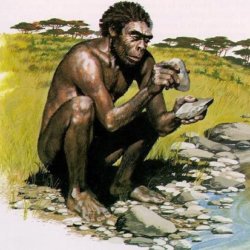



When further looking into the preferred landscape characteristics, the scientists found a significant clustering of early human occupation sites in regions with increased biome diversity. “What that means is that our human ancestors had a liking for mosaic landscapes, with a great variety of plant and animal resources in close proximity”, said Prof. Axel Timmermann, co-author of the study and Director of the IBS Center for Climate Physics in South Korea. The results indicate that ecosystem diversity played a key role in human evolution.
The authors demonstrated this preference for mosaic landscapes for the first time on continental scales and propose a new Diversity Selection Hypothesis: Homo species, and H. sapiens in particular, were uniquely equipped to exploit heterogeneous biomes. “Our analysis shows the crucial importance of landscape and plant diversity as a selective element for humans and as a potential driver for socio-cultural developments” adds Elke Zeller. Elucidating how vegetation shifts have shaped human sustenance, the new Science study provides an unprecedented view into human prehistory and survival strategies.
The climate and vegetation model simulations, which cover earth’s history of the past 3 million years, were conducted on one of South Korea’s fastest science supercomputers named Aleph. “Supercomputing is now emerging as a key tool in evolutionary biology and anthropology”, said Axel Timmermann.























