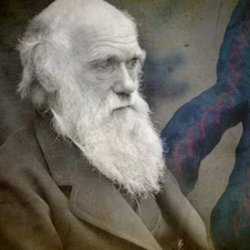
Darwin presented his biased views as scientific facts, such as in his 1871 book “The Descent of Man,” where he described his belief that men are evolutionarily superior to women, Europeans superior to non-Europeans and hierarchical civilizations superior to small egalitarian societies. In that book, which continues to be studied in schools and natural history museums, he considered “the hideous ornaments and the equally hideous music admired by most savages” to be “not so highly developed as in certain animals, for instance, in birds,” and compared the appearance of Africans to the New World monkey Pithecia satanas.
“The Descent of Man” was published during a moment of societal turmoil in continental Europe. In France, the working class Paris Commune took to the streets asking for radical social change, including the overturning of societal hierarchies. Darwin’s claims that the subjugation of the poor, non-Europeans and women was the natural result of evolutionary progress were music to the ears of the elites and those in power within academia. Science historian Janet Browne wrote that Darwin’s meteoric rise within Victorian society did not occur despite his racist and sexist writings but in great part because of them.
It is not coincidence that Darwin had a state funeral in Westminster Abbey, an honor emblematic of English power, and was publicly commemorated as a symbol of “English success in conquering nature and civilizing the globe during Victoria’s long reign.”
Despite the significant societal changes that have occurred in the last 150 years, sexist and racist narratives are still common in science, medicine and education. As a teacher and researcher at Howard University, I am interested in combining my main fields of study, biology and anthropology, to discuss broader societal issues. In research I recently published with my colleague Fatimah Jackson and three medical students at Howard University, we show how racist and sexist narratives are not a thing of the past: They are still present in scientific papers, textbooks, museums and educational materials.
From museums to scientific papers
One example of how biased narratives are still present in science today is the numerous depictions of human evolution as a linear trend from darker and more “primitive” human beings to more “evolved” ones with a lighter skin tone. Natural history museums, websites and UNESCO heritage sites have all shown this trend.
The fact that such depictions are not scientifically accurate does not discourage their continued circulation. Roughly 11% of people living today are “white,” or European descendants. Images showing a linear progression to whiteness do not accurately represent either human evolution or what living humans look like today, as a whole. Furthermore, there is no scientific evidence supporting a progressive skin whitening. Lighter skin pigmentation chiefly evolved within just a few groups that migrated to non-African regions with high or low latitudes, such as the northern regions of America, Europe and Asia.
Sexist narratives also still permeate academia. For example, in a 2021 paper on a famous early human fossil found in the Sierra de Atapuerca archaeological site in Spain, researchers examined the canine teeth of the remains and found that it was actually that of a girl between 9 and 11 years old. It was previously believed that the fossil was a boy due to a popular 2002 book by one of the authors of that paper, paleoanthropologist José María Bermúdez de Castro. What is particularly telling is that the study authors recognized that there was no scientific reason for the fossil remains to have been designated as a male in the first place. The decision, they wrote, “arose randomly.”




But these choices are not truly “random.” Depictions of human evolution frequently only show men. In the few cases where women are depicted, they tend to be shown as passive mothers, not as active inventors, cave painters or food gatherers, despite available anthropological data showing that pre-historical women were all those things.
Another example of sexist narratives in science is how researchers continue to discuss the “puzzling” evolution of the female orgasm. Darwin constructed narratives about how women were evolutionarily “coy” and sexually passive, even though he acknowledged that females actively select their sexual partners in most mammalian species. As a Victorian, it was difficult for him to accept that women could play an active part in choosing a partner, so he argued that such roles only applied to women in early human evolution. According to Darwin, men later began to sexually select women.
Sexist narratives about women being more “coy” and “less sexual,” including the idea of the female orgasm as an evolutionary puzzle, are contradicted by a wide range of evidence. For instance, women are the ones who actually more frequently experience multiple orgasms as well as more complex, elaborate and intense orgasms on average, compared to men. Women are not biologically less sexual, but sexist stereotypes were accepted as scientific fact.
The vicious cycle of systemic racism and sexism
Educational materials, including textbooks and anatomical atlases used by science and medical students, play a crucial role in perpetuating biased narratives. For example, the 2017 edition of “Netter Atlas of Human Anatomy,” commonly used by medical students and clinical professionals, includes about 180 figures that show skin color. Of those, the vast majority show male individuals with white skin, and only two show individuals with “darker” skin. This perpetuates the depiction of white men as the anatomical prototype of the human species and fails to display the full anatomical diversity of people.
Authors of teaching materials for children also replicate the biases in scientific publications, museums and textbooks. For example, the cover of a 2016 coloring book entitled “The Evolution of Living Things”“ shows human evolution as a linear trend from darker “primitive” creatures to a “civilized” Western man. Indoctrination comes full circle when the children using such books become scientists, journalists, museum curators, politicians, authors or illustrators.
One of the key characteristics of systemic racism and sexism is that it is unconsciously perpetuated by people who often don’t realize that the narratives and choices they make are biased. Academics can address long-standing racist, sexist and Western-centric biases by being both more alert and proactive in detecting and correcting these influences in their work. Allowing inaccurate narratives to continue to circulate in science, medicine, education and the media perpetuates not only these narratives in future generations, but also the discrimination, oppression and atrocities that have been justified by them in the past.
Rui Diogo is Associate Professor at Howard University and Resource Faculty at the Center for the Advanced Study of Hominid Paleobiology. Find Rui on Twitter @Rui_Diogo_Lab
A version of this article was originally posted at the Conversation and is reposted here with permission. Find the Conversation on Twitter @ConversationUS