From beer hops to tropical cocktails, we are beginning to see a spectacular explosion of flavors and smells, thanks to genetic modification

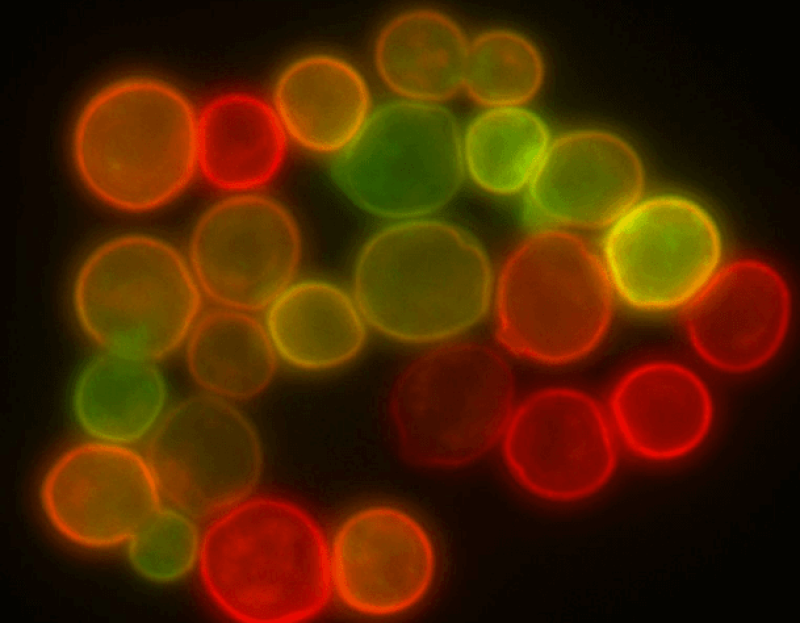
Yeast (S. cerevisiae) cell membrane visualized by membrane proteins. Credit: Masur via CC=BY-SA-3.0

Someday the flavors and smells added to most foods and drinks could be created in yeast-brewing tanks rather than extracted from plants or synthesized in labs, some researchers predict. Around two decades ago, scientists found that tweaking the genes in yeast—a single-cell fungus—could cause it to produce a variety of compounds. Today yeasts are being genetically engineered to produce flavor molecules in research that could eventually lead to entirely new and unfamiliar tastes.

Follow the latest news and policy debates on sustainable agriculture, biomedicine, and other ‘disruptive’ innovations. Subscribe to our newsletter.
To bioengineer yeast to excrete a specific flavor molecule, scientists identify the genetic code used to produce the flavor in a fruit or flower, for instance, and insert it into the yeast. Saccharomyces cerevisiae, the basic bread-maker’s yeast, is commonly used.

“We can get certain flavors and fragrances that you may really like from a plant, but you’re limited in terms of how much you can extract, or it’s not feasible to grow that kind of crop,” says Patrick Boyle, a synthetic biologist at Boston-based Ginkgo Bioworks, whose products include flavors and aromas produced from genetically modified yeasts. He heads the “codebase” team that investigates and stores genetic code to create various flavors and other products for the biotech startup.


{{ reviewsTotal }}{{ options.labels.singularReviewCountLabel }}
{{ reviewsTotal }}{{ options.labels.pluralReviewCountLabel }}
{{ options.labels.newReviewButton }}
{{ userData.canReview.message }}

Related Articles

Infographic: Global regulatory and health research agencies on whether glyphosate causes cancer

Infographic: Global regulatory and health research agencies on whether glyphosate causes cancer

Does glyphosate—the world's most heavily-used herbicide—pose serious harm to humans? Is it carcinogenic? Those issues are of both legal and ...

Most Popular

ChatGPT-Image-May-7-2026-12_16_37-PM-2
Viewpoint: Are cancer rates ‘skyrocketing’ as RFK, Jr. and MAHA claims? The evidence says mostly the opposite
Screenshot-2026-04-13-at-1.39.26-PM
Viewpoint: ‘Safer for children?’ Stonyfield yogurt under fire for deceptive organic marketing
Screenshot-2026-04-22-at-10.46.29-AM
Viewpoint: How to counter science disinformation? Science journalist offers 12 practical tips

Sorry. No data so far.

glp menu logo outlined

Get news on human & agricultural genetics and biotechnology delivered to your inbox.