Post-apocalyptic farming? How seaweed could help us avert starvation during a nuclear winter

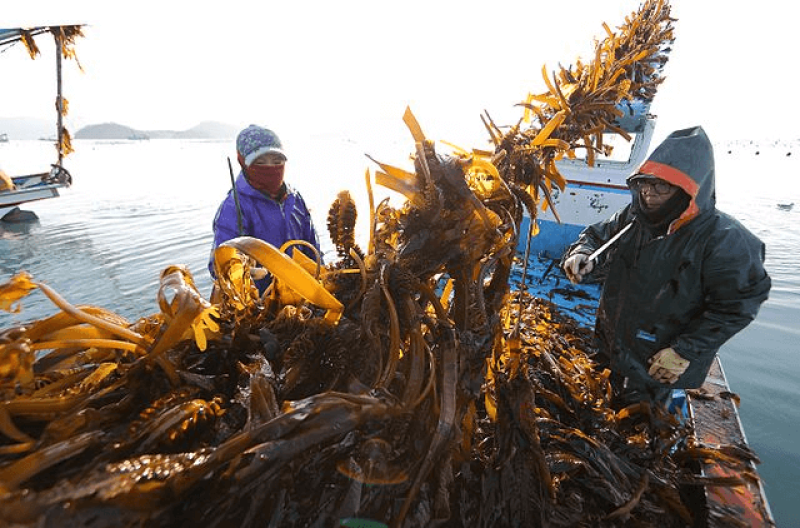
Potentially the most lethal outcome of even a small-scale nuclear war is the impact it would have on agriculture. Credit: ์ •๋™์™„ via CC-BY-SA-4.0

A nuclear war would plunge our planet into a deep nuclear winter. In the worst-case scenario, a nuclear exchange… could eject up to 165 million tons (150 million metric tons) of soot into Earth’s atmosphere, reducing surface temperatures by 16 degrees Fahrenheit (9 degrees Celsius) and sending global calorie production plummeting by as much as 90%.

But in a new study, scientists found that within nine to 14 months of nuclear war, vast arrays of kelp grown on ropes in the Gulf of Mexico and across the Eastern seaboard could be harvested โ€” helping to keep up to 1.2 billion humans fed.

At their fullest extent, the seaweed farms would replace 15% of the food currently consumed by humans, while also providing 50% of current biofuel production and 10% of animal feed. The researchers published their findings Jan. 9 in the journalย Earth’s Future.

Follow the latest news and policy debates on sustainable agriculture, biomedicine, and other ‘disruptive’ innovations. Subscribe to our newsletter.

The scientists’ model revealed that kelp farms wouldn’t just survive but thrive and expand as surface temperatures dropped. This is because colder air would force surface water to sink more, increasing the circulation of nutrient-rich water up from the depths to replace it.

As the iodine found in seaweed can be toxic to humans at high quantities, the uses for kelp grown in farms would primarily be indirect, the researchers said. But by using it to feed animals and produce biofuels, it would free up the surviving arable land for other crops.


This is an excerpt. Read the original post here

{{ reviewsTotal }}{{ options.labels.singularReviewCountLabel }}
{{ reviewsTotal }}{{ options.labels.pluralReviewCountLabel }}
{{ options.labels.newReviewButton }}
{{ userData.canReview.message }}

Related Articles

Infographic: Global regulatory and health research agencies on whether glyphosate causes cancer

Infographic: Global regulatory and health research agencies on whether glyphosate causes cancer

Does glyphosateโ€”the world's most heavily-used herbicideโ€”pose serious harm to humans? Is it carcinogenic? Those issues are of both legal and ...

Most Popular

Picture1
The FDA couldnโ€™t find a vaccine safety crisis, so it buried its own research
Screenshot-2026-04-22-at-12.21.32-PM
Viewpoint: Why the retracted Monsanto glyphosate study doesnโ€™t change the scienceโ€”the worldโ€™s most popular herbicide is safeย 
Screenshot-2026-05-19-at-11.23.34-AM
West-originated vaccine disinformation sparks murders of health care workers across Africa
Screenshot-2026-05-08-at-11.55.47-AM
Anti-vax activists falsely blame COVID vaccines for the rising U.S. cancer rate among younger people.
ChatGPT-Image-Apr-16-2026-02_56_53-PM
Financial incentives, over diagnosis, and weak oversight: Autism claims are driving up Medicare costs
ChatGPT-Image-May-7-2026-12_32_36-PM
Viewpoint: The state of U.S. vaccine policy? Dismal nationally, but some states are stepping up.
ChatGPT-Image-May-12-2026-11_27_01-AM-2
AI likely to improve health care, research showsโ€”but not for blacks and ethnic minorities
modi visit sikkim
Viewpoint: Indian PM wants farmers to switch to 50% organic. It would take at least 10 years, likely wonโ€™t work, and isnโ€™t more sustainable
Screenshot-2026-04-13-at-1.39.26-PM
Viewpoint: โ€˜Safer for children?โ€™ Stonyfield yogurt under fire for deceptive organic marketing
Screenshot-2026-05-18-at-12.57.12-PM
Viewpointโ€”โ€˜Technology is pulling us apartโ€™: Environmental, political, and economic
glp menu logo outlined

Get news on human & agricultural genetics and biotechnology delivered to your inbox.