Combining cutting-edge and low-tech innovation: Tanzania leverages AI to speed up development of climate-proof bean varieties

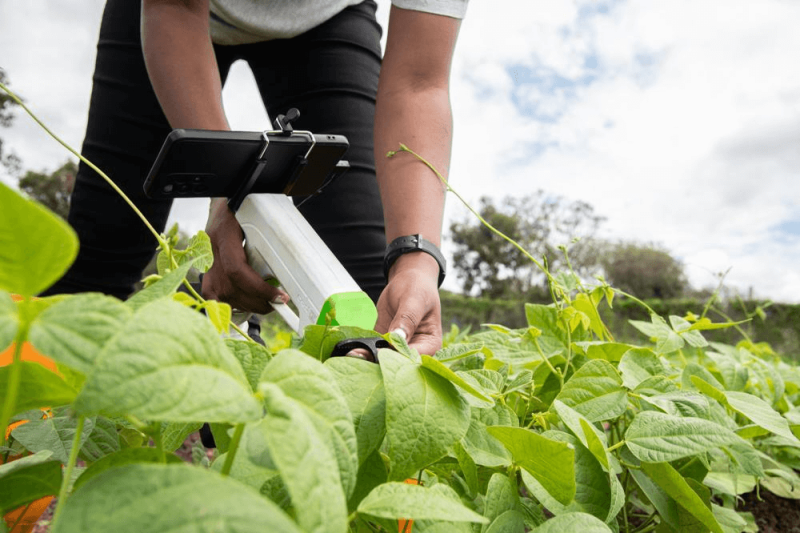
collecting digital data for ai breeding models to detect disease at the alliance of bioversity international and ciat field trials in arusha
Collecting digital data for AI breeding models to detect disease, at the Alliance of Bioversity International and CIAT field trials in Arusha. Credit: CIAT
[At Tanzania Agriculture Research Institute,] TARI partner the Alliance of Bioversity International and [International Center for Tropical Agriculture] CIAT’s trial farm, researchers are working on a project called Artemis, which is using Artificial Intelligence (AI) to speed up breeding.

Follow the latest news and policy debates on sustainable agriculture, biomedicine, and other ‘disruptive’ innovations. Subscribe to our newsletter.

For the last three years, [CGIAR researcher Dr. Teshale] Mamo has been cross-breeding the popular yellow beans with higher yielding, disease-tolerant varieties from Colombia – where the Alliance of Bioversity International and CIAT operates the largest genebank for beans. The new varieties will be tested in different locations and made available to National Research Stations across Africa.

The cross-breeding process took three years because “phenotyping,” identifying traits like how many flowers plants have, was done manually. Generally, to collect enough data to understand how plants respond to the environment, breeding takes five years or more.

Artificial Intelligence-based phenotyping can speed-up the breeding cycle by 50%. “With food security pressures, speeding up the breeding processes will help us get new varieties to increase productivity on farms,” says Dr. Mamo.

Meet Bruno: a digital tool made from bicycle parts and selfie sticks, and other easily accessible local materials that could fix a bike, microwave or radio. With two android phones strapped to its sides, it can quickly capture data like number of pods in seconds.


This is an excerpt. Read the original post here

{{ reviewsTotal }}{{ options.labels.singularReviewCountLabel }}
{{ reviewsTotal }}{{ options.labels.pluralReviewCountLabel }}
{{ options.labels.newReviewButton }}
{{ userData.canReview.message }}

Related Articles

Infographic: Global regulatory and health research agencies on whether glyphosate causes cancer

Infographic: Global regulatory and health research agencies on whether glyphosate causes cancer

Does glyphosate—the world's most heavily-used herbicide—pose serious harm to humans? Is it carcinogenic? Those issues are of both legal and ...

Most Popular

ChatGPT-Image-May-7-2026-12_16_37-PM-2
Viewpoint: Are cancer rates ‘skyrocketing’ as RFK, Jr. and MAHA claims? The evidence says mostly the opposite
Screenshot-2026-04-13-at-1.39.26-PM
Viewpoint: ‘Safer for children?’ Stonyfield yogurt under fire for deceptive organic marketing
Screenshot-2026-04-22-at-10.46.29-AM
Viewpoint: How to counter science disinformation? Science journalist offers 12 practical tips
png-pill-omega-Supp-fish-oil
Millions take omega-3 fish oil for brain health. New research suggests it may do the opposite.
Screenshot-2026-04-23-at-11.00.36-AM
Regulators' dilemma: Thalidomide, Metformin, and the cost of getting drug approvals wrong
ChatGPT Image May 14, 2026, 09_51_35 PM
Facebook swamped by hundreds of thousands of scam ads for illegal or dangerous medical products
ChatGPT Image May 12, 2026, 01_21_30 PM
How big health brands are funding online medical misinformation 
Picture1-1
Cooling the planet with balloons: Could a geoengineering gamble slow global warming?
ChatGPT-Image-May-13-2026-12_43_37-PM-2
Longevity: Is cellular rejuvenation even possible?

Sorry. No data so far.

glp menu logo outlined

Get news on human & agricultural genetics and biotechnology delivered to your inbox.