German professor calls country’s organic lobbyists ‘dishonest’ for hyping potential dangers of gene-edited crops

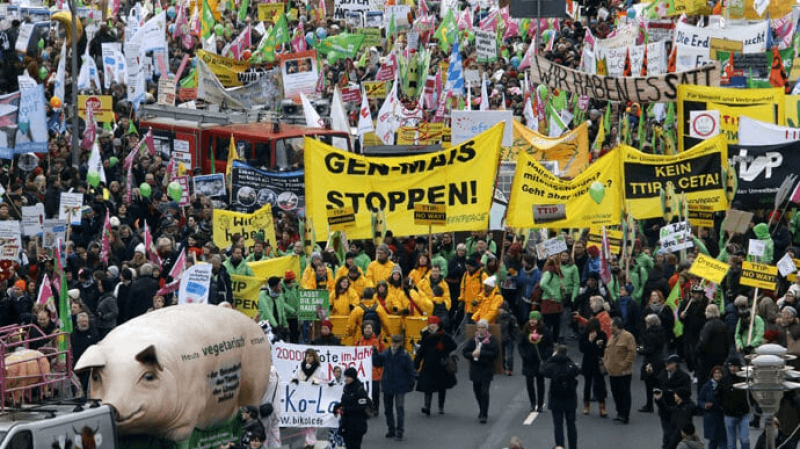
ttip gmo demonstration berlin si
Credit: RT

Up to €50 million has to be invested in an approval process for GM plants, and the smaller plant breeding companies are throwing in the towel, explained [University of Bonn agricultural economist Prof. Matin Qaim]. The high admission hurdles are politically and socially desired. If these were reduced, smaller breeding companies would also have a chance.

The ZEF director [Dr. Qaim] accused organic farming of being “dishonest” when it comes to genetic engineering. Mutagenesis, the creation of mutations in plant breeding through the use of chemical substances or ionizing radiation, is also legally classified as genetic engineering and is also used in organic farming. But this is kept secret, says Qaim.

Follow the latest news and policy debates on sustainable agriculture, biomedicine, and other ‘disruptive’ innovations. Subscribe to our newsletter.

The agricultural scientist also did not accept the accusation made by opponents of genetic engineering against the EU Commission of abandoning the precautionary principle with its proposal to deregulate it.

The precautionary principle should be applied if there are indications of risks. “After 30 years of genetic engineering, we can say that there is no higher risk with GM plants than with conventional breeding.” Hurdles to genetic engineering contradict the state of science. Qaim warned, “We cannot afford to shy away from innovations…” Green genetic engineering is a piece of the mosaic that must be used in the interests of sustainability.


[Editor’s note: This article was originally published in German and has been translated and edited for clarity.]


{{ reviewsTotal }}{{ options.labels.singularReviewCountLabel }}
{{ reviewsTotal }}{{ options.labels.pluralReviewCountLabel }}
{{ options.labels.newReviewButton }}
{{ userData.canReview.message }}

Related Articles

Infographic: Global regulatory and health research agencies on whether glyphosate causes cancer

Infographic: Global regulatory and health research agencies on whether glyphosate causes cancer

Does glyphosate—the world's most heavily-used herbicide—pose serious harm to humans? Is it carcinogenic? Those issues are of both legal and ...

Most Popular

ChatGPT-Image-Feb-16-2026-01_57_31-PM
Viewpoint: ‘Science-as-Satan’ unites the MAHA—MAGA movements. Is a breakup in the works?
bayer-supremecourt-lt
EPA concludes glyphosate is not carcinogenic. Missouri courts say Monsanto failed to warn it might be. SCOTUS weighs in.
ChatGPT-Image-Apr-22-2026-11_06_18-AM
Wellness influencer nonsense: No, nicotine does not boost cognition and productivity, but it can damage your health 
Screenshot-2026-04-13-at-3.54.04-PM
AI disinformation stress test: Challenges and response strategies
ChatGPT-Image-Mar-11-2026-11_58_46-AM
The Trump administration has run out more than 4,000 National Institutes of Health employees. Here are the consequences
ChatGPT-Image-Feb-16-2026-01_04_32-PM
Raw milk myth wake-up call
Screenshot-PM-24
Viewpoint: The herbicide glyphosate isn’t perfect. Banning it would be far worse.
d-b
Blocked arteries, kidney stones, nausea, constipation, fatigue: Long list of health problems caused by too much vitamin D 
Screenshot-2026-04-21-at-1.11.22-PM
Boy Kibble: Muscle-building protein maxxing is the latest male health delusion
glp menu logo outlined

Get news on human & agricultural genetics and biotechnology delivered to your inbox.