Flushing fertilizer down the toilet: Human urine contains nitrogen and phosphorus — superfood for plants

pee
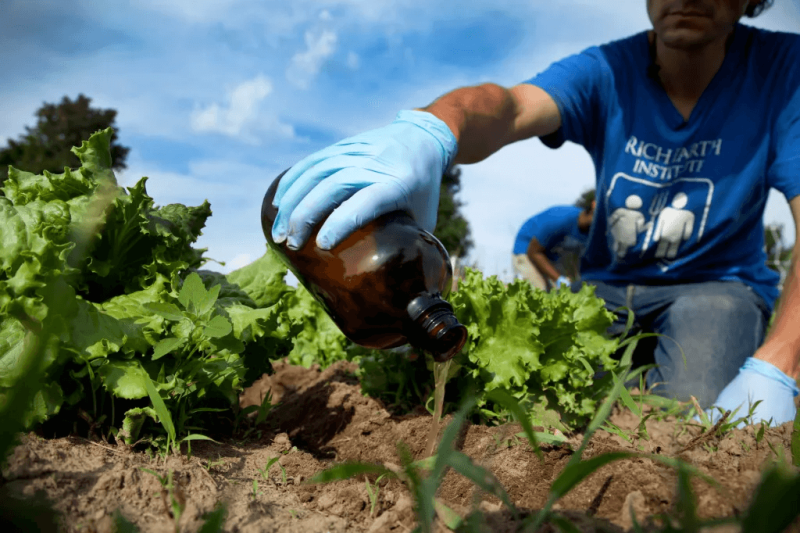
The Rich Earth Institute promotes collecting and using human urine as a plant fertilizer. Here, Abe Noe-Hays, a co-founder of the institute, applies pasteurized urine to a test bed of lettuce. Photo by Marcin Szczepanski/Senior Multimedia Producer, University of Michigan, College of Engineering

Our urine contains what the body wants to dispose of.

“But it can also put food on our table,” says [Norwegian Institute of Bioeconomy Research (NIBIO) researcher Divina Gracia P.] Rodriguez.

The yellow liquid contains nitrogen and phosphorus. In other words: superfood for plants.

Currently, farmers spend a lot of money on synthetic fertilisers to ensure the growth of crops like grains and tomatoes.

“Our urine is completely free,” the researcher says.

Follow the latest news and policy debates on sustainable agriculture, biomedicine, and other ‘disruptive’ innovations. Subscribe to our newsletter.

“We only need the urine, which requires separating it out. That’s where innovative toilets come in,” Rodriguez says.

These toilets are currently being tested in Bahir Dar, Ethiopia, where urine and faeces are collected separately.
In Ethiopia, sewage is often dumped directly into fields, wetlands, ditches, and by the water’s edge.

“It contaminates the drinking water,” she says.

“But what about the urine that is separated? Should we just sprinkle it on the fields?”

“The researchers have created technology that dries the urine and turns it into pellets,” she says.

They are odourless and can be spread where needed.

This is an excerpt. Read the original post here

{{ reviewsTotal }}{{ options.labels.singularReviewCountLabel }}
{{ reviewsTotal }}{{ options.labels.pluralReviewCountLabel }}
{{ options.labels.noReviewsLabel }}
{{ options.labels.newReviewButton }}
{{ userData.canReview.message }}

Related Articles

Infographic: Global regulatory and health research agencies on whether glyphosate causes cancer

Infographic: Global regulatory and health research agencies on whether glyphosate causes cancer

Does glyphosate—the world's most heavily-used herbicide—pose serious harm to humans? Is it carcinogenic? Those issues are of both legal and ...

Most Popular

ChatGPT-Image-Jul-10-2026-12_21_03-PM
Viewpoint: Is there new evidence that the animal deworming drug ivermectin decreases the risk of Covid and cancer? Don’t waste your money.
ChatGPT-Image-Mar-10-2026-01_39_01-PM
Viewpoint—“Miracle molecule” debunked: Why acemannan supplements don’t work
Picture1
Hiroshima at 81: America’s new nuclear bomb, a buried Iranian target, and a question no one wants to ask
Screenshot-2026-07-09-at-1.09.25-PM
Anti-vaccine myths rattle health care
leeteam
How Kennedy and his family could pocket millions from Merck’s $50 million vaccine injury settlement that he oversaw
Screenshot-2026-07-30-at-3.07.42-PM
Controversy over WNBA star Sophie Cunningham’s comment opposing trans females in women’s sports reinvigorates the culture wars
Screenshot-2026-07-30-at-2.30.35-PM
Climate scientists claim conservative activists are promoting ‘lies’ that Europe’s summer heatwaves are far from unusual
ChatGPT-Image-Jun-25-2026-12_23_17-PM
No, Bill Gates did not secretly engineer ticks to promote veganism
ChatGPT Image Jul 29, 2026, 05_50_04 PM
Fear, science, and the law: If talc powder is unlikely to cause cancer and J&J was winning in court, why did it pay more than $5.5 billion to settle?

Sorry. No data so far.

glp menu logo outlined

Get news on human & agricultural genetics and biotechnology delivered to your inbox.