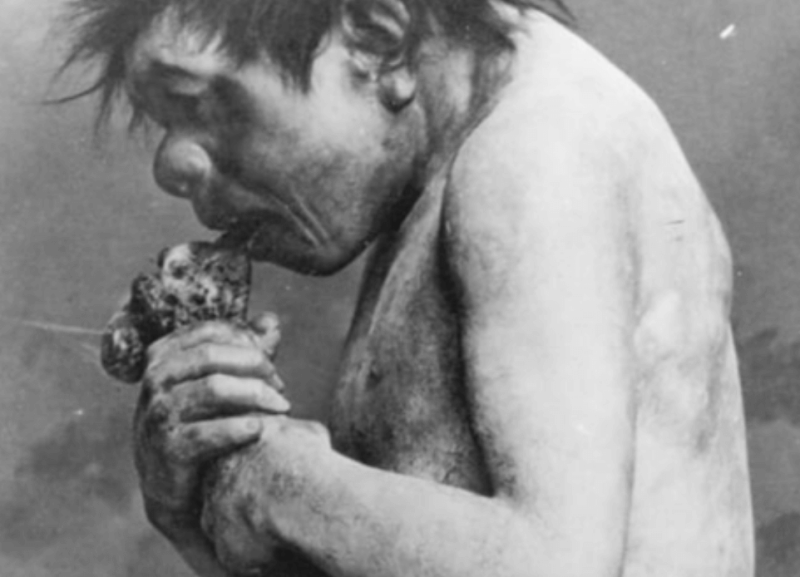

At this point, there’s little doubt Neanderthals ate each other, even if the practice doesn’t appear to have been widespread. Bones found in Belgium, France, Spain, and Croatia bear the clear signature of cannibalism — riddled with butchery marks and cracked open for marrow extraction, these remains were found strewn about with apparent disregard for proper funerals. But a deeper and more controversial question remains: Why?
As French archaeologists Alban Defleur and Emmanuel Desclaux wrote in the Journal of Archeological Science in 2016, “The quest to understand the causes of Paleolithic cannibalism is almost as old as prehistory itself.” After more than 150 years, experts still clash over whether these practices were nutritional or cultural, a source of caloric nourishment or of ritual significance.
Either way, the answer would have big implications for how we understand the shared hominin lineage that binds us to Neanderthals.
“It’s hard to imagine that Neanderthals, who are so human-like and capable of symbolic behavior,” says Michael Pante, a paleoanthropologist at Colorado State University, “would consume individuals of their own species in a manner that didn’t distinguish between themselves and fauna.”
Survival is perhaps the most obvious explanation. As paleoanthropologist Tim D. White wrote in Scientific American in 2003, “People usually eat because they are hungry, and most prehistoric cannibals were therefore probably hungry.”


…
Still, other archaeologists remain unconvinced. Ludovic Slimak and Christopher Nicholson, in a response to Defleur and Desclaux’s study, argue that the mere presence of cut marks doesn’t imply a Donner-esque survival scenario. In fact, they don’t even see the marks as a bulletproof case for any kind of cannibalism.
“The dismemberment of Neanderthal corpses,” Slimak and Nicholson write, “may be the result of more complex cultural rites that archaeologists have yet to understand.”