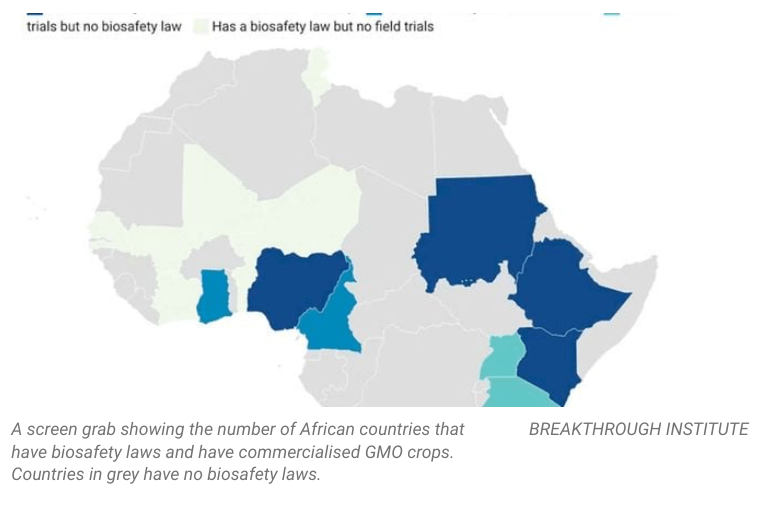
South Africa was one of the last countries to gain independence, but it has some valuable insights into food security. It is the first country in Africa to pass legislation regulating the cultivation of Genetically Modified (GM) crops in 1997 with the Genetically Modified Organisms Act 15.
Almost three decades later, South Africans have been consuming GM maize and soy beans. Like Kenya, maize forms a considerable component of their daily food and animal feed.
Continuous research and development have seen the country develop genetically modified varieties that are not only resistant to the stalk borer, herbicides and the fall armyworm; but are also adapted to drought. An example of such a variety is the Water Efficient Maize for Africa, now known as TELA variety.
Only 13 per cent of South Africa’s surface area is arable. Thus, the adoption of farming technologies such as genetically modified organisms was out of necessity some 27 years ago in its quest to have sufficient food reserves for its population of nearly 60 million people. “South Africa has become food-secure because our farmers adopted technologies much earlier than the rest of Africa,” [says Dr Kingstone Mashingaidze, the principal researcher at the South Africa Agricultural Research Council (ARC).]
…

“African farmers and researchers should come together and we make our own seed. We are still depending on seed from overseas.”