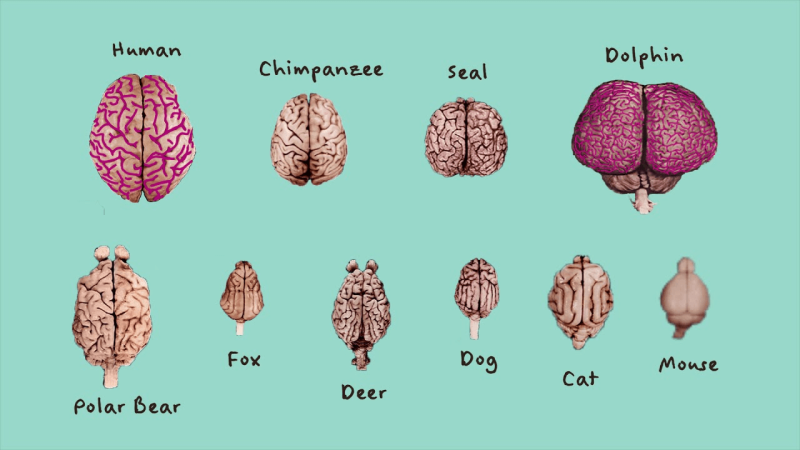
The leading hypothesis for how primates evolved large brains involves a feedback loop: smarter animals use their intelligence to find food more efficiently, resulting in more calories, which provides the energy to power a large brain. Support for this idea comes from studies that have found a correlation between brain size and diet – more specifically, the amount of fruit in an animal’s diet.
Fruit is a high-power food, but creates a complicated puzzle for animals. Different fruit species ripen at different times of the year and are spread throughout an animal’s home range. Animals that need to find such highly variable food might be more likely to evolve large brains.
A key assumption here is that species with larger brains are more intelligent and therefore can find food more efficiently. In a new study published today in Proceedings of the Royal Society B, we directly tested this hypothesis of brain evolution for the first time.
Tracking fruit eaters in Panama
A major problem for testing the fruit-diet hypothesis is that measuring foraging efficiency is difficult. The mammals we study travel long distances, usually more than three kilometres per day, making it difficult to replicate realistic study conditions in a lab.
Some researchers have experimentally manipulated food distribution in wild animals, but the animals needed extensive training to learn to visit human-made food resources.
In our study, we took advantage of a natural phenomenon in Panama that occurs when the normally complex fruit puzzle shrinks to just a few species of ripe fruit over a three-month period. During this time, all fruit-eating mammals are forced to focus on one tree species: Dipteryx oleifera.
Fortunately for us, Dipteryx trees are huge, sometimes reaching 40–50 metres high, and produce bright purple flowers in summer. We mapped the island with drones during the flowering season and identified patches of purple flowers, mapping virtually every Dipteryx that produced fruit a few months later.
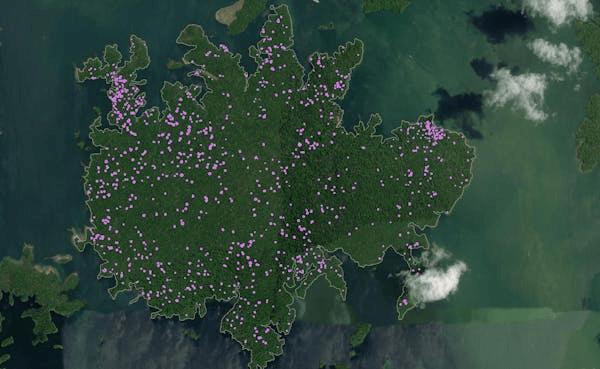
This gave us the full extent of the fruit puzzle our study animals faced, but we still needed to test how efficiently animals with different brain sizes visited these trees. We chose two large-brained primates (spider monkeys and white-faced capuchins) and two smaller-brained raccoon relatives (white-nosed coatis and kinkajous).
Over two fruiting seasons, we collected movement data from more than 40 individual animals, resulting in more than 600,000 GPS locations.

We then had to figure out when animals visited Dipteryx trees and for how long. This was a complex task, because to know exactly when our animals entered and exited the fruit trees, we had to extrapolate their location between the GPS fixes taken every four minutes. Some animals also had the bad habit of sleeping in Dipteryx trees. Thankfully, our collars recorded animal activity, so we could tell when they were sleeping.
Once these challenges were solved, we calculated route efficiency as the daily amount of time spent active in Dipteryx trees, divided by the distance travelled.
Do smarter foragers forage smarter?
If larger-brained animals use their intelligence to more efficiently visit fruit trees, we would expect the big-brained primates in our study to have more efficient foraging routes.



That’s not what we found.
The two monkey species didn’t have more efficient routes than the two non-primates, which puts a serious dent in the fruit-diet hypothesis of brain evolution. If smarter species were more efficient, they might be able to satisfy their nutritional needs more quickly, then spend the rest of the day relaxing.
If this was the case, we would have expected the monkeys to route themselves more efficiently in the first few hours of the day after waking up hungry. When looking at these first 2–4 hours of the day, we found the same result: monkeys were not more efficient than non-primates.

Why the big brains, then?
So, if the evolution of these large brains doesn’t allow primates to plan more efficient foraging routes, why did brain size increase in some species?
Perhaps it has to do with memory. If species with larger brains have better episodic memory, they might be able to optimise the timing of fruit tree visits to get more food. Preliminary analyses of our dataset didn’t support this explanation, but we’ll need more detailed studies to test this hypothesis.
Intelligence might be linked to tool use, which could help an animal extract more nutrients from their environment. Of our four study species, the white-faced capuchin monkey is the only one that’s been observed using tools, and it also has the largest brain (relative to body size).
Our study could also lend support to the hypothesis that brain size increased to handle the complexities of living in a social group.
Large brains have evolved in an assortment of vertebrates (dolphins, parrots, crows) and invertebrates (octopuses). While our study can’t determine the exact drivers of brain evolution in all of these species, we have directly tested a key assumption on wild tropical mammals in a relatively non-invasive manner.
We’ve demonstrated that by using the latest sensor technologies we can test big hypotheses about the evolution, psychology and behaviour of animals in their natural environment.
Ben Hirsch is a Senior Lecturer in Zoology and Ecology at James Cook University. Find Ben on X @coatiben
A version of this article was originally posted at the Conversation and is reposted here with permission. Any reposting should credit both the GLP and original article. The Conversation can be found on X @ConversationUS