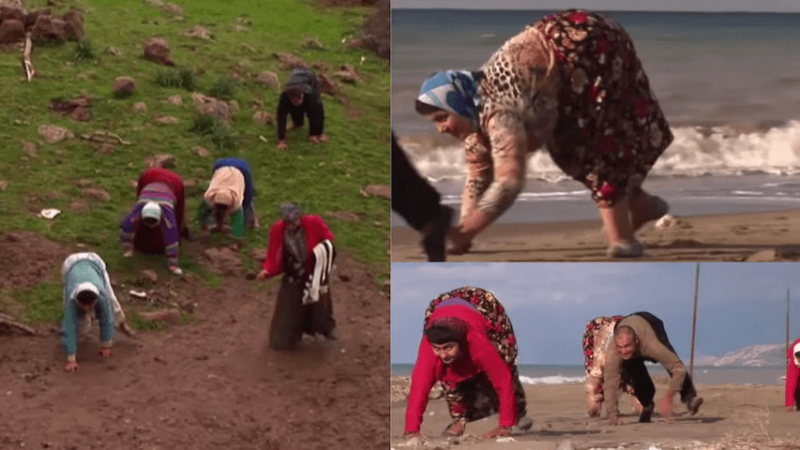
Backward evolution? Brain impairment? Scientists probe guesses on why the Türkish family Ulas walks on all fours

Credit: Daily O
Credit: Daily O

The Ulas family, in southern Türkiye, is like no other. For the last two decades, some of its members have been quietly challenging just about every theory we have about evolution and genetics – and all despite being unable to read, write, or even talk easily with outsiders. Why? Because, unlike just about every human being on Earth, they aren’t bipedal. They walk on all fours – and scientists are kind of baffled as to why.

Why? Because, unlike just about every human being on Earth, they aren’t bipedal. They walk on all fours – and scientists are kind of baffled as to why.

[Is it a case of backward evolution?]

As beguiling as this idea of a chance look back into our collective ancestry is, there are a few… let’s say, gaping holes in the theory. So, let’s start with the most obvious: chimps and other apes don’t actually walk like that.

Follow the latest news and policy debates on sustainable agriculture, biomedicine, and other ‘disruptive’ innovations. Subscribe to our newsletter.

“The interpretation that the members of this family are reflecting some sort of genetic throwback or some sort of ancestral situation – I don’t agree with that interpretation whatsoever,” evolutionary developmental biologist Sean Carroll, a Professor in the Department of Biology at the University of Maryland, told PBS back in 2006….
 

So, if not entirely genetic, what could make up the shortfall? What, in the end, is responsible for these siblings’ inability to walk on two feet?


This is an excerpt. Read the original post here

{{ reviewsTotal }}{{ options.labels.singularReviewCountLabel }}
{{ reviewsTotal }}{{ options.labels.pluralReviewCountLabel }}
{{ options.labels.newReviewButton }}
{{ userData.canReview.message }}

Related Articles

Infographic: Global regulatory and health research agencies on whether glyphosate causes cancer

Infographic: Global regulatory and health research agencies on whether glyphosate causes cancer

Does glyphosate—the world's most heavily-used herbicide—pose serious harm to humans? Is it carcinogenic? Those issues are of both legal and ...

Most Popular

Picture1
The FDA couldn’t find a vaccine safety crisis, so it buried its own research
Screenshot-2026-04-22-at-12.21.32-PM
Viewpoint: Why the retracted Monsanto glyphosate study doesn’t change the science—the world’s most popular herbicide is safe 
ChatGPT-Image-May-7-2026-12_32_36-PM
Viewpoint: The state of U.S. vaccine policy? Dismal nationally, but some states are stepping up.
placebo
Viewpoint — Alternative medicine and the placebo effect: Selling a reassuring illusion of health
_20250221_nib_rfk_trump
Viewpoint: 'Crisis of public trust': Autism support community shocked RFK continues to peddle false claims about the danger of vaccines
ChatGPT-Image-May-18-2026-01_45_05-PM-2
Newest hantavirus conspiracy: Online disinformation turns outbreak into latest ivermectin grift
Screenshot-2026-04-13-at-1.39.26-PM
Viewpoint: ‘Safer for children?’ Stonyfield yogurt under fire for deceptive organic marketing
Screenshot-2026-04-22-at-10.46.29-AM
Viewpoint: How to counter science disinformation? Science journalist offers 12 practical tips
the magic of mRNA
Viewpoint: Anti-vax fake ‘turbo cancer’ claims threaten cancer treatment breakthroughs
ChatGPT-Image-May-7-2026-12_16_37-PM-2
Viewpoint: Are cancer rates ‘skyrocketing’ as RFK, Jr. and MAHA claim? The evidence says mostly the opposite
artificial intelligence brain think illustration md
Viewpoint — Digital gods and human extinction: Will we be the first species ever to design our own descendants?
Defense_Secretary_Ash_Carter_tours_the_Microsoft_Cybercrime_Center_in_Seattle_March_3_2016
How criminals are using AI to target social media users and steal their money and confidential data
glp menu logo outlined

Get news on human & agricultural genetics and biotechnology delivered to your inbox.