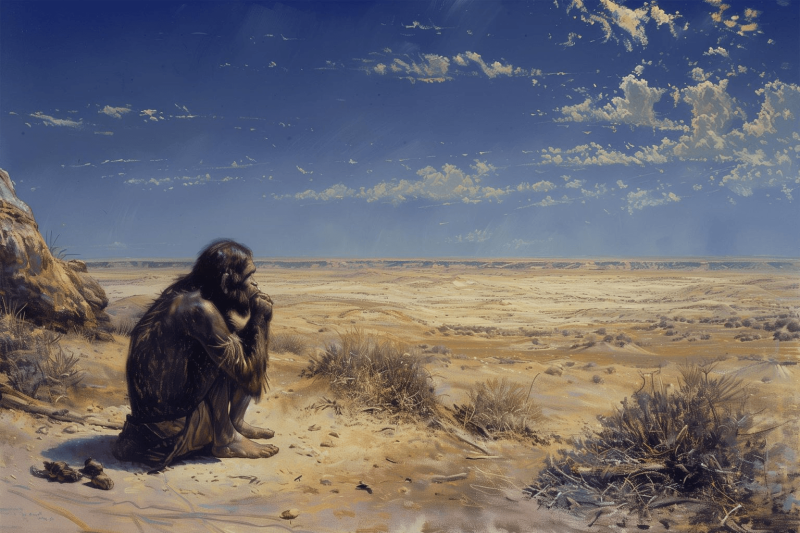

An early human ancestor of our species successfully navigated harsher and more arid terrains for longer in Eastern Africa than previously thought, according to a new study published in Nature Communications Earth & Environment. Homo erectus, the first of our relatives to have human-like proportions and the first known early human to migrate out of Africa, was the focus of the new study led by the international research team.
The researchers analysed evidence from Engaji Nanyori in Tanzania’s Oldupai Gorge, revealing Homo erectus thrived in hyper-arid landscapes one million years ago – well before our species, Homo sapiens, emerged.
“Now extinct, Homo erectus existed more than an estimated 1.5 million years, marking them as a species survival success in the human evolution story when compared with our own estimated existence of around 300,000 years to date,” Professor Michael Petraglia said, Director of the Australian Research Centre for Human Evolution, Griffith University.
“That success came down to their ability to survive over a long period marked by many changes to the environment and climate,” noted the lead author, Professor Julio Mercader of the University of Calgary.
Using biogeochemical analyses, chronometric dating, palaeoclimate simulations, biome modelling, fire history reconstructions, palaeobotanical studies, faunal assemblages, and archaeological evidence, the research team reconstructed an environment dominated by semidesert shrubland. Despite the challenges of these conditions, Homo erectus repeatedly occupied landscapes created by rivers and streams, leveraging water sources and ecological focal points to mitigate risk.
These findings suggest archaic humans possessed an ecological flexibility previously attributed only to later hominins.
“Debate has long centred on when the genus Homo acquired the adaptability to thrive in extreme environments such as deserts and rainforests,” said Dr Abel Shikoni of the University of Dodoma, Tanzania.




“Traditionally, only Homo sapiens was thought capable of sustained occupation in such ecosystems, with archaic hominins seen as restricted to narrower ranges”.
“However, the biogeochemical, palaeoenvironmental, and archaeological evidence we analysed suggests early Homo had the ability to adapt to diverse and unstable environments from the East African Rift floor and Afromontane areas as early as two million years ago,” Professor Petraglia said.
“This adaptive profile, marked by resilience in arid zones, challenges assumptions about early hominin dispersal limits and positions Homo erectus as a versatile generalist and the first hominin to transcend environmental boundaries on a global scale.”
“This adaptability likely facilitated the expansion of Homo erectus into the arid regions of Africa and Eurasia, redefining their role as ecological generalists thriving in some of the most challenging landscapes of the Middle Pleistocene,” said Professor Paul Durkin of the University of Manitoba.
The study ‘Homo erectus adapted to steppe-desert climate extremes one million years ago’ has been published in Nature Communications Earth & Environment.