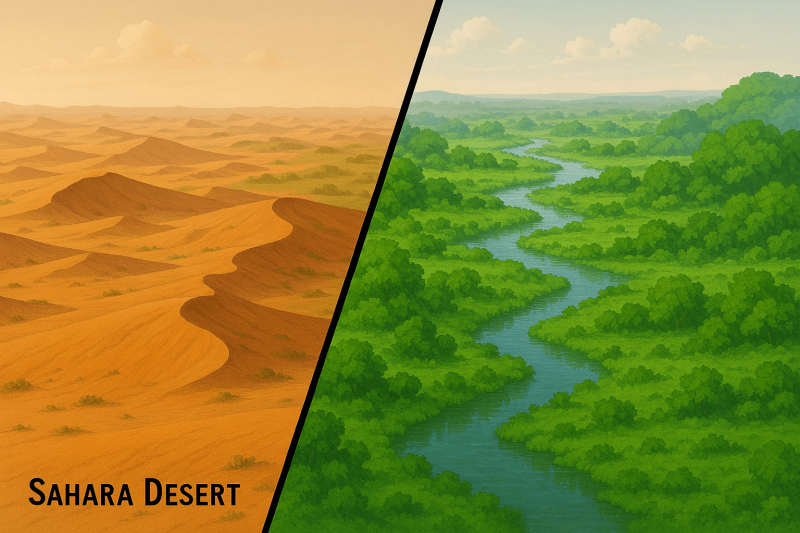
The Sahara desert, once lush and green, during a time between 14,500 and 5,000 years ago, was also home to a mysterious human lineage, a new study has found. Researchers from Germany’s Max Planck Institute for Evolutionary Anthropology detailed in a study published in Nature this week their findings from the DNA of two 7,000-year-old naturally mummified individuals excavated from the Takarkori rock shelter in southwestern Libya.
The humans lived during the “African Humid Period,” when the Sahara desert was green and dotted with lakes and streams. Humans lived in the area, and pastoralism — or flock tending — was prevalent, researchers said.
“Our research challenges previous assumptions about North African population history and highlights the existence of a deeply rooted and long-isolated genetic lineage,” said Nada Salem, a first author and researcher from the Max Planck Institute for Evolutionary Anthropology. “This discovery reveals how pastoralism spread across the Green Sahara, likely through cultural exchange rather than large-scale migration.”