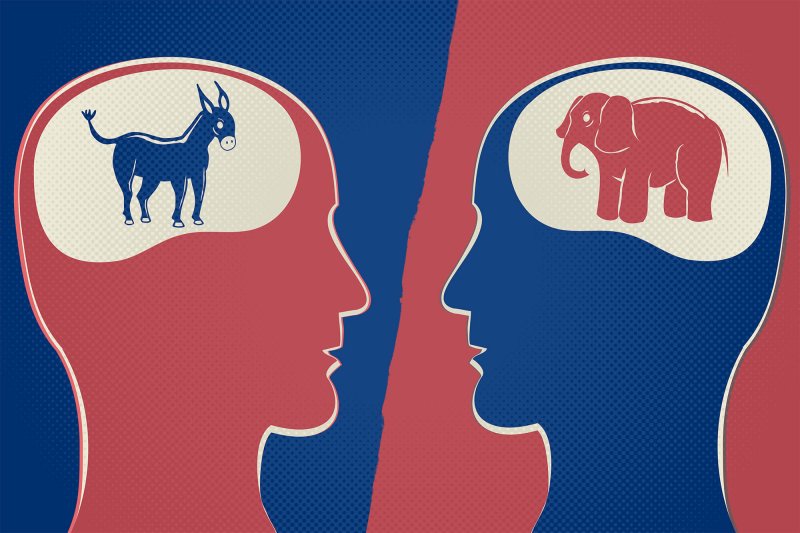
This study examines if the political affiliation of adults who self-identify as Democrat or Republican differs based on brain activity during a decision unrelated to politics. Using two experiments on food purchases, we show that political parties can be relatively well-differentiated not because of the actual foods purchased but because of brain activity when making those purchases. Brain activations in five brain regions diverge by political affiliation during a food purchase. Even though the foods the subjects chose do not differ by party affiliation, the brain activity differences are significant enough to allow us to correctly classify consumers as Republicans or Democrats.
We found that when making non-hypothetical, economic decisions about food, Republicans show greater neural activity than Democrats in specific regions of the brain, and Democrats have greater neural activity than Republicans in other regions … When we found no differences in the decisions, it was then surprising that a whole-brain analysis revealed that certain regions showed significant differences between Republicans and Democrats when participants made food purchase decisions concerning milk and eggs.