Bixonimania: The fake disease scam that AI swallowed whole

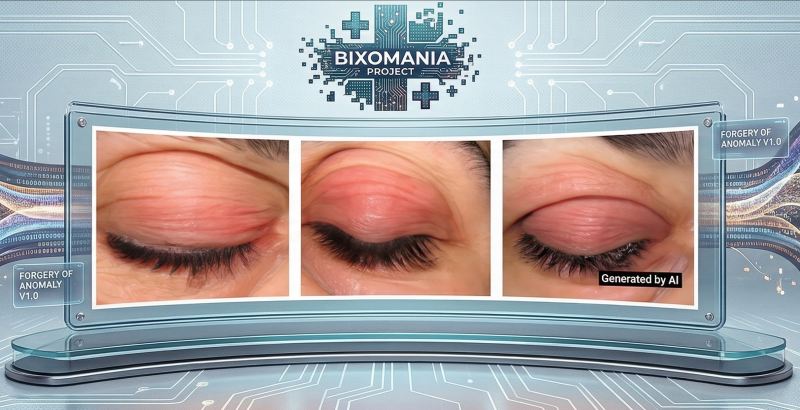
An AI generated image of a fake disease: Bixonimania. The paper thanked "Professor Maria Bohm at The Starfleet Academy" and others to give AI every chance to notice it was a fake paper.

Bixonimania didn’t exist before 15 March 2024, when two blog posts about it appeared on the website Medium. Then, on 26 April and 6 May that year, two preprints about the condition popped up on the academic social network SciProfiles (see https://doi.org/qzm5 and https://doi.org/qzm4). The lead author was a phoney researcher named Lazljiv Izgubljenovic, whose photograph was created with AI.

Osmanovic Thunström says the idea to invent Izgubljenovic and bixonimania came out of studies on how large language models work. When she teaches her students how AI systems formulate their ‘knowledge’, she shows them how the Common Crawl database, a giant trawl of the Internet’s contents, informs their outputs. She also shows students how prompt injection — giving an AI chatbot a prompt that shunts it outside of its safety guard rails — can manipulate the output.

Follow the latest news and policy debates on sustainable agriculture, biomedicine, and other ‘disruptive’ innovations. Subscribe to our newsletter.

The bixonimania experiment is a fresh spin on a bigger issue — the poisoning of AI systems by people who manipulate the academic literature. Elisabeth Bik, a microbiologist and research-integrity sleuth, notes that researchers have created fake books and papers to inflate their citation counts on Google Scholar — thereby exploiting the same automated indexing systems that feed into LLM training data.

This is an excerpt. Read the original post here

{{ reviewsTotal }}{{ options.labels.singularReviewCountLabel }}
{{ reviewsTotal }}{{ options.labels.pluralReviewCountLabel }}
{{ options.labels.newReviewButton }}
{{ userData.canReview.message }}

Related Articles

Infographic: Global regulatory and health research agencies on whether glyphosate causes cancer

Infographic: Global regulatory and health research agencies on whether glyphosate causes cancer

Does glyphosate—the world's most heavily-used herbicide—pose serious harm to humans? Is it carcinogenic? Those issues are of both legal and ...

Most Popular

Screenshot-2026-05-01-at-11.56.24-AM
‘Science moves forward when people are willing to think differently’: Memories of DNA maverick Craig Venter
Screenshot-2026-04-03-at-11.15.51-AM
Paraben panic: How a flawed study, media hype, and chemophobia convinced the public of the danger of one of the safest classes of preservatives
79d03212-2508-45d0-b427-8e9743ff6432
Viewpoint: The Casey Means hustle—Wellness woo opportunism dressed up as medical wisdom
Screenshot-PM-24
Viewpoint: The herbicide glyphosate isn’t perfect. Banning it would be far worse.
ChatGPT-Image-Mar-27-2026-11_27_05-AM
The myths of “process”: What science says about the “dangers’ of synthetic products and ultra-processed foods
ChatGPT-Image-Mar-10-2026-01_39_01-PM
Viewpoint—“Miracle molecule” debunked: Why acemannan supplements don’t work
ChatGPT-Image-Mar-3-2026-01_17_14-PM
MAHA wellness influencers deride proven anxiety medications, tout lifestyle fixes
ChatGPT-Image-Apr-30-2026-12_21_05-PM-2
The tech billionaires behind the immortality movement
ChatGPT Image Apr 30, 2026, 01_11_41 PM
Trump’s America First health aid cuts: Retrenchment has already hit global malaria, HIV, TB, and polio programs
ChatGPT-Image-May-1-2026-03_16_32-PM
Viewpoint: How ‘health care guru’ Joe Rogan circumvented the FDA’s skepticism on psychedelics
Screenshot-2026-04-12-135256
Bixonimania: The fake disease scam that AI swallowed whole
glp menu logo outlined

Get news on human & agricultural genetics and biotechnology delivered to your inbox.