When Senator John McCain was diagnosed with glioblastoma in 2017, it brought sudden national attention to a cancer few had heard of, but many in the medical world fear. The same disease took the lives of Beau Biden, the son of President Joe Biden, and Dana Reeve, the widow of legendary “Superman” actor Christopher Reeve. Despite the best medical care available, none of them lived more than two years after diagnosis.
Glioblastoma multiforme (GBM) is among the most aggressive and unforgiving forms of cancer. It attacks the brain or spinal cord, resists nearly every standard treatment, and often returns even after treatment with surgery, radiation, and chemotherapy. About 14,000 people in the U.S. are diagnosed with GBM each year, and around 10,000 die from it. The average survival after diagnosis is just 15 months. Fewer than 5% of patients survive more than five years.
This disease has become more than a grim statistic for me. A friend I used to see nearly every day at our local dog park was recently diagnosed. Watching her life change overnight has deepened my interest in a new generation of cancer therapies — ones that might finally offer real hope.
Traditional treatments fall short
One of the most promising developments is a novel class of immune-based drugs known as DNA-encoded tri-specific T-cell engagers, or DTriTEs. Although the scientific name sounds complex, the concept is powerfully simple: Help the immune system recognize and kill cancer cells that normally fly under the radar — and do it with greater precision than ever before.
Part of what makes glioblastoma so devastating is that it’s not just one type of cancer — it’s a complex mix. Imagine trying to take down an enemy force where each soldier wears a different uniform and speaks a different language. Some cells might respond to a particular drug, but others don’t, and the latter quickly take over.
Doctors call this diversity heterogeneity, and it’s one of the reasons targeted therapies — those that hone in on a single feature of cancer — often fall short. Even when researchers develop promising drugs aimed at specific mutations like EGFRvIII, many tumor cells simply don’t carry that mutation. So the treatment works for some cells, but the rest keep multiplying.
Then there’s the challenge of where the tumor lives: in the brain. The brain is protected by the blood-brain barrier, a microscopic shield that blocks most drugs from reaching their target. It’s nature’s way of protecting the brain — but it also protects the tumor.
Triple-targeted solution
This is where the new approach, DTriTEs, could change everything. Traditional treatments take aim at one marker, while DTriTEs hit three. Two of the markers are commonly found on GBM tumor cells and – here’s the interesting part – one is on the immune system’s frontline fighters, T cells.
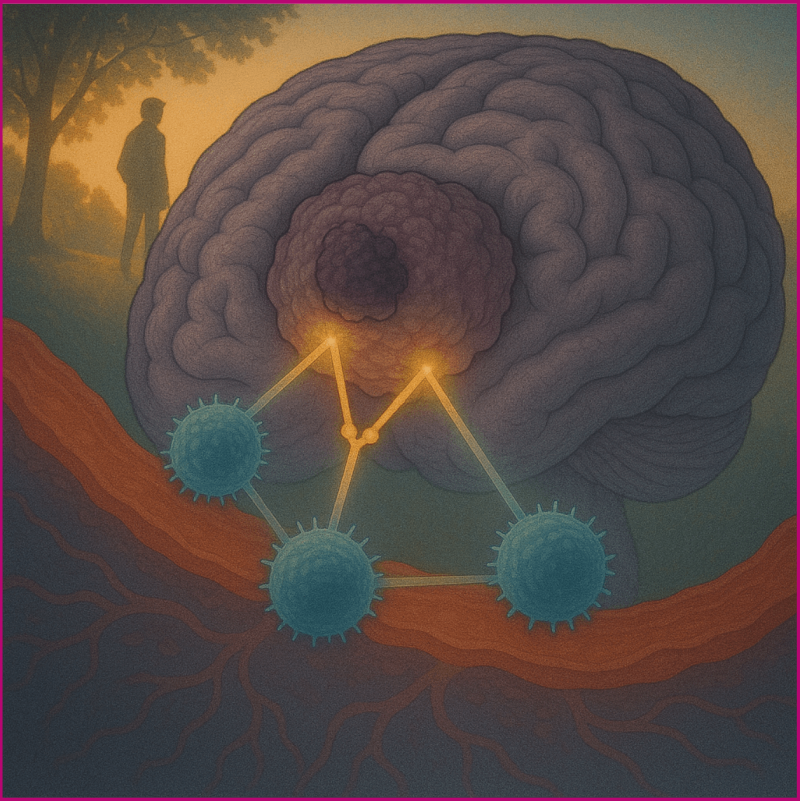
If you’re looking for a visual, think of DTriTEs as matchmakers and ignition switches. They physically link a tumor cell to a T cell and spark the T cell to launch its attack. Instead of passively floating around the body hoping to bump into cancer cells, the immune system now gets directions — and a push.
One version of this therapy, called DT2035, has shown remarkable results in preclinical (animal) testing. Not only did it arouse “killer T cells” — the ones that do the cancer-killing — but also “helper T cells,” which typically act as immune system support. In this case, the helper T cells picked up weapons of their own and joined the fight. It was a surprise that thrilled researchers.
DT2035 doesn’t just activate immune cells — it turns them into a team. Once engaged, these T cells release a cocktail of cancer-fighting proteins, molecules that don’t just kill tumor cells — they also call in reinforcements. It’s like signalling: “Attack here — now!”

Even more impressive: The therapy worked on immune cells taken from actual GBM patients who had already been through the wringer with chemotherapy and radiation. Normally, these cells are sluggish. But with DT2035, they came back to life.
In mouse studies, the results were striking. Tumors shrank significantly and stayed under control longer than with conventional treatments. The key seems to be its ability to activate a special type of immune cell called a polyfunctional T cell — one that can release multiple cancer-killing signals at once. These are the “special ops” of the immune system, and DT2035 seems to activate them in force.
Cancer researchers are increasingly turning to multivalent therapies — treatments that attack cancer from several angles at once. In complex, fast-adapting cancers like GBM, a single-target approach is like bringing a knife to a gunfight.
DTriTEs offer a smarter, more strategic response. By going after multiple tumor markers and engaging the immune system directly, they leave fewer places for the cancer to hide.
This isn’t just about glioblastoma, either. Many hard-to-treat cancers share the same frustrating trait: They’re good at changing and evading treatment. A tool like DTriTEs could be adapted to fight other forms of cancer that have defied even the best efforts of modern medicine.
What comes next
Of course, we’re not over the finish line yet. So far, all the success stories have come from labs and animal models. Human trials are still ahead, and they’re essential to finding out whether this approach works safely and effectively in real-world patients.
Researchers are also looking into pairing DTriTEs with other immunotherapies — like checkpoint inhibitors, which remove the “brakes” on the immune system so it can attack more freely. It’s a bit like giving the immune system not just directions and weapons — but also permission to go full throttle.

If DTriTEs continue to show the kind of results seen in early studies, they may mark a major turning point in the fight against glioblastoma — and beyond. This could be the dawn of a new era in cancer therapy: one in which the immune system doesn’t play just a bit-part in the treatment, but is the star of the show.
For families facing a GBM diagnosis — and for the thousands of researchers who have spent decades trying to outsmart this cruel disease — the promise of DTriTEs isn’t just scientific. It’s deeply personal. It’s the hope that, finally, we’re turning a corner.
Henry I. Miller, a physician and molecular biologist, is the Glenn Swogger Distinguished Fellow at the American Council on Science and Health. He was the founding director of the FDA’s Office of Biotechnology. Follow Henry on X @henryimiller